In the world of industrial engineering and plant design, piping systems are among the most critical components. Whether in power plants, oil and gas facilities, chemical processing units, or water treatment plants, piping systems must withstand a wide range of loads—thermal expansion, fluid forces, external loads, seismic events, and more. Errors in design can lead to structural failures, costly rework, or even catastrophic accidents.
This is where Bentley AutoPIPE online training comes into play: a sophisticated engineering software that enables accurate stress analysis and design of piping systems throughout their lifecycle.
What Is Bentley AutoPIPE?
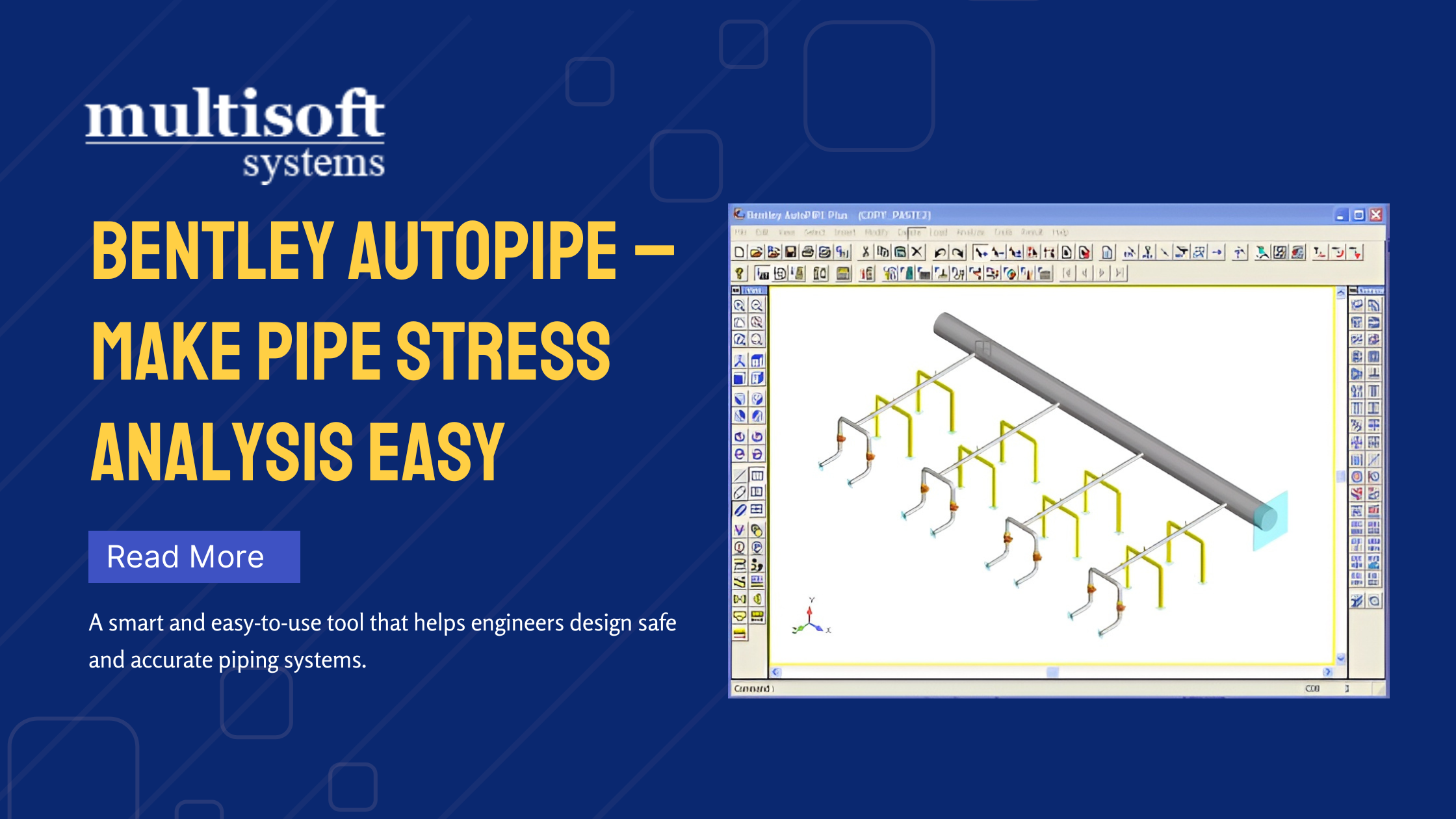
Bentley AutoPIPE is a specialized engineering application for pipe stress analysis, developed by Bentley Systems. It allows engineers to create, analyze, and optimize piping systems by calculating stresses, loads, deflections, fatigue, fluid transients, and related effects under various static and dynamic loading conditions. The software is widely used in industries such as power generation, oil and gas, petrochemical, shipbuilding, and manufacturing to ensure compliance with international codes and standards while improving safety and performance.
AutoPIPE is designed to be both powerful and flexible. Whether working on a simple single-line pipe run or an extensive three-dimensional network with complex support conditions, it provides robust capabilities to model the physical behavior of piping systems with high fidelity.
History and Evolution
Bentley Systems introduced AutoPIPE decades ago to address the growing need for reliable, computational analysis of piping systems in industrial projects. Over the years, AutoPIPE evolved from a basic stress calculation tool into a comprehensive analysis suite, integrating advanced features such as:
- Fluid transient analysis
- Nonlinear load sequencing
- Pipe-to-structure interaction
- Fatigue assessment
- CAD integration and data exchange
- Support for international design codes
The software continually incorporates modern engineering practices, user feedback, and technological advances, ensuring that it meets the complex challenges of contemporary piping design. Bentley AutoPIPE certification has become a standard tool across engineering consultancies and owner-operators worldwide, trusted for its accuracy, reliability, and extensive validation against real-world scenarios.
Core Capabilities
1. Static and Dynamic Stress Analysis
At its core, AutoPIPE performs static and dynamic stress analysis of piping systems. Static analysis deals with sustained loads like weight, pressure, temperature differences, and support reactions, while dynamic analysis addresses time-dependent effects, such as seismic events, fluid hammer, and vibration. These analyses help engineers predict how a piping system will behave under real operating conditions.
2. Fluid Transient (Water Hammer) Analysis
Fluid transients, often called “water hammer,” occur when there is a sudden change in flow velocity—such as a valve closure. This generates pressure waves that travel through the fluid and pipe wall, potentially causing high stresses. AutoPIPE includes tools that simulate fluid transient events so users can assess and mitigate the risks associated with transient pressure surges.
3. Nonlinear Load Sequencing
In real projects, loads don’t always act in a simple linear fashion. Temperature, pressure, and external forces can change over time or interact in complex ways. AutoPIPE’s nonlinear load sequencing capability allows engineers to apply loads in realistic sequences and combinations to better evaluate worst-case scenarios and ensure safety margins remain acceptable.
4. Pipe-to-Structure Interaction
Piping systems don’t exist in isolation—they interact with supports, equipment, and surrounding structures. AutoPIPE models these interactions so that supporting structures are accurately represented. This allows for more accurate prediction of displacements, stresses, and support loads that could affect both the pipe and the supporting structure.
5. Fatigue and Load History Analysis
Repetitive loads, thermal cycling, and vibration can lead to fatigue failure over time. AutoPIPE assesses fatigue life by analyzing load history and stress cycles. This enables engineers to predict where fatigue issues might arise and implement design changes—such as rerouting, adding supports, or changing materials—to extend asset life.
6. International Design Codes and Standards
AutoPIPE supports compliance with internationally recognized codes such as ASME B31.1 (Power Piping), ASME B31.3 (Process Piping), and other regional standards. This ensures that designs are not only structurally sound but also meet regulatory and industry requirements—a critical need in global engineering projects.
User Workflow: From Model to Results
The user workflow in Bentley AutoPIPE follows a logical, engineering-driven sequence that takes a piping system from conceptual modeling to validated stress analysis results. The process typically begins with defining the piping geometry. Engineers create the piping layout by specifying node points, pipe lengths, diameters, fittings, bends, and components. This geometry can be built directly within AutoPIPE or imported from compatible plant design and CAD tools, ensuring consistency between design and analysis. Once the physical layout is established, material properties such as pipe material, corrosion allowance, insulation, and fluid density are assigned. Operating conditions including temperature, pressure, and design limits are then defined, as these directly influence stress calculations and system behavior.
After setting up geometry and materials, engineers apply boundary conditions and supports. These include anchors, guides, line stops, springs, and flexible supports that realistically represent how the piping is restrained in the field. Correct support modeling is critical, as it governs load transfer, displacement, and stress distribution. The next step involves defining load cases. Sustained loads (weight and pressure), thermal loads, operating loads, occasional loads (wind or seismic), and expansion cases are combined based on applicable design codes. For complex systems, nonlinear load sequencing may be used to simulate real operating scenarios.
Once all inputs are complete, the analysis is executed. Bentley AutoPIPE training calculates stresses, displacements, forces, moments, and support reactions across the system. Engineers then review graphical and numerical results to identify overstressed locations, excessive displacements, or overloaded supports. If issues are detected, the model is refined by adjusting routing, supports, or materials. Finally, comprehensive reports and code compliance summaries are generated, providing clear documentation for design approval, safety reviews, and construction.
Integration with CAD and Enterprise Tools
One of AutoPIPE’s strengths is its ability to integrate with other design and enterprise software:
- CAD Integration: AutoPIPE connects seamlessly with Bentley’s plant design tools like AutoPLANT and OpenPlant, enabling engineers to import 3D pipe models directly from design drawings into the stress analysis environment. This reduces duplication of effort and improves consistency between design and analysis.
- ProjectWise Integration: Through Bentley’s ProjectWise platform, AutoPIPE models and results can be managed as part of a broader project information system. This enables version control, collaboration, and integration with document workflows across distributed teams.
- Data Exchange Formats: AutoPIPE also supports industry-standard data exchange formats like Plant Exchange Format (PXF), enabling smooth interoperability with other engineering tools.
These integrations promote a consistent, traceable engineering workflow from conceptual design to construction and operations.
Why Engineers Choose AutoPIPE?
1. Accuracy and Reliability
AutoPIPE’s analysis engine is rigorously validated and continuously updated to reflect the latest engineering practices. Its ability to handle complex load interactions and nonlinear behavior sets it apart from simpler calculators or spreadsheet tools.
2. Comprehensive Analysis Suite
Rather than relying on multiple disparate tools, engineers benefit from having static, dynamic, fluid transient, fatigue, and load sequencing analysis all within one application. This minimizes errors and ensures cohesive results.
3. Flexibility Across Industries
Whether designing power plant steam piping, offshore oil and gas manifolds, or hydrocarbon processing lines, AutoPIPE adapts to various materials, loads, and regulatory environments.
4. Support for Global Standards
With built-in support for international codes, AutoPIPE ensures that designs conform to required engineering standards, simplifying review and approval processes.
5. Integration with Design Ecosystems
Integration with CAD, document management systems, and plant information models makes AutoPIPE an efficient choice for multidisciplinary engineering teams operating in complex project environments.
Real-World Applications
Bentley AutoPIPE is widely applied across multiple industries where piping systems play a critical role in safety, reliability, and operational efficiency. In the power generation sector, it is extensively used to analyze high-temperature and high-pressure piping systems such as steam lines, feedwater systems, and cooling circuits in thermal, nuclear, and combined-cycle power plants. These systems are subject to severe thermal expansion, cyclic loading during startups and shutdowns, and seismic conditions, making accurate stress analysis essential. AutoPIPE helps engineers ensure compliance with power piping codes while optimizing support layouts and reducing maintenance risks.
In the oil and gas industry, both onshore and offshore facilities rely on AutoPIPE to design and validate complex piping networks that transport hydrocarbons under fluctuating pressure and temperature conditions. Refineries, gas processing plants, LNG terminals, and offshore platforms benefit from its ability to analyze thermal expansion, vibration, fatigue, and pipe-to-structure interaction, which are common challenges in these environments. The software is also used for revamp and brownfield projects, where existing piping must be assessed against new operating conditions. Chemical and petrochemical plants use AutoPIPE to handle piping systems exposed to corrosive fluids, high temperatures, and continuous process variations. Accurate stress and fatigue analysis helps prevent leaks, joint failures, and unplanned shutdowns while ensuring long-term asset integrity. In water and wastewater treatment facilities, AutoPIPE supports the analysis of large-diameter pipelines, pump discharge lines, and transient events such as water hammer, helping utilities maintain system reliability and service continuity.
Beyond heavy industry, AutoPIPE is also applied in shipbuilding, industrial manufacturing, and district energy systems, making it a versatile solution for any project requiring precise, code-compliant piping stress analysis.
Training, Support, and Community
Bentley Systems offers extensive documentation, tutorials, training programs, and user communities for AutoPIPE users. Engineers can participate in forums, attend webinars, and access technical support to stay updated with best practices. Professional training—whether through Bentley’s own platform or authorized partners—helps users master advanced features such as nonlinear load sequencing and fluid transient analysis.
While AutoPIPE is powerful, effective use requires solid engineering judgment and an understanding of piping behavior:
- Proper Setup: Incorrect boundary conditions or load assignments can lead to inaccurate results.
- Interpretation: Stress output must be interpreted by experienced engineers to ensure meaningful conclusions.
- Model Complexity: Very large systems may require careful simplification to remain computationally efficient.
Continuous training and review of project results are essential to mitigate these challenges.
Future Directions
As engineering tools evolve, so does AutoPIPE:
- Cloud Integration: Improved cloud-based workflows and collaboration.
- Machine Learning: Use of data analytics to automate modeling suggestions or anomaly detection.
- Enhanced Integration: Deeper links with digital twins and asset lifecycle platforms.
Bentley’s ongoing development roadmap indicates that AutoPIPE will continue embracing modern engineering needs, focusing on interoperability, automation, and data-driven insights.
Conclusion
Bentley AutoPIPE stands as an industry-leading solution for piping stress analysis and design. Its comprehensive feature set, integration capabilities, support for international standards, and robust engineering engine make it a preferred choice among engineers worldwide. From static loads and fluid transients to fatigue and nonlinear behaviors, AutoPIPE equips professionals to analyze complex piping systems with confidence and accuracy. Whether in power plants, oil and gas facilities, or industrial processing units, this powerful software ensures safe, compliant, and optimized piping designs that meet the demands of modern engineering projects. Enroll in Multisoft Systems now!