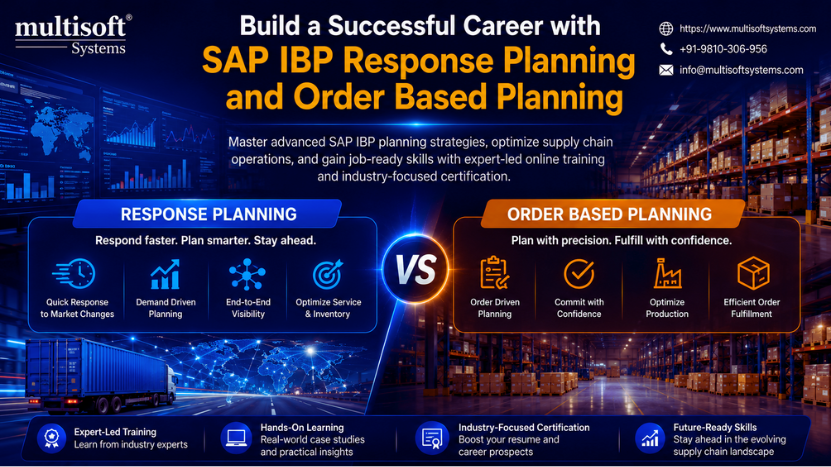
As supply chains become more dynamic and customer expectations continue to rise, organizations need intelligent planning solutions that enable faster and more accurate decision-making. SAP Integrated Business Planning (SAP IBP) is a cloud-based supply chain planning solution that helps businesses optimize demand, supply, inventory, and production planning through real-time data and advanced analytics. Two of its most powerful capabilities are SAP IBP Response Planning and SAP IBP - Order Based Planning (OBP). While both modules are designed to improve supply chain performance, they serve different planning purposes. SAP IBP Response Planning focuses on balancing supply and demand using time-series planning, making it ideal for medium- and long-term planning. In contrast, SAP IBP - Order Based Planning (OBP) works at the individual order level, enabling organizations to manage customer orders, production schedules, material availability, and supply constraints with greater precision.
Choosing between these two modules depends on business requirements, manufacturing complexity, and planning objectives. This comparison guide explains their features, benefits, differences, and ideal use cases to help organizations and SAP professionals make informed decisions.
What is SAP IBP Response Planning?
SAP IBP Response Planning is an advanced supply chain planning solution within SAP IBP that helps organizations balance demand and supply in real time. It uses time-series planning to optimize inventory, production, procurement, and distribution while considering business constraints such as available capacity, material shortages, and supplier limitations. The solution enables planners to respond quickly to disruptions, perform what-if scenario analysis, manage supply allocation, and improve customer service levels. By providing end-to-end visibility across the supply chain, SAP IBP Response Planning helps organizations reduce planning cycles, improve operational efficiency, and make informed decisions using real-time data and advanced analytics.
What is SAP IBP - Order Based Planning (OBP)?
SAP IBP - Order Based Planning (OBP) is an advanced planning solution that operates at the individual order level rather than using aggregated planning data. It manages customer orders, purchase orders, production orders, stock transfers, and inventory while maintaining detailed relationships between supply and demand through dynamic pegging. This approach enables organizations to identify how disruptions affect specific customer orders and quickly determine alternative planning options. SAP IBP - Order Based Planning is particularly valuable for industries with complex manufacturing processes, high product variation, and customer-specific production requirements. It improves order fulfillment, production scheduling, inventory utilization, and overall supply chain responsiveness.
SAP IBP Response Planning vs SAP IBP - Order Based Planning
Although both modules belong to the SAP IBP suite, they address different planning challenges. SAP IBP Response Planning focuses on aggregate supply and demand balancing using time-series data, making it suitable for tactical planning and medium-term decision-making. On the other hand, SAP IBP - Order Based Planning focuses on operational execution by planning at the order level, allowing organizations to manage customer commitments, production sequencing, and material availability more accurately. Many organizations implement both modules together to create a comprehensive planning environment where Response Planning provides strategic supply plans, while Order Based Planning ensures accurate execution of individual customer orders.
SAP IBP Response Planning vs SAP IBP - Order Based Planning: Feature-by-Feature Comparison
|
Feature |
SAP IBP Response Planning |
SAP IBP - Order Based Planning (OBP) |
|
Planning Approach |
Time-series planning |
Order-level planning |
|
Planning Level |
Aggregate |
Detailed individual orders |
|
Primary Focus |
Supply-demand balancing |
Customer order fulfillment |
|
Planning Horizon |
Medium to long term |
Short to medium term |
|
Data Granularity |
Product and time bucket |
Individual order objects |
|
Customer Order Visibility |
Limited |
Complete visibility |
|
Production Scheduling |
Basic |
Advanced scheduling |
|
Dynamic Pegging |
Not available |
Available |
|
Capacity Planning |
Yes |
Yes |
|
Material Availability |
Aggregate level |
Order-specific level |
|
Inventory Optimization |
High |
High with order allocation |
|
Constraint Management |
Yes |
Yes |
|
What-if Scenario Planning |
Supported |
Supported |
|
Exception Management |
Supported |
Supported |
|
Multi-Level BOM Planning |
Limited |
Extensive |
|
Supply Allocation |
Yes |
Yes |
|
Best For |
Tactical planning |
Operational execution |
|
Typical Industries |
FMCG, Retail, Manufacturing |
Automotive, Aerospace, Industrial Manufacturing |
|
Integration |
SAP S/4HANA, SAP ERP |
SAP S/4HANA, SAP ERP |
|
Main Benefit |
Faster supply response |
Better order fulfillment and scheduling |
Business Benefits Comparison
Both SAP IBP Response Planning and SAP IBP - Order Based Planning help organizations improve supply chain performance, but each delivers unique business advantages. Response Planning enhances tactical planning by balancing supply and demand efficiently, while Order Based Planning improves operational execution by managing customer orders with greater precision. When implemented together, they provide organizations with an end-to-end planning framework that improves visibility, responsiveness, and customer satisfaction.
Key Business Benefits
- Faster response to supply chain disruptions
- Improved customer service levels
- Better demand and supply synchronization
- Reduced inventory carrying costs
- Enhanced production planning and scheduling
- Increased planner productivity
- Better utilization of manufacturing resources
- Improved order fulfillment accuracy
- Greater supply chain visibility
- Data-driven decision-making with real-time analytics
- Reduced operational costs
- Improved collaboration across supply chain teams
SAP IBP Response Planning vs SAP IBP - Order Based Planning: Pros and Cons
Both planning solutions offer significant value, but selecting the right one depends on organizational goals. SAP IBP Response Planning is ideal for businesses looking to optimize demand and supply balancing across products, locations, and time periods. It provides faster planning and excellent visibility at an aggregate level but offers limited order-level insights. In contrast, SAP IBP - Order Based Planning delivers highly detailed planning by focusing on individual customer orders, dynamic pegging, and advanced scheduling. While it provides superior operational control, it requires more detailed master data and planning configuration. Many enterprises achieve the best results by combining both modules to support strategic planning and operational execution simultaneously.
Career Opportunities in SAP IBP
The demand for SAP IBP professionals continues to grow as organizations accelerate their digital supply chain transformation initiatives. Companies across manufacturing, automotive, pharmaceuticals, retail, consumer goods, and logistics actively seek professionals with expertise in SAP IBP Response Planning and SAP IBP - Order Based Planning. Career opportunities include SAP IBP Functional Consultant, Supply Chain Consultant, Demand Planner, Supply Planner, Solution Architect, SAP SCM Consultant, Business Analyst, and Digital Supply Chain Specialist. Professionals with hands-on implementation experience and SAP certification often enjoy competitive salaries and excellent career growth opportunities in global organizations.
Skills Required to Learn SAP IBP Response Planning and SAP IBP - Order Based Planning
To build expertise in SAP IBP Response Planning and SAP IBP - Order Based Planning, professionals need a combination of supply chain knowledge, business process understanding, and SAP fundamentals. These skills help learners understand how planning decisions impact procurement, manufacturing, inventory, and customer service. Below are the essential skills explained in detail.
-
Supply Chain Management Fundamentals
A strong understanding of supply chain management is the foundation for learning SAP IBP. Professionals should know how raw materials move from suppliers to manufacturing plants, warehouses, distributors, and finally to customers. Understanding concepts such as procurement, logistics, warehouse management, transportation, inventory control, and customer fulfillment helps learners understand how SAP IBP supports end-to-end supply chain planning.
-
Demand and Supply Planning Concepts
Demand and supply planning are at the core of SAP IBP. Learners should understand how organizations forecast customer demand and create supply plans to meet business requirements. Knowledge of demand forecasting, supply balancing, safety stock, replenishment planning, seasonal demand, and sales forecasting enables professionals to create efficient planning models and respond effectively to changing market conditions.
-
Inventory Management Knowledge
Inventory management plays a critical role in maintaining product availability while controlling operational costs. Professionals should understand inventory concepts such as stock levels, safety stock, reorder points, inventory turnover, lead time, stock optimization, and warehouse replenishment. This knowledge helps planners maintain the right inventory levels and minimize shortages or excess stock.
-
Production Planning Processes
Understanding production planning is essential for professionals working with manufacturing organizations. Learners should be familiar with production scheduling, manufacturing orders, work centers, production capacity, shop floor operations, and material planning. This knowledge helps users understand how SAP IBP integrates production planning with demand and supply planning to improve manufacturing efficiency.
-
Basic SAP ERP or SAP S/4HANA Knowledge
Since SAP IBP integrates closely with SAP ERP and SAP S/4HANA, having basic knowledge of these systems is highly beneficial. Professionals should understand core business processes such as sales, purchasing, inventory management, production planning, and material management. Familiarity with SAP navigation and business transactions makes it easier to understand how planning data flows between SAP systems and SAP IBP.
-
Master Data Management
Master data forms the backbone of every planning process in SAP IBP. Learners should understand the importance of maintaining accurate master data, including products, locations, customers, suppliers, resources, transportation lanes, and planning calendars. High-quality master data ensures reliable planning results and minimizes errors during demand and supply planning activities.
-
Understanding of Bills of Materials (BOM)
A Bill of Materials (BOM) defines the list of raw materials, components, and subassemblies required to manufacture a finished product. Professionals should understand how BOM structures support production planning, material availability checks, and order planning. This knowledge is especially important for SAP IBP - Order Based Planning, where component availability directly impacts production schedules and customer order fulfillment.
-
Capacity Planning Concepts
Capacity planning ensures that manufacturing resources are available to meet production requirements. Professionals should understand machine capacity, labor availability, production constraints, shift planning, and resource utilization. SAP IBP uses these concepts to create realistic production plans while preventing resource overload and improving operational efficiency.
-
Business Process Analysis
SAP IBP consultants frequently work with business stakeholders to analyze existing planning processes and recommend improvements. Therefore, learners should develop the ability to map business processes, identify inefficiencies, gather business requirements, and recommend optimized planning strategies. Strong business analysis skills help ensure that SAP IBP solutions align with organizational objectives.
-
Analytical and Problem-Solving Skills
Supply chain planners deal with large volumes of business data and unexpected disruptions every day. Analytical thinking enables professionals to interpret reports, identify planning issues, evaluate multiple scenarios, and make informed decisions. Problem-solving skills help planners respond effectively to supply shortages, demand fluctuations, production delays, and inventory challenges.
-
Microsoft Excel and Reporting Skills
Although SAP IBP offers advanced dashboards and analytics, Microsoft Excel remains one of the most commonly used tools for supply chain planning. SAP IBP provides Microsoft Excel integration through its Excel Add-in, allowing planners to create planning views, analyze key figures, and perform simulations directly from Excel. Knowledge of formulas, pivot tables, charts, filters, and data analysis improves productivity and reporting capabilities.
-
Communication and Stakeholder Management
Supply chain planning involves collaboration between procurement teams, production managers, sales departments, warehouse personnel, logistics providers, and senior management. Professionals should possess effective communication skills to explain planning decisions, coordinate with different teams, conduct workshops, and manage stakeholder expectations. Strong interpersonal skills contribute to successful SAP IBP implementation and business adoption.
-
Basic Understanding of SAP HANA and Cloud Technologies
SAP IBP is built on the SAP HANA Cloud platform, making basic knowledge of cloud computing and in-memory database technology valuable for learners. Professionals should understand concepts such as cloud deployment, real-time data processing, system integration, data synchronization, and high-performance analytics. Familiarity with SAP HANA helps users appreciate how SAP IBP delivers fast planning calculations, real-time insights, and scalable supply chain planning capabilities.
Final Thoughts
Developing these technical and business skills provides a strong foundation for mastering SAP IBP Response Planning and SAP IBP - Order Based Planning. While prior SAP experience can be beneficial, professionals with backgrounds in supply chain management, manufacturing, logistics, procurement, or business analysis can also successfully learn SAP IBP. Combining these skills with hands-on training and real-world project experience enables learners to become highly sought-after SAP IBP consultants and supply chain planning professionals.
Conclusion
SAP IBP Response Planning and SAP IBP - Order Based Planning are both powerful components of SAP's intelligent supply chain planning portfolio, each designed to address different business needs. While Response Planning helps organizations optimize supply and demand at a strategic level, Order Based Planning provides detailed execution capabilities for managing customer orders and production activities. Selecting the right solution depends on your organization's planning complexity, operational requirements, and business objectives. At Multisoft Systems, our expert-led SAP IBP training programs combine theoretical concepts with practical implementation experience, enabling professionals to develop in-demand skills and build successful careers in modern supply chain planning.