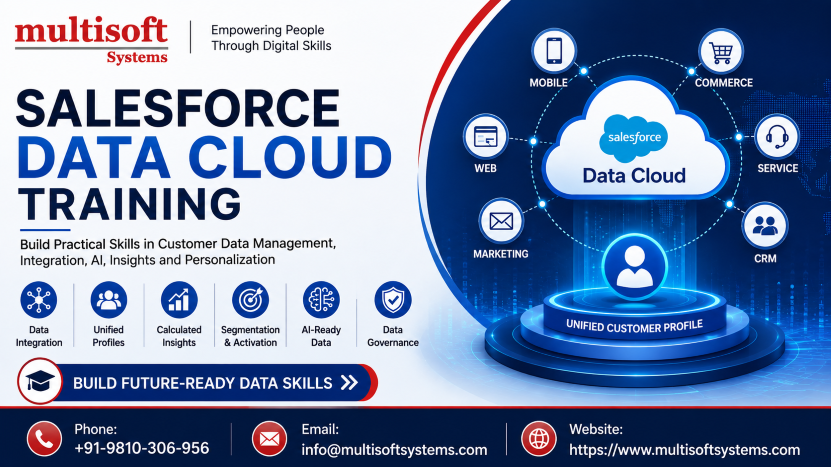
Customer data has become one of the most valuable assets for modern businesses. Organizations collect information from CRM systems, websites, commerce platforms, marketing channels, mobile applications, customer service interactions, and external data sources. However, collecting data is only the first step. Businesses also need to connect, organize, understand, and activate this information to create better customer experiences and make faster decisions. This is where Salesforce Data Cloud Training becomes relevant. Salesforce Data Cloud - now branded by Salesforce as Data 360 since October 14, 2025 - provides capabilities for connecting data from Salesforce and external sources, creating unified profiles, generating insights, building segments, and activating data across business processes. Salesforce states that the underlying functionality remains the same despite the name change. For professionals, learning this platform can provide practical knowledge of data integration, data modeling, identity resolution, segmentation, calculated insights, data governance, and AI-supported data use cases. Multisoft Systems' Salesforce Data Cloud Training focuses on data integration, management, optimization, governance, data quality, external data sources, analytics, AI, and practical case studies.
This guide explains the fundamentals of Salesforce Data Cloud, current data trends, important learning areas, career opportunities, common challenges, and a practical learning path for beginners and experienced professionals.
What Is Salesforce Data Cloud?
Salesforce Data Cloud Training is a cloud-based data platform designed to help organizations connect, organize, and use customer information from Salesforce and external data sources. It helps bring data from different systems together to create a more connected view of customers and their interactions. The platform supports important capabilities such as data ingestion, data modeling, identity resolution, unified customer profiles, calculated insights, segmentation, and data activation. These capabilities allow businesses to move beyond storing customer information and use connected data for analytics, personalization, marketing, service, sales, and AI-driven business processes. For professionals, understanding Salesforce Data Cloud provides a foundation for working with modern customer data management and connected CRM environments.
Why Is Salesforce Data Cloud Important?
Salesforce Data Cloud is important because modern businesses collect customer information from multiple systems and channels. Bringing this information together can help organizations create a more connected understanding of customers and use data more effectively. Data Cloud supports data integration, unified customer profiles, insights, segmentation, activation, and AI-related use cases. These capabilities can help businesses improve customer experiences, support data-driven decisions, and connect customer information with marketing, sales, service, and other business processes.
Key Benefits
- Unified Customer Data - Connect customer information from multiple sources.
- Better Customer Profiles - Create a more complete view of customer interactions.
- Data Integration - Connect Salesforce and external data sources.
- Personalized Experiences - Use customer information to support relevant engagement.
- Actionable Insights - Turn connected data into useful business insights.
- Customer Segmentation - Create targeted customer groups based on data.
- Data Activation - Use segments and insights across relevant business processes.
- AI-Ready Data - Provide connected and trusted data for AI-driven use cases.
- Improved Decision-Making - Support business decisions with more connected customer information.
- Data Governance - Support data quality, security, and responsible customer data management.
Salesforce Data Cloud and Current Data Trends
Customer data management is becoming increasingly important as businesses collect information from CRM systems, websites, commerce platforms, marketing channels, and other digital sources. Current trends are moving toward unified customer profiles, real-time data access, data integration, AI-ready information, personalization, and stronger data governance. Salesforce Data Cloud supports these trends by helping organizations connect data from Salesforce and external sources, organize it through data models, resolve customer identities, create insights, build segments, and activate data across business processes. The platform also supports ingestion and zero-copy approaches for accessing external data. As AI and automation become more important in customer engagement, organizations need trusted and connected data that can provide useful context for decision-making and personalized experiences.
Salesforce Data Cloud Training for Beginners
Beginners can approach Salesforce Data Cloud by first understanding basic CRM and data management concepts and then progressing into more specialized platform capabilities. Multisoft Systems recommends familiarity with Salesforce functionality and data management concepts for this training. The course is designed for professionals including Salesforce administrators, developers, business analysts, data managers, and IT managers.
A beginner-friendly learning sequence can include:
- Introduction to Salesforce Data Cloud
- Core platform capabilities
- Data sources and preparation
- Data modeling
- Customer 360 Data Model
- Data ingestion and integration
- Identity resolution
- Unified profiles
- Calculated insights
- Data segmentation
- Activations
- Data governance
- AI and data-driven use cases
- Practical projects
- Certification preparation
Starting with fundamentals is important because advanced features depend on properly prepared and modeled data.
Core Salesforce Data Cloud Concepts
- Data Sources - Connect customer and business data from Salesforce and external systems.
- Data Ingestion - Bring data into the platform for processing and management.
- Data Modeling - Organize data using objects, fields, relationships, and appropriate data structures.
- Data Model Objects (DMOs) - Provide a structured way to represent and organize data.
- Customer 360 Data Model - Create a connected view of customer information across different sources.
- Identity Resolution - Match records from different systems that represent the same customer.
- Unified Customer Profiles - Combine relevant customer information into a more complete profile.
- Calculated Insights - Generate meaningful business metrics and insights from connected data.
- Data Segmentation - Create customer groups based on attributes, behavior, and other criteria.
- Activations - Make customer segments and data available for relevant business processes.
- Data Integration - Connect Salesforce with external applications and data environments.
- Data Governance - Support data quality, security, access control, and responsible data management.
- Data Quality - Maintain accurate, consistent, and reliable customer information.
- AI and Data - Use connected and trusted data to support AI-driven experiences and business processes.
Salesforce Data Modeling
Salesforce Data Modeling is an important part of managing customer information in Data Cloud. It defines how data is structured, connected, and represented within the platform. Learners need to understand objects, fields, relationships, primary keys, foreign keys, and data structures to work effectively with information from different sources. A well-designed data model helps organize customer information and provides a foundation for data integration, identity resolution, insights, and segmentation. The Customer 360 Data Model also helps connect relevant customer information across different business systems. Understanding data modeling is therefore essential for professionals who want to build practical Salesforce Data Cloud skills.
Identity Resolution and Unified Customer Profiles
Identity Resolution helps identify records from different data sources that belong to the same customer. Customer information can often exist in multiple systems with different names, email addresses, phone numbers, or identifiers. Data Cloud uses matching and reconciliation approaches to connect relevant records and create unified customer profiles. This provides organizations with a more complete view of customer information across different interactions and systems. Learning identity resolution helps professionals understand how customer records are matched, how information is reconciled, and how unified profiles can support personalization, analytics, segmentation, and customer engagement.
Calculated and Streaming Insights
Calculated and streaming insights help organizations turn customer data into useful information for business decisions. Calculated insights can be used to derive metrics such as purchase frequency, customer value, order patterns, or engagement levels from connected data. Streaming insights can support scenarios where businesses need to respond to changing customer activity more quickly. These capabilities help professionals move beyond simply storing data and understand how connected information can be transformed into meaningful business insights. Learning this area is useful for professionals working with customer analytics, personalization, marketing, sales, and data-driven decision-making.
Data Segmentation and Activations
Data Segmentation allows businesses to create groups of customers based on specific attributes, behaviors, activities, or calculated insights. For example, organizations can identify high-value customers, recently active customers, or customers interested in particular products. After creating segments, activations can help make those audiences available for relevant business processes and customer engagement activities. This connects data management with practical business action. Professionals learning Salesforce Data Cloud should understand how to define useful segments, apply appropriate criteria, use insights, publish segments, and connect customer data with downstream processes.
Salesforce Data Cloud and AI
Artificial intelligence is becoming increasingly important in customer engagement, automation, analytics, and decision-making. Salesforce Data Cloud can provide connected customer information that helps support AI-driven business processes and personalized experiences. AI applications require relevant and reliable data to provide useful context and meaningful results. Learning Data Cloud therefore involves understanding the relationship between connected data, customer profiles, insights, automation, and AI. Professionals can benefit from understanding how unified and governed customer information can support modern AI use cases while maintaining appropriate data quality, security, and governance practices.
Data Governance and Data Quality
Data Governance and Data Quality are essential for maintaining reliable customer information. Organizations need to ensure that data is accurate, consistent, accessible to authorized users, and managed according to appropriate business and compliance requirements. Poor-quality or duplicated information can affect customer profiles, insights, segmentation, and business decisions. Data Cloud professionals should understand data quality practices, access management, security, governance policies, and responsible data usage. Strong governance helps organizations maintain greater confidence in their customer information while supporting effective data management and personalized customer experiences.
Salesforce Data Cloud Integration
Salesforce Data Cloud Integration enables organizations to connect customer information from Salesforce and external systems. Data may come from CRM applications, websites, commerce platforms, marketing systems, service applications, data warehouses, and other business sources. Integration helps bring relevant information together so it can be modeled, analyzed, unified, segmented, and activated. Professionals should understand data sources, data ingestion, data mapping, connections, and different integration approaches. Strong integration skills can help organizations create more connected data environments and reduce information silos across departments and applications.
Who Should Learn Salesforce Data Cloud?
Salesforce Data Cloud can be relevant for professionals who work with Salesforce, customer data, analytics, integration, or digital business processes. It can be particularly useful for:
- Salesforce Administrators
- Salesforce Developers
- Business Analysts
- Data Managers
- IT Managers
- CRM Professionals
- Data Integration Professionals
- Marketing Technology Professionals
- Customer Data Professionals
- Technology Consultants
Multisoft Systems' training specifically identifies Salesforce administrators, developers, business analysts, data managers, and IT managers as relevant learners.
Common Salesforce Data Cloud Learning Challenges
Learning Salesforce Data Cloud can be challenging because it combines CRM knowledge with data management, integration, modeling, analytics, identity resolution, segmentation, and activation. Beginners may initially find data modeling difficult because they need to understand how information from different systems is structured and connected. Identity resolution can also require practice because learners need to understand matching and reconciliation concepts. Integration is another common challenge, particularly when working with external data sources. Professionals may also need time to understand how calculated insights, segmentation, and activation connect technical data management with real business requirements. A structured learning approach and hands-on practice can make these concepts easier to understand.
Salesforce Data Cloud Career Opportunities
- Salesforce Data Cloud Consultant
- Salesforce Data Cloud Specialist
- Salesforce Administrator
- Salesforce Developer
- Salesforce Data Architect
- CRM Consultant
- Data Integration Consultant
- Customer Data Platform Specialist
- Business Analyst
- Data Management Professional
- Salesforce Solution Consultant
- Customer Data Analyst
Career Growth With Salesforce Data Cloud Skills
For existing Salesforce professionals, learning Data Cloud can provide an opportunity to expand beyond traditional CRM functionality. A Salesforce Administrator can add customer data management skills. A developer can strengthen integration and data modeling knowledge. A business analyst can better understand how customer data supports decision-making. A data professional can add Salesforce-specific capabilities to an existing data management background. The combination of CRM + data + analytics + AI is becoming increasingly relevant as businesses look for ways to connect customer information and create more personalized experiences.
Why Choose Multisoft Systems for Salesforce Data Cloud Training?
Multisoft Systems offers instructor-led Salesforce Data Cloud Training designed around data integration, management, optimization, governance, data quality, analytics, AI, and practical business use cases. The published training highlights include instructor-led online learning, project-based learning, experienced trainers, course completion certification, lifetime e-learning access, and after-training support. The curriculum covers core platform concepts, data modeling, data preparation, Customer 360 data modeling, segmentation, calculated insights, activations, and data actions. Practical exercises and case studies can help learners connect technical concepts with real-world requirements. Multisoft Systems also offers customized corporate training where schedule, duration, and course material can be tailored according to organizational learning requirements.
Future of Salesforce Data Cloud
The future of Salesforce Data Cloud is closely connected with the growing demand for unified customer data, real-time insights, AI, automation, and personalized customer experiences. As organizations collect information from more digital channels, the ability to connect and manage customer data across different systems will become increasingly important. Salesforce is also expanding Data Cloud capabilities around AI, data integration, identity resolution, segmentation, and activation. Professionals can therefore benefit from developing skills that combine customer data management, integration, analytics, governance, and AI. As businesses continue their digital transformation, knowledge of Salesforce Data Cloud can help professionals understand how connected and trusted data can support smarter decisions, personalized engagement, and modern customer-focused business processes.
Conclusion
Salesforce Data Cloud Training can help professionals build practical skills in customer data management, data modeling, identity resolution, unified profiles, insights, segmentation, activation, integration, AI, and data governance. As businesses increasingly depend on connected and trusted customer data, these skills can support modern CRM and digital transformation initiatives. Whether you are a Salesforce professional, data specialist, business analyst, developer, or IT manager, structured learning can help you strengthen your knowledge and career opportunities.
Enroll in Multisoft Systems now to develop practical Salesforce Data Cloud skills through expert-led training, hands-on learning, real-world scenarios, and certification-oriented preparation.