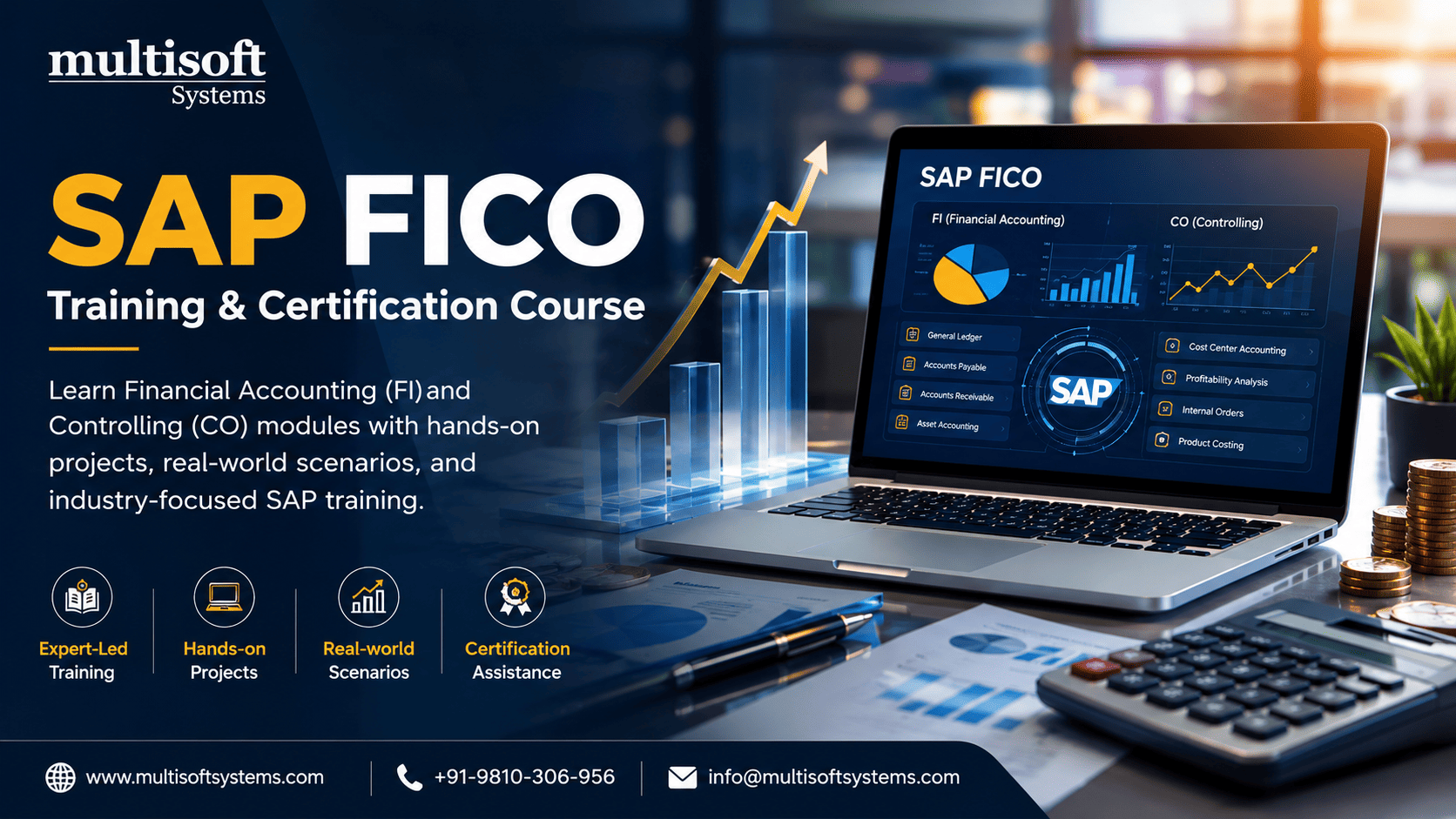
SAP FICO (Financial Accounting and Controlling) is one of the most important modules in the SAP ERP ecosystem. It helps organizations manage financial transactions, accounting records, cost control, profitability analysis, and financial reporting within a centralized system. SAP FICO combines two major components—SAP FI (Financial Accounting) and SAP CO (Controlling)—to provide complete financial management and decision-making capabilities. It enables businesses to maintain accurate financial records, comply with regulatory standards, monitor costs, and improve profitability through real-time financial insights. SAP FICO integrates seamlessly with other SAP modules such as Materials Management (MM), Sales and Distribution (SD), Production Planning (PP), Human Capital Management (HCM), and Project Systems (PS), making it the financial backbone of enterprise operations.
Introduction to SAP FICO
In today's competitive business environment, organizations require accurate financial information, efficient accounting processes, and real-time cost control mechanisms. Managing financial operations manually can lead to errors, delays, and compliance issues. To overcome these challenges, enterprises rely on Enterprise Resource Planning (ERP) systems that integrate various business functions into a unified platform. SAP FICO online training is one of the most widely implemented modules in SAP ERP and SAP S/4HANA. It provides organizations with comprehensive tools for managing accounting, financial reporting, budgeting, cost monitoring, and profitability analysis. The module supports both external financial reporting and internal management accounting, enabling organizations to make informed business decisions.
The term SAP FICO is derived from two major components:
- SAP FI (Financial Accounting)
- SAP CO (Controlling)
Together, these components help organizations manage financial transactions while also monitoring and controlling operational costs.
What is SAP FI?
SAP FI (Financial Accounting) is responsible for recording, processing, and reporting financial transactions. It helps organizations maintain accurate financial records and generate statutory reports required by regulatory authorities. The FI module supports:
- General Ledger Accounting
- Accounts Payable
- Accounts Receivable
- Asset Accounting
- Bank Accounting
- Financial Reporting
- Tax Accounting
SAP FI ensures that all financial transactions are recorded in real time and reflected across the organization.
What is SAP CO?
SAP CO (Controlling) focuses on internal cost management and profitability analysis. While FI is concerned with external reporting, CO helps management monitor costs, allocate resources, and evaluate business performance.
SAP CO provides tools for:
- Cost Center Accounting
- Internal Orders
- Product Costing
- Profit Center Accounting
- Profitability Analysis
- Budget Monitoring
The primary objective of SAP CO is to support managerial decision-making by providing detailed cost and performance information.
Architecture of SAP FICO
SAP FICO operates within the SAP ERP landscape and integrates with multiple business processes. Every financial transaction generated in procurement, sales, production, or project management automatically updates the relevant accounting records.
The architecture typically includes:
- Business Transactions
- SAP Functional Modules
- Financial Accounting Layer
- Controlling Layer
- Reporting and Analytics
This integrated architecture eliminates duplicate data entry and ensures consistency across the organization.
Major Components of SAP FI
1. General Ledger Accounting (FI-GL)
The General Ledger serves as the central repository for all financial transactions. Key functions include:
- Journal Entries
- Balance Sheet Generation
- Profit and Loss Statements
- Financial Consolidation
- Real-Time Reporting
The General Ledger provides a complete picture of an organization's financial position.
2. Accounts Payable (FI-AP)
Accounts Payable manages vendor-related transactions. Features include:
- Vendor Master Records
- Invoice Processing
- Payment Management
- Vendor Reconciliation
- Tax Calculation
It helps organizations track outstanding liabilities and maintain healthy vendor relationships.
3. Accounts Receivable (FI-AR)
Accounts Receivable handles customer-related financial activities. Functions include:
- Customer Invoicing
- Credit Management
- Payment Collection
- Customer Account Monitoring
- Aging Analysis
Organizations use FI-AR to improve cash flow and manage receivables effectively.
4. Asset Accounting (FI-AA)
Asset Accounting manages fixed assets throughout their lifecycle. Key activities include:
- Asset Acquisition
- Asset Transfers
- Asset Retirement
- Depreciation Calculation
- Asset Reporting
This component ensures accurate valuation and tracking of organizational assets.
5. Bank Accounting
Bank Accounting manages all banking transactions. Capabilities include:
- Bank Reconciliation
- Electronic Bank Statements
- Cash Position Monitoring
- Fund Transfers
- Payment Processing
It improves cash management and financial transparency.
6. Tax Accounting
Organizations operating in multiple regions must comply with various tax regulations. SAP FI supports:
- GST/VAT Calculations
- Withholding Tax
- Tax Reporting
- Regulatory Compliance
The system automates tax-related calculations and reporting activities.
Major Components of SAP CO
1. Cost Center Accounting (CCA)
Cost Center Accounting tracks costs incurred by departments or business units. Benefits include:
- Departmental Cost Monitoring
- Budget Tracking
- Cost Allocation
- Variance Analysis
Management can identify high-cost areas and improve operational efficiency.
2. Internal Orders
Internal Orders are used to track costs associated with specific projects, events, or activities. Examples include:
- Marketing Campaigns
- Maintenance Activities
- Research Projects
- Training Programs
Organizations can analyze expenses and evaluate project performance.
3. Product Costing (CO-PC)
Product Costing determines the cost of manufacturing goods or delivering services. Functions include:
- Material Cost Calculation
- Labor Cost Analysis
- Overhead Allocation
- Standard Cost Estimation
It helps organizations establish competitive pricing strategies.
4. Profit Center Accounting (PCA)
Profit Center Accounting evaluates the profitability of individual business units. Organizations can:
- Monitor Revenue
- Track Expenses
- Measure Profitability
- Compare Business Segments
This information supports strategic decision-making.
5. Profitability Analysis (CO-PA)
Profitability Analysis helps organizations analyze profits generated from:
- Products
- Customers
- Markets
- Sales Regions
- Distribution Channels
The module provides valuable insights into revenue generation and business growth opportunities.
Integration of SAP FICO with Other SAP Modules
SAP FICO serves as the financial core of the SAP ecosystem and seamlessly integrates with various SAP modules to ensure accurate financial reporting and real-time business visibility. This integration eliminates data duplication, improves process efficiency, and enables organizations to maintain a single source of truth for financial transactions. One of the most significant integrations is with SAP Materials Management (MM), where procurement activities such as purchase orders, goods receipts, and vendor invoices automatically generate accounting entries in SAP FI. Similarly, integration with SAP Sales and Distribution (SD) allows customer billing, revenue recognition, and accounts receivable postings to be recorded instantly in the financial system. SAP Production Planning (PP) works closely with SAP CO by transferring manufacturing costs, labor expenses, and material consumption data for cost analysis and product costing. SAP FICO certification also integrates with SAP Human Capital Management (HCM), where payroll processing results in automatic postings to salary, tax, and benefits accounts, ensuring accurate financial records. In project-based organizations, integration with SAP Project Systems (PS) enables project costs, budgets, and revenues to be tracked and analyzed within the controlling environment. SAP Plant Maintenance (PM) connects maintenance activities and equipment-related expenses with cost centers and internal orders, helping organizations monitor operational costs effectively. Furthermore, SAP Warehouse Management (WM) and Extended Warehouse Management (EWM) integrate inventory movements with financial accounting, ensuring accurate stock valuation and inventory reporting.
In SAP S/4HANA environments, these integrations become even more powerful through real-time processing and the Universal Journal concept, which consolidates financial and controlling data into a single platform. Every business transaction, whether related to procurement, sales, manufacturing, human resources, or project execution, immediately updates the relevant financial records. This high level of integration enables organizations to achieve greater transparency, faster financial closing, improved compliance, and better decision-making. As a result, SAP FICO acts as the central financial engine that connects all business operations and transforms transactional data into meaningful financial insights for management and stakeholders.
Key Features of SAP FICO
SAP FICO offers numerous features that support enterprise financial management.
- Transactions are updated instantly across all connected modules.
- Organizations can generate reports automatically without manual calculations.
- Global organizations can operate in multiple currencies and maintain consolidated financial records.
- The system supports local and international accounting standards.
- Every transaction is recorded with complete traceability.
- Organizations can monitor budgets and control spending effectively.
- Management can identify profitable products, customers, and business units.
Business Benefits of SAP FICO
Organizations implementing SAP FICO experience significant operational improvements.
- Automation reduces manual errors and ensures reliable financial data.
- Month-end and year-end closing processes become more efficient.
- Managers can monitor expenses and optimize resource allocation.
- Real-time reports provide valuable business insights.
- Organizations can meet statutory and tax requirements effectively.
- Automated workflows reduce administrative workload.
- Decision-makers gain a comprehensive view of financial performance.
SAP FICO in SAP S/4HANA
SAP FICO in SAP S/4HANA represents the next generation of financial management, offering enhanced performance, real-time analytics, and a simplified data architecture. Unlike traditional SAP ERP systems, SAP S/4HANA leverages the in-memory capabilities of the SAP HANA database to process large volumes of financial data instantly. One of its key innovations is the Universal Journal (ACDOCA), which combines financial accounting and controlling data into a single source of truth, eliminating data redundancy and improving reporting accuracy. SAP S/4HANA Finance provides real-time insights into financial performance, profitability, cash flow, and cost management through embedded analytics and intuitive SAP Fiori applications. The solution streamlines financial closing processes, supports advanced compliance requirements, and enables faster decision-making with up-to-date business information. Organizations can automate routine financial tasks, improve operational efficiency, and gain greater visibility across all business functions. With features such as predictive analytics, intelligent automation, and seamless integration with other SAP modules, SAP FICO in SAP S/4HANA helps enterprises accelerate digital transformation while maintaining accurate financial control and governance.
Industry Applications of SAP FICO
SAP FICO is widely used across industries to manage financial operations, control costs, and ensure regulatory compliance. In the manufacturing sector, SAP FICO training helps organizations track production costs, monitor inventory valuation, manage fixed assets, and analyze product profitability. Retail companies utilize SAP FICO to handle large volumes of customer transactions, revenue management, accounts receivable, and financial reporting across multiple stores and regions. In the banking and financial services industry, the module supports financial accounting, risk monitoring, asset management, and regulatory reporting, ensuring transparency and compliance with financial standards.
Healthcare organizations use SAP FICO to manage budgets, monitor operational expenses, process patient-related financial transactions, and maintain accurate financial records. In the oil and gas industry, SAP FICO plays a critical role in project accounting, asset accounting, cost allocation, and financial planning for large-scale operations. Information technology and consulting firms leverage SAP FICO to track project costs, manage billing processes, analyze profitability, and optimize resource utilization. The telecommunications sector uses the module for revenue recognition, contract accounting, and expense management. Across all industries, SAP FICO provides real-time financial visibility, improves decision-making, enhances operational efficiency, and supports strategic business growth through accurate financial management and reporting capabilities.
Career Opportunities in SAP FICO
SAP FICO remains one of the most sought-after SAP domains worldwide. Popular job roles include:
- SAP FICO Consultant
- SAP Finance Analyst
- SAP Functional Consultant
- SAP S/4HANA Finance Consultant
- Financial Systems Manager
- ERP Finance Specialist
- Business Process Consultant
Professionals with accounting knowledge and SAP expertise often enjoy excellent career growth and global employment opportunities.
Future Trends in SAP FICO
As organizations continue their digital transformation journeys, SAP FICO is evolving rapidly. Emerging trends include:
- AI-Powered Financial Analytics
- Predictive Accounting
- Robotic Process Automation (RPA)
- Cloud-Based Financial Management
- Real-Time Business Intelligence
- Machine Learning for Financial Forecasting
- Advanced Compliance Monitoring
These innovations are helping organizations become more agile, data-driven, and financially efficient.
Conclusion
SAP FICO is a powerful financial management solution that combines accounting, cost control, reporting, and profitability analysis into a unified platform. Through its FI and CO components, it supports both external financial reporting and internal management accounting. Its seamless integration with other SAP modules enables real-time financial visibility, improved operational efficiency, and better decision-making.
Whether an organization operates in manufacturing, retail, healthcare, banking, or technology, SAP FICO provides the financial foundation required for sustainable growth and regulatory compliance. As businesses increasingly adopt SAP S/4HANA and intelligent enterprise technologies, SAP FICO continues to remain a critical component of modern digital finance transformation. Enroll in Multisoft Systems now!