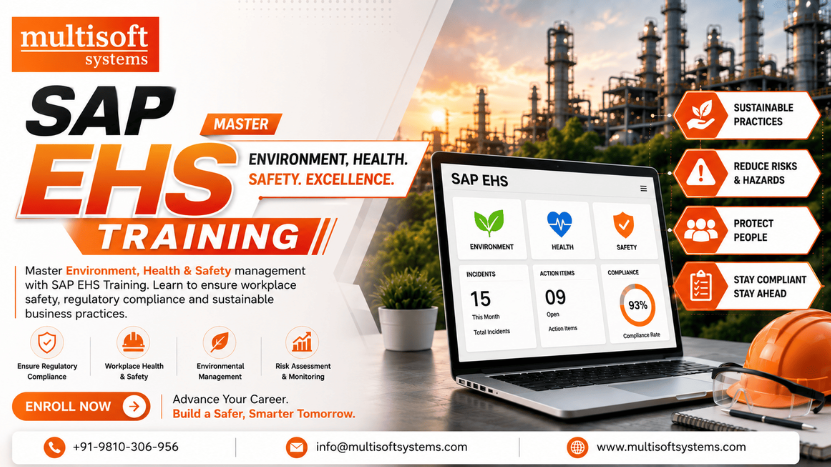
In today’s highly regulated business environment, organizations are expected to maintain workplace safety, protect employee health, comply with environmental regulations, and manage hazardous substances responsibly. As industries continue to expand their operations globally, managing Environment, Health, and Safety (EHS) requirements has become increasingly complex. Companies operating in manufacturing, chemicals, pharmaceuticals, oil and gas, mining, energy, and other industrial sectors require a centralized system to ensure compliance while minimizing operational risks.
SAP EHS (Environment, Health, and Safety) is a comprehensive solution designed to help organizations manage environmental compliance, occupational health, industrial hygiene, workplace safety, hazardous substance management, and product safety activities. Integrated within the SAP ecosystem, SAP EHS enables businesses to streamline regulatory processes, reduce environmental impact, improve employee safety, and ensure sustainable operations. The solution supports organizations in identifying potential risks, managing incidents, monitoring compliance requirements, and generating mandatory regulatory reports. By consolidating EHS-related information into a single platform, SAP EHS provides real-time visibility into safety and environmental performance across the enterprise.
As sustainability and ESG (Environmental, Social, and Governance) initiatives gain strategic importance, SAP EHS online training plays a critical role in helping organizations achieve operational excellence while maintaining compliance with local and international regulations.
What is SAP EHS?
SAP Environment, Health, and Safety (SAP EHS) is an integrated software solution that helps organizations manage safety, environmental, and occupational health processes throughout the enterprise. It provides tools for handling regulatory compliance, hazardous substance management, workplace safety, industrial hygiene, incident management, and environmental reporting.
SAP EHS allows companies to establish standardized procedures for identifying hazards, assessing risks, monitoring workplace conditions, and ensuring compliance with government regulations. The solution integrates with various SAP modules such as Materials Management (MM), Production Planning (PP), Plant Maintenance (PM), Human Capital Management (HCM), Quality Management (QM), and Supply Chain Management (SCM).
Organizations use SAP EHS training to:
- Ensure workplace safety
- Manage hazardous materials
- Monitor environmental impact
- Track incidents and accidents
- Maintain regulatory compliance
- Improve employee health programs
- Support sustainability initiatives
- Reduce operational risks
SAP EHS transforms traditional safety management from a reactive process into a proactive and preventive strategy.
Evolution of SAP EHS
The increasing focus on workplace safety and environmental sustainability has driven organizations to adopt advanced EHS management systems. Initially, EHS processes were handled manually through spreadsheets, paper records, and isolated systems, making compliance difficult and error-prone. SAP introduced EHS as a specialized solution to centralize compliance-related activities. Over time, the solution evolved from basic hazardous substance management to a comprehensive platform covering environmental management, occupational health, incident management, and product safety.
Modern SAP EHS capabilities now support:
- Digital compliance management
- Automated regulatory reporting
- Real-time incident tracking
- Enterprise-wide risk management
- Sustainability reporting
- Integration with ESG initiatives
- Cloud-enabled safety management
This evolution has positioned SAP EHS as a strategic tool rather than merely a compliance application.
Architecture of SAP EHS
SAP EHS is built on an integrated architecture that enables seamless communication between various safety, environmental, and operational processes. The system acts as a centralized repository for all EHS-related data and activities. The architecture consists of multiple functional components that work together to support environmental management, health surveillance, safety compliance, and risk control. Information flows across departments, allowing organizations to maintain consistent safety standards throughout the enterprise. The solution integrates directly with operational modules such as procurement, manufacturing, maintenance, and human resources. When a hazardous material is procured, produced, stored, or transported, SAP EHS certification automatically applies relevant safety and compliance rules. A key strength of SAP EHS architecture is its ability to provide real-time visibility into safety metrics, incident records, environmental emissions, employee health data, and compliance activities. This centralized structure improves decision-making and enhances organizational accountability. The architecture also supports global operations by accommodating country-specific regulations, industry standards, and reporting requirements. This flexibility allows multinational organizations to maintain consistent EHS practices while meeting regional compliance obligations.
Core Components
SAP EHS consists of several integrated components that address different aspects of environmental, health, and safety management.
1. Product Safety
Product Safety helps organizations manage hazardous substances throughout the product lifecycle. It enables the creation and maintenance of safety-related information, ensuring compliance with chemical regulations and transportation requirements. The module supports:
- Safety Data Sheet (SDS) generation
- Hazard classification
- Label management
- Dangerous goods handling
- Regulatory reporting
- Chemical inventory management
Product Safety ensures that organizations maintain accurate safety information for all materials and products.
2. Occupational Health
Occupational Health focuses on protecting employee well-being by monitoring workplace health risks and managing medical surveillance programs. Organizations can track:
- Employee medical records
- Health examinations
- Exposure monitoring
- Vaccination programs
- Occupational illnesses
- Fitness-for-duty evaluations
This component helps companies create healthier work environments and comply with occupational health regulations.
3. Industrial Hygiene and Safety
Industrial Hygiene and Safety enables organizations to identify workplace hazards and implement preventive measures. The module supports:
- Risk assessments
- Workplace inspections
- Exposure monitoring
- Hazard identification
- Safety observations
- Corrective actions
By proactively managing risks, organizations can reduce workplace incidents and improve safety performance.
4. Incident Management
Incident Management provides a structured approach to recording, investigating, and resolving workplace incidents. The solution allows organizations to document:
- Injuries and illnesses
- Near-miss events
- Property damage
- Environmental incidents
- Equipment failures
- Corrective and preventive actions
Comprehensive investigation workflows help organizations identify root causes and prevent recurrence.
5. Environmental Management
Environmental Management helps organizations monitor and control their environmental impact. Key capabilities include:
- Emissions tracking
- Waste management
- Water consumption monitoring
- Environmental reporting
- Permit management
- Sustainability measurements
The module supports environmental compliance while promoting sustainable business practices.
How SAP EHS Works?
SAP EHS operates by collecting, organizing, and analyzing safety and environmental data across business processes. When hazardous materials are introduced into operations, the system automatically evaluates associated risks and compliance requirements. Safety information is generated and distributed to relevant departments. Workplace hazards are identified through inspections, monitoring programs, and risk assessments. Potential issues are documented and assigned for corrective action. If an incident occurs, SAP EHS training course initiates investigation workflows, tracks corrective measures, and maintains audit trails. Occupational health programs continuously monitor employee exposure and medical compliance. Environmental performance data is collected from operational systems and used to generate compliance reports. Management dashboards provide visibility into key performance indicators, enabling proactive decision-making. This end-to-end approach creates a unified framework for managing environmental, health, and safety activities.
Key Features
SAP EHS offers a wide range of features designed to support compliance, safety, and sustainability initiatives.
- The solution provides centralized management of hazardous substances, ensuring that organizations maintain accurate safety information and comply with chemical regulations. Automated Safety Data Sheet generation simplifies regulatory documentation processes.
- Advanced incident management capabilities enable rapid reporting, investigation, and resolution of workplace events. Organizations can analyze trends, identify root causes, and implement preventive measures.
- Occupational health management helps monitor employee health risks through medical surveillance programs and exposure tracking. Environmental management tools facilitate emissions monitoring, waste management, and sustainability reporting.
- Real-time dashboards and analytics provide visibility into compliance status, safety performance, and environmental metrics. Integration with other SAP applications ensures consistent data across business processes.
These features collectively improve operational efficiency while reducing compliance risks.
Business Benefits of SAP EHS
Organizations implementing SAP EHS gain significant operational, financial, and regulatory advantages.
- One of the primary benefits is improved regulatory compliance. Automated processes help organizations meet local and international requirements while reducing administrative burdens.
- Workplace safety improves through proactive hazard identification and incident prevention strategies. Fewer accidents lead to lower compensation costs, reduced downtime, and improved employee morale.
- Environmental management capabilities help organizations minimize waste, reduce emissions, and support sustainability goals. Better environmental performance enhances corporate reputation and stakeholder confidence.
- Centralized data management improves decision-making by providing accurate and timely information. Management teams gain visibility into safety trends, compliance status, and operational risks.
SAP EHS also supports digital transformation initiatives by replacing manual processes with automated workflows and integrated reporting mechanisms.
Industry Applications of SAP EHS
SAP EHS is widely used across industries where safety, compliance, and environmental management are critical. The chemical industry uses SAP EHS to manage hazardous substances, regulatory compliance, and Safety Data Sheets. Pharmaceutical companies leverage the solution to ensure employee safety and maintain compliance with health regulations. Oil and gas organizations utilize SAP EHS for risk management, incident reporting, and environmental monitoring. Manufacturing companies rely on the system to improve workplace safety and reduce operational hazards. Mining companies use SAP EHS to monitor occupational health risks and manage environmental obligations. Energy providers employ the solution to track emissions, manage permits, and support sustainability initiatives. Food and beverage companies benefit from compliance management, employee safety monitoring, and environmental reporting capabilities. Transportation and logistics organizations use SAP EHS for dangerous goods management and regulatory compliance.
Challenges in SAP EHS Implementation
Despite its advantages, SAP EHS implementation can present several challenges.
- Organizations often face difficulties in consolidating data from multiple legacy systems. Ensuring data accuracy and consistency requires significant planning and governance.
- Regulatory requirements vary across regions and industries, making configuration complex for multinational enterprises. Businesses must continuously update compliance rules to reflect changing regulations.
- User adoption can also be challenging, particularly when employees are accustomed to manual processes. Effective training and change management strategies are essential for successful implementation.
- Integration with operational systems may require additional customization and technical expertise. Large-scale deployments often involve substantial resource commitments and organizational coordination.
Addressing these challenges through proper planning and stakeholder engagement significantly improves implementation success.
Future Trends in SAP EHS
The future of SAP EHS is closely aligned with digital transformation, sustainability, and intelligent technologies. Artificial Intelligence and Machine Learning are expected to enhance predictive safety analytics by identifying potential hazards before incidents occur. Advanced analytics will enable organizations to anticipate risks and implement preventive measures more effectively. Internet of Things (IoT) integration will improve workplace monitoring through connected sensors that track environmental conditions, equipment performance, and employee exposure levels in real time. Cloud-based EHS platforms will continue to expand, providing greater scalability, accessibility, and collaboration across global operations. Mobile technologies will further improve field inspections, incident reporting, and compliance monitoring. Sustainability and ESG reporting requirements will drive increased demand for integrated environmental management capabilities. Organizations will rely on SAP EHS to support carbon accounting, emissions reduction programs, and corporate sustainability objectives. These innovations will transform SAP EHS into an even more strategic platform for enterprise risk management and sustainable operations.
Conclusion
SAP EHS is a comprehensive enterprise solution that helps organizations manage environmental compliance, occupational health, workplace safety, hazardous substances, and sustainability initiatives from a single integrated platform. By combining regulatory compliance, risk management, incident handling, and environmental monitoring capabilities, SAP EHS enables businesses to create safer workplaces while maintaining operational efficiency. The solution provides organizations with the tools needed to proactively identify hazards, manage compliance obligations, monitor employee health, and reduce environmental impact. Its seamless integration with other SAP modules ensures consistent data flow and enterprise-wide visibility into safety and environmental performance.
As organizations continue to prioritize sustainability, ESG goals, and employee well-being, SAP EHS will remain a critical component of modern enterprise management. Through intelligent automation, advanced analytics, and integrated compliance capabilities, SAP EHS empowers businesses to achieve safer, more sustainable, and more responsible operations while supporting long-term growth and regulatory excellence. Enroll in Multisoft Systems now!