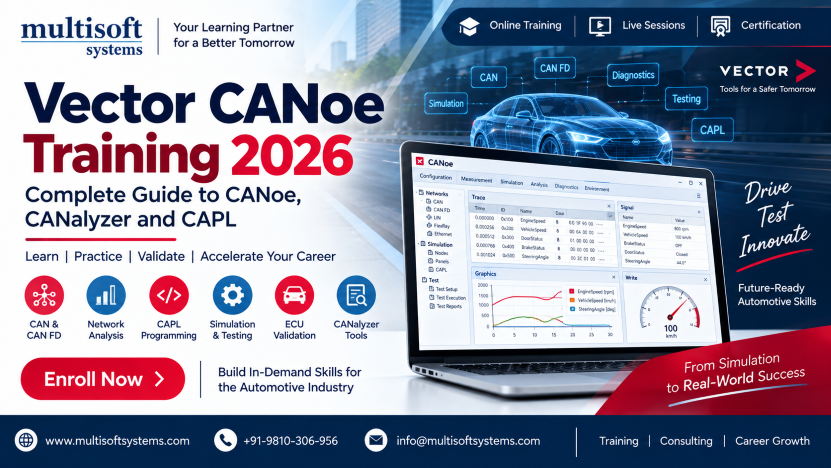
The automotive industry is moving toward increasingly connected, software-driven and automated vehicles. Modern vehicles contain many electronic control units (ECUs) that communicate through vehicle networks and must be developed, simulated, analyzed and tested before they reach production. As these systems become more complex, engineers need specialized tools to understand network communication, simulate vehicle behavior and validate ECU functionality. Vector CANoe Training is designed for professionals who want to develop practical knowledge of CANoe, CAN, CAN FD, simulation, network analysis and CAPL programming. Multisoft Systems also offers Vector Canoe Online Training, CANalyzer CAPL Course focused on practical automotive and embedded-systems applications. CANoe is used for development, simulation, analysis, diagnostics and testing of distributed embedded systems. Vector describes CANoe as a development and test platform that can be used across software components, ECUs and complete distributed networks, including Software-in-the-Loop (SIL) and Hardware-in-the-Loop (HIL) environments.
This article explains what CANoe is, why CANoe skills are becoming important, what learners can study, how CAPL fits into the workflow and how CANoe knowledge can support automotive testing and embedded-system careers.
What Is Vector CANoe?
Vector CANoe is a software platform used to develop, simulate, analyze and test communication between electronic systems. It can work with vehicle communication networks and supports activities such as measurement, simulation, diagnostics, stimulation and automated testing. In automotive engineering, ECUs need to exchange information reliably. CANoe allows engineers to observe this communication, create simulations, stimulate systems and evaluate responses. This makes it useful throughout different stages of development. CANoe is not limited to a single development activity. It can support early simulation as well as testing with real hardware. Vector also provides CANoe capabilities for SIL and HIL workflows, allowing engineers to test software components and systems in virtual or hardware-based environments.
Why Is CANoe Training Important?
Vehicle electronics are becoming more sophisticated. Software-defined vehicles, ADAS, electric vehicles, connected services and advanced diagnostics are increasing the amount of software and communication that must be validated. Vector's current automotive focus highlights the industry's transition toward software-defined vehicles and the growing complexity of diagnostics, ADAS, e-mobility and cybersecurity.
For engineers, learning CANoe can therefore provide practical exposure to several important areas:
- CAN and CAN FD communication
- ECU network analysis
- Simulation and modeling
- Measurement and data analysis
- Network stimulation
- CAPL programming
- Diagnostics
- Automated testing
- SIL and HIL testing
- Test data logging
- Signal and message interpretation
A structured training program can help learners understand how these capabilities fit together instead of learning each concept separately.
What Is Covered in Vector CANoe Online Training?
The Multisoft Systems course is structured around CAN fundamentals, CAN FD, data interpretation, CANoe configuration, measurement, simulation, CAPL and related practical concepts. The curriculum contains 15 modules covering the complete progression from CAN basics to message-oriented CAPL.
-
Understanding CAN Fundamentals
The first stage focuses on the foundation of vehicle networking. Learners explore the electronification of motor vehicles, primary bus-networking tasks, standards and implementation, node architecture, bus connections and termination. Understanding these concepts is important because CANoe is ultimately used to work with communication between networked systems. Engineers need to understand what is happening on the bus before they can effectively analyze or simulate it.
-
Learning CAN Protocol Characteristics
The course then moves into CAN protocol characteristics such as message transmission and reception, bus access, arbitration, message types, error detection and error handling. Learners also explore the relationship between baud rate and CAN-bus length along with synchronization and resynchronization. These concepts help engineers interpret communication behavior and identify problems that may occur within a network.
-
CAN FD
CAN FD is another important part of the curriculum. Participants learn why CAN FD was introduced, its message structure, larger data fields and bit-rate switching. As automotive networks continue to evolve, understanding CAN FD can help professionals work with newer communication requirements and testing environments.
Data Interpretation in CANoe
Raw network traffic is not always easy to understand. Engineers need to interpret messages, signals and network nodes correctly. The training introduces CAN data concepts and the CANdb++ Editor. This helps learners understand how network information can be represented and interpreted within a CANoe environment. A strong understanding of data interpretation can make network analysis more efficient because engineers can move beyond simply viewing raw messages and begin relating them to meaningful signals and system behavior.
CANoe Configuration and Measurement
Once the fundamentals are understood, learners can move into CANoe configuration. The course introduces available CAN hardware, configuration concepts and the CANoe environment. Measurement and analysis are central CANoe capabilities. Learners explore graphical interfaces, data flow, measurement setup and simulation setup as well as measurement and analysis windows. Filters and trigger blocks are also covered. These features can help engineers focus on relevant communication events rather than manually reviewing large amounts of network traffic.
Data Logging and Offline Analysis
Testing does not always happen in real time. Engineers often need to record communication and review it later. The CANoe curriculum includes recording data traffic, using trigger conditions, importing and exporting data, data conversion and offline analysis of logged data. Offline analysis can be particularly useful when investigating intermittent problems or comparing network behavior across different test scenarios.
Simulation and Modeling With CANoe
Simulation allows engineers to test system behavior without requiring every component to be physically available. The course introduces simulation and modeling concepts along with configuration creation, system panels, nodes, network panels and signal generators. Vector also describes CANoe as a platform for simulation and testing of distributed embedded systems. Its professional variant supports the creation of simulation models with CAPL and .NET and provides functions for test development. This makes simulation an important skill for professionals involved in ECU development and validation.
What Is CAPL?
CAPL stands for Communication Access Programming Language. It is a programming language used with Vector tools for developing communication-related logic, simulation behavior and automated test functions. Vector's CAPL learning material describes CAPL as being used in Vector tools to automate and simulate CAN, LIN and FlexRay networks. The learning path introduces language constructs and practical exercises that help users develop scripts for vehicle communication and testing. For CANoe and CANalyzer users, CAPL can extend the functionality of the tool beyond standard configuration.
Why Learn a CANalyzer CAPL Course?
A CANalyzer CAPL Course can be useful for engineers who want to move from basic network observation toward programmable analysis and automation. CAPL can be used to define behavior based on events, messages and signals. It can also support test-related activities and custom tool extensions. The Multisoft Systems curriculum introduces CAPL through the CAPL Browser, network nodes, program nodes, variables, operators, conditions and loops. It then progresses to signal-oriented CAPL and message-oriented CAPL. Vector's official CAPL learning content similarly covers data types, variables, calculations, conditions, functions and loops before moving toward practical CANoe exercises.
Signal-Oriented CAPL
Signal-oriented CAPL focuses on working with signals and network behavior. The course covers CAPL with the Signal Server and Interaction Layer, controlling network nodes, signal manipulation, system and environment variables and timers. This can help engineers create more dynamic simulation and testing logic. For example, a test application may need to respond when a particular signal changes or when a defined condition occurs. CAPL can provide the programming mechanism required to implement such behavior.
Message-Oriented CAPL
Message-oriented CAPL provides another way to work with CAN communication. The curriculum introduces message-oriented programming, message analysis, event procedures and CAN-specific functions. This knowledge can be useful when engineers need to analyze messages, trigger actions or create automated behavior based on communication events.
CANoe and Automated Testing
Automated testing is becoming increasingly important because modern vehicles contain large numbers of software functions that must be validated repeatedly. CANoe supports testing from individual software components through complete systems and can be used with virtual and real environments. Vector's current CANoe ecosystem also includes automated testing solutions for areas such as EV charging, diagnostics and ADAS. For example, its EV test package supports automated conformance, interoperability and security testing for charging communication. This demonstrates how CANoe-related skills can connect with modern automotive testing requirements.
CANoe, SIL and HIL Testing
Software-in-the-Loop and Hardware-in-the-Loop are important approaches for validating automotive software. In SIL environments, software can be executed in virtual environments before complete physical hardware is available. HIL testing introduces real hardware into the test environment. CANoe supports both SIL and HIL applications as part of its broader development and test capabilities. Learning how simulation, measurement and testing work together can help engineers understand modern validation workflows.
CANoe for ADAS and Modern Vehicle Development
Advanced Driver Assistance Systems require extensive testing because functions must respond correctly to different driving situations and sensor inputs. Vector's CANoe.ADAS solution supports analysis, simulation and testing of ADAS functions using recorded or simulated data. It can support open-loop and closed-loop scenarios in SIL and HIL environments. For professionals, this shows how CANoe knowledge can extend beyond traditional CAN monitoring toward advanced vehicle-function validation.
CANoe and Electric Vehicle Testing
Electric vehicles are creating new testing requirements around charging communication, vehicle networks and software-controlled functions. Vector's CANoe Test Package EV supports conformance, interoperability and security testing for charging communication standards and includes automated test execution and reporting. The growth of connected EV ecosystems means that engineers increasingly need skills that combine communication analysis, automated testing and protocol understanding.
CANoe and Automotive Cybersecurity
Cybersecurity has become a major concern as vehicles become more connected and software-defined. Vector identifies cybersecurity as an essential part of connected and software-defined vehicle development and references standards including ISO/SAE 21434 and UNECE regulations. CANoe also includes capabilities for testing security-protected ECUs and networks through its Security Manager. CANoe training does not replace specialized cybersecurity training, but understanding communication analysis and testing can provide useful technical context for engineers working in secure vehicle development.
Who Should Take Vector CANoe Training?
The Multisoft Systems course identifies CANoe users and CAN users working in controller development, motor vehicle electrical departments and test planning and execution as its target audience.
The training can also be relevant for:
- Automotive engineers
- ECU developers
- Embedded systems engineers
- CAN network engineers
- Automotive testers
- Validation engineers
- Test automation engineers
- Diagnostics engineers
- Vehicle communication professionals
- Automotive software engineers
- Students interested in automotive embedded systems
Because the course has no set prerequisites according to the Multisoft Systems page, learners can start without a formal prerequisite requirement.
Why Hands-On Practice Matters
CANoe is a practical engineering tool, so hands-on learning is especially valuable. Understanding terminology alone does not provide enough experience to configure a network, analyze traffic, build simulations or develop CAPL logic. Multisoft Systems highlights interactive learning, practical exercises, project-based learning and hands-on assignments as part of its training approach.
Practical exercises can help learners develop the ability to:
- Create CANoe configurations
- Analyze communication traffic
- Work with CAN and CAN FD
- Interpret signals and messages
- Record and analyze data
- Build simulation environments
- Create panels
- Develop CAPL scripts
- Test network behavior
- Troubleshoot communication issues
CANoe Certification Training Assessment
Assessment can help participants evaluate their understanding of CANoe concepts and related technical skills. Multisoft Systems describes an assessment containing multiple-choice and short-answer questions along with evaluation of analytical thinking, problem-solving and communication abilities. The assessment platform also includes secure login, automated scoring and time limits. The assessment should be viewed as part of the learning process rather than a replacement for practical experience.
Career Opportunities After CANoe Training
CANoe skills can support career paths in automotive software development, ECU testing, embedded systems, validation and vehicle communication.
Potential roles include:
- CANoe Test Engineer
- Automotive Test Engineer
- ECU Validation Engineer
- Embedded Systems Engineer
- CAN Network Engineer
- Automotive Diagnostics Engineer
- Test Automation Engineer
- Vehicle Communication Engineer
- CAPL Developer
- Automotive Software Engineer
- HIL/SIL Test Engineer
- Automotive Validation Specialist
Actual career opportunities depend on technical experience, domain knowledge and employer requirements.
Why Choose Multisoft Systems for Vector CANoe Training?
Multisoft Systems offers instructor-led online training, project-based learning, experienced trainers, customized schedules and doubt-clearing sessions for its CANoe program. The course page also describes hands-on assignments, real-time scenarios and industry case studies. Training delivery can be customized according to learning goals and skill levels. The program covers a broad learning path from CAN fundamentals to CAN FD, measurement, analysis, simulation and CAPL. This structured progression can help learners develop their understanding step by step.
The Future of CANoe Skills
The automotive industry is moving toward software-defined vehicles with centralized computing, advanced connectivity, automated testing and continuous software development. Vector's current SDV material highlights the integration of development, coding, testing and deployment within increasingly automated workflows. CANoe is also evolving with capabilities for ADAS, diagnostics, EV charging, security and software-based testing. Its current version supports an expanding range of development and validation scenarios. For engineers, this means that CANoe knowledge can be more valuable when combined with related skills such as CAPL, CAN FD, diagnostics, automation, embedded software and automotive communication protocols.
Conclusion
Vector CANoe Training provides a practical pathway for professionals who want to understand automotive communication, ECU testing, simulation and network analysis. From CAN and CAN FD fundamentals to measurement, data logging, simulation, modeling and CAPL programming, the learning journey covers important areas of modern automotive engineering. Multisoft Systems combines these topics through instructor-led online learning, practical exercises and project-based training. The relevance of CANoe is also expanding as the automotive industry adopts software-defined vehicles, ADAS, electric mobility, connected systems and increasingly automated testing. For professionals working with ECUs, CAN networks, embedded systems or automotive testing, developing CANoe and CAPL skills can strengthen their ability to analyze communication, build simulations and support structured validation processes. Enroll in Multisoft Systems now!