Course Schedule
| Oct, 2026 | Weekdays | Mon-Fri | Enquire Now |
| Weekend | Sat-Sun | Enquire Now | |
| Nov, 2026 | Weekdays | Mon-Fri | Enquire Now |
| Weekend | Sat-Sun | Enquire Now |
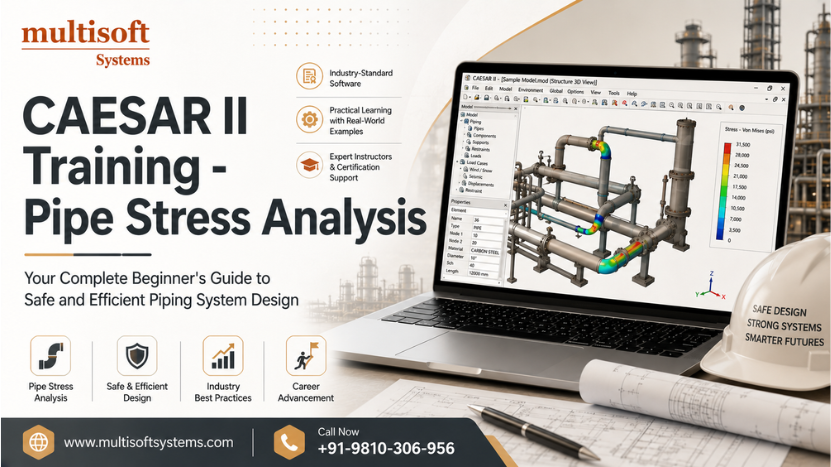
Beginner's Guide to CAESAR II Training - Pipe Stress Analysis
Industrial piping systems are essential for transporting liquids, gases, steam, and chemicals safely across various industries, including oil and gas, power generation, chemical processing, pharmaceuticals, manufacturing, and water treatment. These systems operate under high pressure, varying temperatures, and different environmental conditions, making their design and safety extremely important. Even a small design error can lead to pipe failure, equipment damage, production downtime, and costly repairs. This is why pipe stress analysis plays a vital role in modern engineering. CAESAR II Training - Pipe Stress Analysis helps engineers understand how piping systems respond to different operating conditions and enables them to design safe, reliable, and code-compliant pipelines.
By learning CAESAR II, professionals gain practical skills in analyzing thermal expansion, sustained loads, dynamic loads, support reactions, and equipment nozzle loads. This beginner's guide explains what CAESAR II is, why pipe stress analysis is important, its key features, industrial applications, career opportunities, and the benefits of learning this industry-leading engineering software.
What is CAESAR II?
CAESAR II is a leading pipe stress analysis and piping flexibility software widely used by mechanical and piping engineers to evaluate the structural behavior of piping systems under different operating conditions. It enables engineers to simulate real-world scenarios by analyzing factors such as internal pressure, pipe weight, thermal expansion, vibration, wind, seismic loads, and equipment movement. Instead of relying on complex manual calculations, CAESAR II provides accurate analysis, detailed engineering reports, and code compliance checks based on international standards such as ASME and API. The software helps identify excessive stress, pipe displacement, and equipment loading before construction begins, allowing engineers to optimize piping designs and improve plant safety. As a result, CAESAR II Training - Pipe Stress Analysis has become an essential skill for professionals involved in piping design, engineering, EPC projects, and industrial plant development.
What Does CAESAR II Analyze?
The software performs detailed analysis for:
- Pipe stress calculations
- Thermal expansion analysis
- Sustained load analysis
- Occasional load analysis
- Dynamic load analysis
- Equipment nozzle load evaluation
- Pipe support optimization
- Seismic analysis
- Wind load analysis
- Vibration analysis
- Expansion loop design
- Structural flexibility assessment
By identifying potential issues during the design phase, CAESAR II helps organizations reduce risks, improve safety, and avoid expensive modifications after installation.
Why Pipe Stress Analysis Matters
Every piping system experiences different types of forces during its operating life. Hot fluids cause pipes to expand, while cooling causes contraction. Internal pressure creates stress on pipe walls, and heavy equipment adds additional loads to connected piping. Environmental conditions such as earthquakes, wind, and vibration further increase these stresses.
Without proper pipe stress analysis, these forces can cause serious engineering problems.
Some common problems include:
- Pipe cracking
- Equipment nozzle failure
- Support damage
- Excessive pipe movement
- Leakage
- Fatigue failure
- Structural instability
- Plant shutdowns
- Increased maintenance costs
- Safety hazards
Pipe stress analysis helps engineers understand how piping systems behave under all operating conditions before they are installed.
-
Improves Plant Safety
Safety is the highest priority in every industrial facility. Pipe failures can release hazardous chemicals, steam, flammable gases, or toxic liquids. Stress analysis identifies weak areas in advance and helps engineers create safer designs.
-
Prevents Equipment Damage
Pipelines are connected to expensive equipment such as pumps, compressors, heat exchangers, boilers, turbines, and pressure vessels. Excessive piping loads can damage these machines.
CAESAR II calculates nozzle loads and ensures that connected equipment remains within acceptable design limits.
-
Reduces Maintenance Costs
Unexpected piping failures often require emergency shutdowns and expensive repairs.
Proper pipe stress analysis minimizes maintenance by improving the overall reliability of piping systems.
-
Ensures Compliance with Engineering Codes
Most industries require piping systems to follow international standards.
CAESAR II supports major piping codes including:
- ASME B31.1
- ASME B31.3
- ASME B31.4
- ASME B31.8
- BS Standards
- EN Standards
- API Standards
- Other international piping regulations
Compliance helps companies pass inspections and maintain operational safety.
-
Increases Design Accuracy
Manual calculations become difficult for complex piping networks.
CAESAR II automates stress calculations and generates detailed engineering reports, reducing human error while improving design quality.
-
Supports Better Decision Making
Engineers can compare multiple design options before construction.
This helps optimize:
- Pipe routing
- Support locations
- Expansion loops
- Spring supports
- Anchor positions
- Flexible connections
The result is a safer and more cost-effective piping system.
Key Features of CAESAR II
- Performs accurate pipe stress analysis for complex piping systems.
- Analyzes thermal expansion and contraction due to temperature changes.
- Evaluates sustained, operating, occasional, and dynamic loads.
- Supports major international piping codes, including ASME B31.1, ASME B31.3, ASME B31.4, and ASME B31.8.
- Calculates equipment nozzle loads for pumps, compressors, turbines, and vessels.
- Performs wind, seismic, and vibration analysis for safe piping design.
- Optimizes pipe support placement, including anchors, guides, and spring hangers.
- Identifies excessive pipe displacement, stress, and support reactions.
- Generates comprehensive engineering reports and code compliance documentation.
- Provides 3D piping modeling for accurate visualization and analysis.
- Integrates with other engineering and plant design software for efficient project workflows.
- Helps improve plant safety, reliability, and overall piping system performance.
Applications of CAESAR II
CAESAR II is widely used across industries where piping systems operate under high pressure, high temperatures, and challenging environmental conditions. It helps engineers design safe, reliable, and code-compliant piping systems by analyzing stress, flexibility, and structural integrity before installation.
-
Oil and Gas Industry
The oil and gas industry relies on extensive piping networks to transport crude oil, natural gas, refined products, and other hydrocarbons. CAESAR II helps engineers analyze pipe stress caused by pressure, temperature changes, and equipment loads, ensuring safe and efficient pipeline operations in refineries, offshore platforms, LNG plants, and pipeline networks.
-
Chemical Plants
Chemical processing facilities transport corrosive, toxic, and high-temperature fluids through complex piping systems. CAESAR II helps engineers design pipelines that can safely withstand thermal expansion, pressure fluctuations, and chemical process conditions, reducing the risk of leaks, equipment failure, and plant shutdowns.
-
Power Generation
Power plants use high-pressure steam, cooling water, and fuel pipelines that operate under extreme temperatures. CAESAR II performs detailed stress analysis to ensure these piping systems remain reliable during continuous operation, protecting boilers, turbines, heat exchangers, and other critical equipment.
-
Petrochemical Industry
Petrochemical plants contain large and highly interconnected piping systems that transport flammable and hazardous materials. CAESAR II evaluates pipe flexibility, thermal movement, and support requirements to improve safety, minimize maintenance, and ensure compliance with international engineering standards.
-
Pharmaceutical Industry
Pharmaceutical manufacturing requires highly accurate and hygienic piping systems for transporting purified water, chemicals, and process fluids. CAESAR II helps engineers design reliable piping networks that maintain structural integrity while meeting strict quality and safety requirements.
-
Food and Beverage Industry
Food and beverage production facilities depend on stainless steel piping systems for transporting liquids, steam, and cleaning solutions. CAESAR II analyzes pipe stress and thermal expansion to ensure safe operation, maintain hygiene standards, and reduce maintenance costs during production and cleaning processes.
-
Water Treatment Plants
Water treatment facilities use extensive piping systems for water distribution, filtration, wastewater processing, and pumping operations. CAESAR II helps engineers evaluate pressure loads, pipe movement, and support requirements, ensuring long-term reliability and efficient plant performance.
-
Marine and Offshore Projects
Ships, offshore oil platforms, and floating production facilities operate in constantly changing environmental conditions. CAESAR II analyzes the effects of vibration, equipment movement, wave motion, wind, and dynamic loads to design flexible piping systems that can perform safely in harsh marine environments.
-
Manufacturing Industries
Manufacturing plants rely on piping systems to transport compressed air, steam, cooling water, chemicals, and other process fluids essential for production. CAESAR II helps engineers optimize piping layouts, reduce stress on equipment, improve system reliability, and minimize downtime by ensuring the piping system performs safely under varying operating conditions.
Benefits of Learning CAESAR II Training - Pipe Stress Analysis
Learning CAESAR II Training - Pipe Stress Analysis provides valuable technical knowledge and practical skills that are highly sought after in the engineering industry. The training helps professionals understand how piping systems behave under different operating conditions, including pressure, temperature changes, vibration, and external loads. By mastering CAESAR II, engineers can accurately perform pipe stress analysis, optimize piping layouts, improve equipment safety, and ensure compliance with international engineering standards such as ASME. It also enhances problem-solving abilities by enabling engineers to identify potential design issues before construction, reducing costly modifications and plant downtime. Professionals with CAESAR II expertise are in demand across industries such as oil and gas, petrochemicals, power generation, pharmaceuticals, manufacturing, and EPC companies. Whether you are a student, mechanical engineer, or piping professional, learning CAESAR II Training - Pipe Stress Analysis can strengthen your technical expertise, improve career opportunities, increase earning potential, and prepare you to work confidently on complex industrial piping projects.
Career Opportunities After Learning CAESAR II Training - Pipe Stress Analysis
- Pipe Stress Engineer
- Piping Design Engineer
- Mechanical Engineer
- Piping Engineer
- Stress Analysis Engineer
- Pipeline Design Engineer
- Plant Design Engineer
- Process Plant Engineer
- EPC Design Engineer
- Static Equipment Engineer
- Project Engineer
- Plant Maintenance Engineer
- Piping Layout Engineer
- Mechanical Design Engineer
- Industrial Plant Engineer
- Offshore Piping Engineer
- Oil and Gas Design Engineer
- Power Plant Piping Engineer
- Chemical Plant Engineer
- Engineering Consultant for Piping Systems
Skills Required for CAESAR II Training - Pipe Stress Analysis
- Basic knowledge of Mechanical Engineering principles
- Understanding of Piping Engineering concepts
- Pipe Stress Analysis fundamentals
- Knowledge of Piping Materials and Components
- Thermal Expansion and Flexibility Analysis
- Static and Dynamic Load Analysis
- Pipe Support and Hanger Design
- Equipment Nozzle Load Evaluation
- Understanding of ASME B31 Codes and API Standards
- Pressure and Temperature Load Calculations
- 3D Piping Modeling Skills
- Engineering Drawing and Isometric Interpretation
- Problem-Solving and Analytical Skills
- Technical Report Preparation
- Familiarity with Industrial Plant Design
- Attention to Detail and Engineering Accuracy
- Basic Computer and Engineering Software Skills
- Teamwork and Communication Skills
- Project Documentation and Code Compliance
- Hands-on Experience with CAESAR II Software
Industry Trends in CAESAR II Training - Pipe Stress Analysis
The demand for professionals skilled in CAESAR II Training - Pipe Stress Analysis is increasing as industries focus on safer, more efficient, and code-compliant piping systems. Engineering companies are adopting advanced simulation software to improve design accuracy, reduce project risks, and optimize plant performance. With the growth of large-scale industrial projects, digital engineering, and stricter international safety standards, pipe stress analysis has become an essential part of modern plant design and maintenance.
Key Industry Trends
- Growing demand for skilled Pipe Stress Engineers across global industries.
- Increased adoption of digital engineering and 3D plant design technologies.
- Rising investment in oil and gas, petrochemical, and energy infrastructure projects.
- Greater focus on plant safety and international code compliance.
- Expansion of EPC (Engineering, Procurement, and Construction) projects worldwide.
- Modernization and revamping of existing industrial plants.
- Higher use of simulation software to improve design accuracy and reduce costs.
- Integration of CAESAR II with other piping and plant design tools.
- Increased emphasis on sustainable, reliable, and efficient piping systems.
- Growing demand for engineers with hands-on experience in pipe stress analysis software.
Best Practices for Learning and Using CAESAR II
- Build a strong foundation in piping engineering and mechanical engineering concepts.
- Learn the fundamentals of pipe stress analysis before using the software.
- Understand international piping codes such as ASME B31.1, ASME B31.3, and API standards.
- Practice with real-world piping projects and industry case studies.
- Create accurate 3D piping models using correct design inputs.
- Verify material properties, operating conditions, and load cases before analysis.
- Analyze thermal expansion, pressure loads, and support reactions carefully.
- Optimize pipe supports, anchors, guides, and spring hangers for better flexibility.
- Review stress reports and validate results before finalizing the design.
- Collaborate with piping, mechanical, structural, and process engineering teams.
- Stay updated with the latest CAESAR II features and engineering standards.
- Gain hands-on project experience to improve problem-solving and design skills.
- Document analysis results clearly for project reviews and compliance.
- Regularly practice software exercises to strengthen technical proficiency.
- Follow engineering best practices to ensure safe, reliable, and code-compliant piping systems.
Conclusion
CAESAR II Training - Pipe Stress Analysis is an excellent choice for engineers and professionals who want to build expertise in piping system design and stress analysis. The software enables users to evaluate pipe flexibility, thermal expansion, pressure loads, and equipment stresses while ensuring compliance with international engineering standards. By learning CAESAR II, professionals can improve plant safety, optimize piping designs, and reduce maintenance costs across various industries. Whether you are a student, mechanical engineer, or piping professional, mastering CAESAR II enhances your technical skills, expands career opportunities, and prepares you to contribute confidently to complex industrial engineering and EPC projects. Enroll in Multisoft Systems now!