Course Schedule
| Oct, 2026 | Weekdays | Mon-Fri | Enquire Now |
| Weekend | Sat-Sun | Enquire Now | |
| Nov, 2026 | Weekdays | Mon-Fri | Enquire Now |
| Weekend | Sat-Sun | Enquire Now |
Bentley AutoPIPE Training: Complete Guide to Piping Stress Analysis and Design
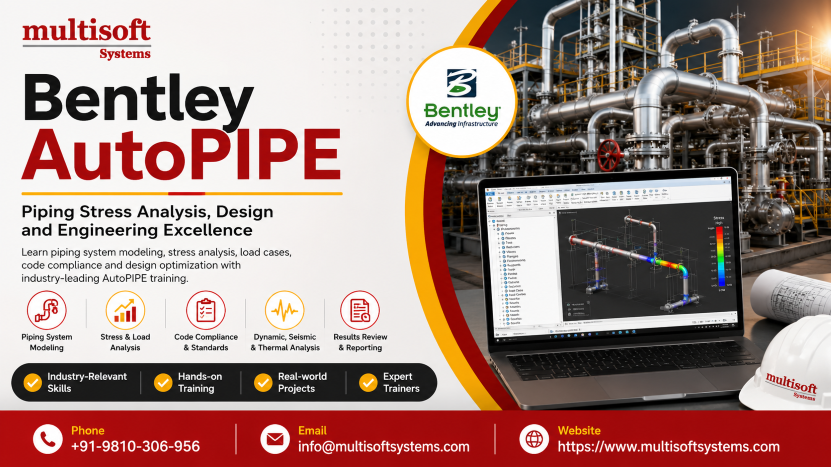
Piping systems are an essential part of many industrial facilities, including oil and gas plants, power generation facilities, water treatment plants, chemical industries, and other engineering projects. These systems must be designed to handle operating conditions such as temperature changes, pressure, weight, movement, wind, seismic activity, and other loads. A poorly analyzed piping system can create operational, safety, maintenance, and reliability challenges. This makes accurate piping stress analysis an important part of engineering design. Bentley AutoPIPE is a specialized engineering software tool used for the analysis and design of piping systems. It enables engineers to model piping networks and evaluate thermal, static, dynamic, and seismic effects. The software also supports different piping codes and analysis requirements used across engineering projects. Bentley AutoPIPE Training can help engineers and designers develop practical skills in piping system modeling, stress analysis, load cases, results interpretation, and design optimization. Multisoft Systems offers instructor-led online training with project-based learning, experienced trainers, practical case studies, and hands-on assignments.
This guide explains Bentley AutoPIPE in simple and professional English. It covers the software's fundamentals, major training topics, prerequisites, practical applications, career opportunities, learning challenges, and the importance of developing piping stress analysis skills.
What Is Bentley AutoPIPE?
Bentley AutoPIPE is an engineering software application used for piping system analysis and design. It helps engineers evaluate how piping systems respond to different operating and environmental loads. According to the Multisoft Systems course information, AutoPIPE is used in industries such as oil and gas, power generation, and water treatment and supports piping stress analysis involving thermal, static, dynamic, and seismic effects. In simple terms, engineers can use AutoPIPE to create a model of a piping system, define relevant properties and loads, perform analysis, review the results, and make informed design decisions.
The software can support analysis of:
- Pipe systems
- Valves
- Fittings
- Supports
- Loads
- Thermal expansion
- Static conditions
- Dynamic conditions
- Seismic effects
- Wind effects
- Offshore loading conditions
The objective is not simply to create a digital model. Engineers need to understand the engineering assumptions, loading conditions, applicable codes, and analysis results before making design decisions.
Why Is Piping Stress Analysis Important?
Piping systems are exposed to different forces and operating conditions throughout their service life. Temperature changes can cause pipes to expand or contract. Internal pressure can create additional stresses. The weight of pipes, valves, fittings, insulation, and contents also affects the system. External conditions such as wind and seismic activity can create additional loading. Piping stress analysis helps engineers study these effects and evaluate whether a piping design is suitable for its intended operating conditions.
Key Reasons for Piping Stress Analysis
- Evaluate stresses in piping systems
- Study thermal expansion and contraction
- Understand displacement
- Evaluate support loads
- Analyze different loading conditions
- Review dynamic behavior
- Consider wind and seismic effects
- Support compliance with applicable piping codes
- Identify potential design issues
- Improve piping system reliability
AutoPIPE provides tools that allow engineers to perform different types of piping analysis and review the resulting engineering information.
Why Learn Bentley AutoPIPE?
Learning Bentley AutoPIPE can help professionals develop specialized knowledge in piping stress analysis and engineering design. Modern engineering projects often require professionals who understand both engineering principles and specialized software tools. AutoPIPE training provides an opportunity to combine piping knowledge with software-based analysis. The Multisoft Systems training objectives include understanding the AutoPIPE interface, creating piping system models, performing static and dynamic analysis, applying industry codes and standards, optimizing piping designs, working with practical scenarios, solving engineering problems, and preparing for professional certification.
Major Benefits of Learning AutoPIPE
- Develop piping system modeling skills
- Understand piping stress analysis
- Learn static and dynamic analysis
- Study thermal effects
- Understand load distribution
- Work with piping codes
- Improve engineering problem-solving
- Practice real-world scenarios
- Develop reporting skills
- Strengthen professional expertise
Bentley AutoPIPE Training for Beginners
Beginners may initially find piping stress analysis challenging because it combines engineering principles, software functionality, loading conditions, and industry standards. A structured Bentley AutoPIPE Training program can make the learning process easier by introducing concepts gradually. The Multisoft Systems program covers modeling, dynamic analysis, piping codes, analysis, and input and results. It also includes practical applications and case studies.
Beginners can start by understanding:
- Basic piping systems
- Pipe components
- AutoPIPE interface
- Modeling methods
- Units and standards
- Loads and load cases
- Static analysis
- Dynamic analysis
- Code compliance
- Results interpretation
After understanding these fundamentals, learners can move toward more advanced analysis and practical engineering scenarios.
Who Should Learn Bentley AutoPIPE?
Bentley AutoPIPE Training can be useful for professionals and students working in piping design, stress analysis, pipeline assessment, and related engineering fields.
The Multisoft Systems target audience includes:
- Piping Engineers and Designers
- Structural Engineers
- Pipeline Engineers
- Mechanical Engineers
- Oil and Gas Professionals
- Power Plant Engineers
- Chemical and Process Engineers
- EPC Professionals
- QA/QC Engineers
- Maintenance Engineers
- Graduate Engineers
- Engineering Students
The training can be especially useful for professionals who want to combine engineering knowledge with specialized piping analysis software skills.
Common Bentley AutoPIPE Learning Challenges
Learning Bentley AutoPIPE can be challenging for beginners because piping stress analysis combines engineering concepts, software tools, loading conditions, and industry codes. A structured learning approach and regular practical practice can make these topics easier to understand.
-
Understanding Piping Stress Analysis
One of the first challenges is understanding concepts such as stress, strain, displacement, thermal expansion, pressure, and load distribution. Learners need to understand what these terms mean and how they affect a piping system before they can confidently interpret AutoPIPE analysis results.
-
Creating Accurate Piping Models
Building an accurate piping model requires attention to pipe geometry, components, supports, material properties, and operating conditions. Beginners may find it difficult to understand how real piping arrangements should be represented within the software. Regular practice with simple models can help learners gradually become comfortable with the modeling process.
-
Understanding Load Cases
Piping systems can experience several loads, including weight, pressure, temperature, wind, seismic, and dynamic loads. Understanding when and why different loads are applied can be challenging. Learners should focus on the engineering meaning of each load instead of simply learning software commands.
-
Working With Piping Codes
AutoPIPE supports various piping codes and standards. Beginners may find code requirements difficult because different projects can have different design requirements. Understanding the purpose of the applicable code and how it relates to analysis is important for developing reliable engineering skills.
-
Interpreting Analysis Results
Generating analysis results is only one part of the process. Engineers also need to understand stress values, displacement, support loads, natural frequencies, and other results. Learning to interpret these outputs correctly requires both software practice and engineering knowledge.
-
Learning Dynamic Analysis
Dynamic analysis can be more advanced than basic static analysis. Topics such as mode shapes, natural frequencies, harmonic loads, time-history analysis, and seismic effects may require additional study and practical examples.
How to Overcome These Challenges
- Start with basic piping and stress concepts.
- Practice simple piping models before complex systems.
- Learn one analysis method at a time.
- Understand the purpose of each load case.
- Study applicable piping codes.
- Practice interpreting results instead of only generating reports.
- Work on real-world scenarios and case studies.
- Use hands-on assignments to strengthen practical skills.
Bentley AutoPIPE Certification Preparation
Professionals interested in certification should build strong practical knowledge rather than relying only on memorization.
A useful preparation approach includes:
- Understand the AutoPIPE interface.
- Learn basic piping modeling.
- Practice components and supports.
- Understand units and standards.
- Study static analysis.
- Study dynamic analysis.
- Review piping codes.
- Practice different load conditions.
- Understand results.
- Practice reporting.
- Complete practical assignments.
- Attempt practice assessments.
Multisoft Systems provides an MCQ and short-answer assessment designed to test course understanding, analytical thinking, problem-solving, and communication skills. Its assessment features include a user-friendly interface, secure authentication, automated scoring, and time limits.
Career Opportunities After Bentley AutoPIPE Training
Bentley AutoPIPE skills can complement engineering knowledge and support career development in piping design and analysis.
Potential roles include:
- Piping Stress Engineer
- Piping Design Engineer
- Piping Engineer
- Mechanical Engineer
- Pipeline Engineer
- Structural Engineer
- Plant Engineer
- Piping Analysis Engineer
- Stress Analysis Professional
- Engineering Design Professional
Career opportunities depend on engineering qualifications, practical experience, software knowledge, project exposure, and industry requirements.
Learning AutoPIPE should therefore be viewed as a specialized technical skill that complements broader engineering expertise.
Industries Where Bentley AutoPIPE Is Relevant
- Oil and Gas
- Power Generation
- Water Treatment
- Chemical and Process Industries
- Offshore Engineering
- Engineering, Procurement and Construction (EPC)
- Petrochemical Industry
- Industrial Plant Engineering
- Pipeline Engineering
- Mechanical Engineering Projects
Why Choose Multisoft Systems for Bentley AutoPIPE Training?
Multisoft Systems provides instructor-led online Bentley AutoPIPE Training with a focus on practical and project-based learning. The published course highlights include instructor-led online training, project-based learning, certified and experienced trainers, course completion certification, customized learning schedules, and doubt-clearing sessions.
The training also emphasizes practical exposure through real-time scenarios, industry case studies, and hands-on assignments.
The curriculum covers major areas including:
- Modeling
- Dynamic analysis
- Piping codes
- Static analysis
- Wind loading
- Offshore analysis
- Input and results
- Reporting
- Practical applications
The program is designed for both beginners and experienced professionals who want to strengthen their AutoPIPE knowledge.
Corporate Bentley AutoPIPE Training
Organizations working on engineering and infrastructure projects may also require team-based training. Corporate training can help teams develop a common understanding of software workflows and engineering processes. Multisoft Systems provides customized training options where schedule, duration, and course material can be tailored according to organizational learning requirements.
Corporate learning can be useful for:
- Engineering teams
- Piping departments
- EPC organizations
- Oil and gas companies
- Power sector teams
- Design teams
- QA/QC teams
- Maintenance teams
The exact training structure can be aligned with the organization's project requirements and learner skill levels.
Future of Piping Stress Analysis
Engineering projects are becoming increasingly digital, while safety, reliability, compliance, and efficient design remain important priorities. Piping stress analysis will continue to require a combination of engineering knowledge, applicable codes, accurate modeling, and appropriate analysis tools. Professionals may increasingly work with integrated digital engineering environments, advanced analysis capabilities, automated workflows, and data-driven engineering processes. For piping engineers, developing software skills alongside core engineering knowledge can provide a broader technical foundation. Learning Bentley AutoPIPE can therefore be part of a professional development strategy for engineers working with piping design, stress analysis, and industrial projects.
Conclusion
Bentley AutoPIPE Training can help engineers and technical professionals develop specialized skills in piping system modeling, stress analysis, design evaluation, and engineering documentation. AutoPIPE supports the analysis of thermal, static, dynamic, seismic, wind, and other loading conditions, making it relevant to complex piping projects across industries such as oil and gas, power generation, water treatment, chemical processing, and EPC engineering. A strong learning path should combine software knowledge with fundamental engineering concepts, piping codes, practical modeling, load cases, analysis methods, and results interpretation. Multisoft Systems' training covers these areas through instructor-led online sessions, project-based learning, case studies, and hands-on assignments.
For piping engineers, designers, mechanical engineers, structural professionals, pipeline specialists, and engineering students, developing AutoPIPE skills can complement existing technical expertise. With consistent practice and a clear understanding of piping stress analysis principles, professionals can build a stronger foundation for working on modern piping design and analysis projects.