Course Schedule
| Oct, 2026 | Weekdays | Mon-Fri | Enquire Now |
| Weekend | Sat-Sun | Enquire Now | |
| Nov, 2026 | Weekdays | Mon-Fri | Enquire Now |
| Weekend | Sat-Sun | Enquire Now |
CCSP Explained: A Complete Guide to Cloud Security Skills and Certification
Cloud computing has changed the way organizations store data, run applications, and deliver digital services. As businesses move more workloads to cloud platforms, protecting cloud environments has become an important responsibility for security and IT professionals. Cloud security requires more than understanding passwords, firewalls, or traditional network protection. Professionals need to understand cloud architecture, data protection, access management, risk management, application security, and the shared responsibility model. The Certified Cloud Security Professional (CCSP) is a well-known professional credential for people who want to develop specialized knowledge in cloud security. It focuses on practical security concepts that apply to modern cloud environments and helps professionals strengthen their understanding of how security should be planned and managed in the cloud. For individuals looking to build these skills, Certified Cloud Security Professional Training can provide structured learning across important cloud security areas.
Multisoft Systems offers training designed to help learners understand the concepts and skills needed to work more confidently with cloud security requirements.
What Is CCSP?
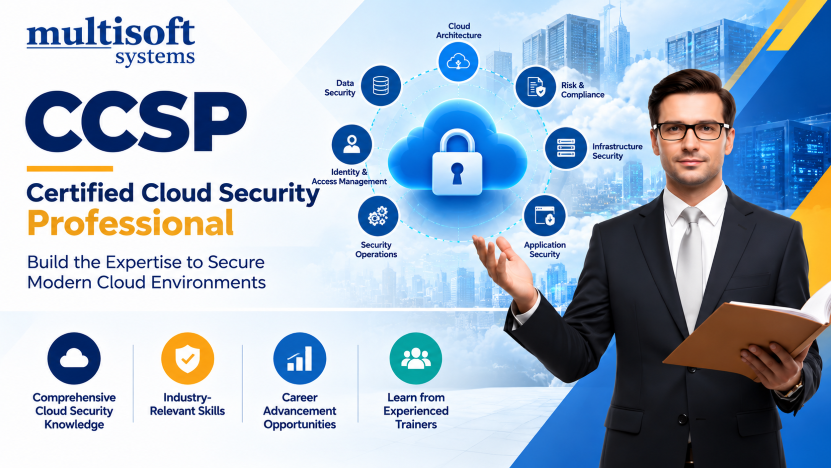
CCSP stands for Certified Cloud Security Professional, a professional certification focused on securing cloud-based environments. It helps professionals understand important areas such as cloud architecture, data protection, identity and access management, infrastructure security, application security, governance, risk, and security operations. Unlike certifications focused on one specific cloud provider, CCSP covers security principles that can be applied across different cloud environments. It is relevant for cybersecurity professionals, cloud architects, security engineers, IT managers, and other professionals involved in cloud security. Structured CCSP training can help learners develop a clear understanding of these concepts and prepare for cloud security responsibilities.
Why Is CCSP Important for Cloud Security Professionals?
Cloud environments introduce security considerations that may not exist in the same form within traditional IT infrastructure. Organizations need to understand where their data is stored, who can access it, how workloads are protected, and how security responsibilities are divided between the cloud provider and the customer. A strong cloud security professional must be able to evaluate these areas and make appropriate security decisions. CCSP provides a structured framework for learning these concepts. It can help professionals understand how security controls relate to cloud architecture, data, applications, infrastructure, and operational processes. For organizations, professionals with cloud security knowledge can contribute to security planning, risk assessment, compliance activities, cloud migration projects, and ongoing security operations.
What Does Certified Cloud Security Professional Training Cover?
A structured CCSP training program generally focuses on the major areas of knowledge required to understand and manage cloud security. Important learning areas include:
- Cloud concepts, architecture, and design
- Cloud governance and risk management
- Legal, regulatory, and compliance considerations
- Cloud data security
- Data lifecycle and information protection
- Cloud platform and infrastructure security
- Application security
- Identity and access management
- Security operations
- Business continuity and disaster recovery
- Incident response
- Security monitoring
- Cloud security controls and best practices
The goal is not simply to memorize security terms. Effective learning should help professionals understand why a particular security control is required and how it can be applied in a real cloud environment.
Understanding Cloud Architecture and Security
Cloud architecture is one of the foundations of cloud security. Before implementing security controls, professionals need to understand how cloud services, applications, networks, storage, and computing resources are organized. CCSP learning introduces concepts related to cloud infrastructure and architectural design so that professionals can identify potential security requirements at different levels. Learners can also develop an understanding of virtualization, cloud service models, deployment models, and security considerations associated with different cloud architectures. This knowledge can be useful when reviewing an existing environment or planning security requirements for a new cloud implementation.
Cloud Data Security and Protection
Data is one of the most important assets that organizations need to protect in cloud environments. Cloud security professionals must understand how data is created, stored, processed, transferred, archived, and eventually removed. Data security involves appropriate classification, access controls, encryption, retention practices, and protection throughout the data lifecycle. CCSP-focused learning helps professionals understand how security requirements can be applied to cloud data and how organizations can reduce the risk of unauthorized access or inappropriate data handling. These skills are particularly relevant for organizations dealing with sensitive business, financial, customer, or employee information.
Identity and Access Management
Controlling who can access cloud resources is a central part of security. Identity and access management helps organizations ensure that users, applications, and services receive only the access they actually require. Professionals learning CCSP concepts can develop knowledge of authentication, authorization, access policies, privileged access, and identity-related security practices. Understanding these concepts can help organizations reduce unnecessary permissions and improve control over cloud resources. Strong identity management also supports broader security strategies because unauthorized access can expose applications, systems, and sensitive information.
Cloud Platform and Infrastructure Security
Cloud infrastructure includes computing resources, storage, networks, virtual environments, and other technical components. Security professionals need to understand how these components can be protected and monitored. Training can help learners explore infrastructure security concepts, secure configurations, network controls, vulnerability management, and other measures used to protect cloud platforms. This knowledge is useful when working with cloud migration, infrastructure management, security assessment, or cloud operations teams.
Application Security in Cloud Environments
Applications running in the cloud can face risks throughout their development and deployment lifecycle. Security therefore needs to be considered from design through development, testing, deployment, and maintenance. CCSP-related learning can help professionals understand secure application development principles, application vulnerabilities, testing approaches, and security controls. It also highlights the importance of integrating security into development and deployment processes rather than treating it as a final step after an application has already been released.
Security Operations and Incident Response
Cloud security does not end once controls have been implemented. Organizations need to monitor their environments, identify unusual activity, respond to incidents, and maintain security over time. Security operations involve monitoring, logging, incident handling, vulnerability management, and recovery procedures. CCSP training can help professionals understand how operational security processes support cloud environments. Learning about incident response can also help security teams prepare for situations such as unauthorized access, data exposure, service disruption, or other security events.
What Skills Can You Develop Through CCSP Training?
A well-structured Certified Cloud Security Professional Training program can help professionals develop several practical skills, including
- Understanding cloud security architecture
- Identifying cloud security risks
- Applying data protection principles
- Understanding identity and access controls
- Evaluating cloud infrastructure security
- Supporting secure application development
- Understanding governance and compliance requirements
- Planning security operations
- Supporting incident response activities
- Understanding business continuity requirements
- Evaluating security controls
- Communicating cloud security requirements with technical and business teams
These skills can be useful across security, cloud, infrastructure, compliance, and risk-related roles.
Who Should Consider CCSP Training?
CCSP can be relevant to professionals who already work in IT, cybersecurity, cloud computing, or information security and want to strengthen their cloud security knowledge. Suitable learners may include:
- Cloud security professionals
- Cybersecurity professionals
- Security engineers
- Security architects
- Cloud architects
- Network security professionals
- Systems administrators
- IT managers
- Security consultants
- Risk and compliance professionals
- Cloud administrators
- IT professionals involved in cloud migration
Professionals who are moving from traditional infrastructure roles into cloud-focused positions may also find cloud security training useful for building the knowledge required in modern IT environments.
CCSP Training Online for Working Professionals
CCSP Training Online can be a practical learning option for professionals who need flexibility while developing new skills. Online instructor-led training allows learners to attend sessions from their preferred location and interact with trainers during the learning process. This can be particularly useful for working professionals who cannot attend regular classroom sessions. A structured online program can combine theoretical concepts with practical examples, discussions, assessments, and security scenarios. Learners can gradually build their understanding of cloud security while continuing their existing professional responsibilities. Multisoft Systems provides online training options designed to help professionals study cloud and security technologies in a structured environment.
CCSP Certification and Professional Development
The CCSP Certification can support professional development by demonstrating structured knowledge of cloud security concepts. However, certification should not be viewed as a replacement for practical experience. Cloud security professionals also need to understand how security controls work in real environments and how they relate to organizational requirements. Combining certification preparation with hands-on learning, cloud platform exposure, security projects, and practical problem-solving can create a stronger professional profile. For professionals already working in cybersecurity or cloud computing, developing cloud security knowledge can also complement existing technical certifications and experience.
Career Opportunities After CCSP
Cloud security skills can support several career paths as organizations continue to rely on cloud infrastructure and services. Depending on experience and technical background, professionals may explore roles such as:
- Cloud Security Engineer
- Cloud Security Architect
- Cloud Architect
- Cybersecurity Engineer
- Information Security Analyst
- Security Consultant
- Security Architect
- Cloud Compliance Specialist
- Risk and Compliance Professional
- Security Operations Professional
- Cloud Infrastructure Security Specialist
- Information Security Manager
Career opportunities vary according to experience, technical skills, industry requirements, and the technologies used by individual organizations. Practical cloud knowledge alongside security expertise can be especially valuable for professionals working on cloud transformation projects.
How to Prepare for CCSP Certification
Preparing for CCSP requires a clear understanding of the certification topics and consistent study. Start by becoming familiar with the major security domains and identifying areas where your existing knowledge is strong or needs improvement. Build your understanding of cloud architecture, data protection, access management, governance, infrastructure security, application security, and operations. Practice applying concepts to real-world security situations rather than relying only on memorization. Mock questions and practice assessments can also help identify weak areas and improve time management. Professionals should also keep their knowledge connected to practical cloud security because real-world understanding makes technical concepts easier to apply.
Why Choose Multisoft Systems for Cloud Security Training?
Multisoft Systems provides structured technology training for professionals looking to develop practical knowledge in areas such as cloud computing and cybersecurity. A focused learning environment can help participants understand complex security concepts in a more organized way and connect theoretical topics with practical business situations. For professionals preparing for CCSP, structured training can provide a clear learning path covering cloud architecture, data security, infrastructure protection, application security, governance, and security operations. The right training approach should focus not only on examination preparation but also on building an understanding that can be applied to real cloud security responsibilities.
Frequently Asked Questions About CCSP
What is CCSP?
CCSP stands for Certified Cloud Security Professional. It is a professional certification focused on cloud security knowledge, including architecture, data security, infrastructure, application security, governance, and security operations.
Is CCSP useful for cloud security professionals?
Yes. CCSP can help professionals demonstrate structured knowledge of cloud security concepts and support their professional development in cloud and cybersecurity-related roles.
What does CCSP Training cover?
CCSP training covers areas such as cloud architecture, governance, risk and compliance, data security, platform and infrastructure security, application security, and security operations.
Is CCSP Training Online available?
Yes. Online learning is a flexible option for professionals who want to study cloud security while continuing their regular work responsibilities.
Who should take CCSP Training?
Cloud security professionals, cybersecurity specialists, cloud architects, security engineers, IT managers, consultants, and professionals involved in cloud migration or security operations can consider CCSP training.
Can CCSP help with career development?
CCSP can support professional development by demonstrating knowledge of cloud security. Career progression also depends on practical experience, technical skills, education, and the requirements of individual employers.
Conclusion
Cloud security has become an important part of modern IT as organizations continue to use cloud platforms for applications, infrastructure, storage, and business services. Professionals need a strong understanding of architecture, data protection, identity management, infrastructure security, application security, governance, and security operations to address these challenges effectively. The Certified Cloud Security Professional (CCSP) provides a structured way to develop and demonstrate knowledge in these areas. Certified Cloud Security Professional Training can make the learning process more organized by covering important concepts and connecting them with practical security situations. For professionals planning to strengthen their cloud security expertise, CCSP can be a valuable addition to their professional development journey.
Multisoft Systems can help learners build a structured foundation in cloud security concepts and prepare for the skills required in today's cloud-focused technology environment.