Course Schedule
| Oct, 2026 | Weekdays | Mon-Fri | Enquire Now |
| Weekend | Sat-Sun | Enquire Now | |
| Nov, 2026 | Weekdays | Mon-Fri | Enquire Now |
| Weekend | Sat-Sun | Enquire Now |
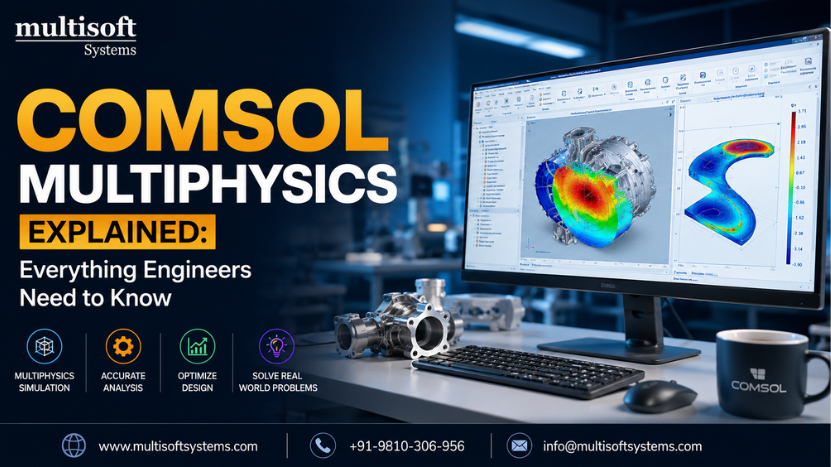
COMSOL Multiphysics Explained: Everything Engineers Need to Know
Engineering innovation today depends on the ability to design, test, and optimize products quickly while minimizing development costs and reducing the need for repeated physical prototypes. As products become more advanced, engineers must analyze multiple physical phenomena—such as heat transfer, fluid flow, structural mechanics, electromagnetics, and chemical reactions—that often occur simultaneously. Traditional testing methods alone are no longer sufficient to meet these challenges, making simulation-driven engineering an essential part of modern product development. COMSOL Multiphysics is one of the industry's leading simulation platforms that enables users to accurately model and analyze complex systems in a virtual environment before manufacturing or implementation. The software provides an integrated platform for multiphysics simulation, allowing users to combine different engineering disciplines within a single model for more realistic and reliable results. From designing efficient electronic devices and renewable energy systems to optimizing biomedical equipment and industrial processes, COMSOL Multiphysics supports innovation across a wide range of industries and research domains.
This comprehensive guide provides an in-depth overview of COMSOL Multiphysics, covering its core features, architecture, physics modules, simulation workflow, applications, implementation process, advantages, challenges, industry use cases, career opportunities, and future trends. Whether you are a student, researcher, design engineer, or experienced simulation professional, this article will help you understand how COMSOL Multiphysics can improve engineering analysis, accelerate product development, and support smarter decision-making through advanced numerical simulation.
What is COMSOL Multiphysics?
COMSOL Multiphysics Training is a powerful simulation software platform that enables engineers, researchers, and scientists to model, simulate, and analyze complex physical systems using numerical methods, primarily the Finite Element Method (FEM). It provides a unified environment where multiple physical phenomena—such as structural mechanics, heat transfer, fluid flow, electromagnetics, acoustics, chemical reactions, and electrical analysis—can be coupled and solved simultaneously within a single model. This multiphysics capability allows users to study how different physical processes interact in real-world products and systems, resulting in more accurate simulations and better engineering decisions. COMSOL Multiphysics offers advanced tools for geometry creation, material selection, meshing, solver configuration, visualization, optimization, and result analysis, making it suitable for product design, research, testing, and innovation. Widely adopted across industries including aerospace, automotive, biomedical, energy, electronics, manufacturing, and academia, COMSOL Multiphysics helps organizations reduce development costs, minimize physical prototyping, improve product performance, and accelerate time-to-market through reliable virtual simulation.
Key Features of COMSOL Multiphysics
- Multiphysics simulation in a single environment
- Finite Element Analysis (FEA)
- Computational Fluid Dynamics (CFD)
- Structural mechanics simulation
- Heat transfer analysis
- Electromagnetic modeling
- Chemical reaction engineering
- Acoustics simulation
- Advanced meshing capabilities
- Powerful solver technology
- Parametric and optimization studies
- Time-dependent and steady-state analysis
- CAD import and integration
- LiveLink integration with MATLAB®, Excel®, and CAD software
- Application Builder for custom simulation apps
- Interactive 2D and 3D visualization
- Extensive material library
- Custom physics interfaces
- Automated report generation
- Cloud-based simulation support
Core Components of COMSOL Multiphysics
COMSOL Multiphysics consists of several integrated components that work together to create accurate engineering simulations. From designing the geometry and selecting materials to defining physics, generating meshes, solving equations, and analyzing results, each component plays a vital role in the simulation workflow. The software provides a structured environment where users can easily build models, customize parameters, perform advanced calculations, and visualize simulation outcomes. These core components simplify complex engineering analyses while enabling seamless multiphysics coupling within a single platform.
Core Components:
- Model Builder
- Geometry
- Materials
- Physics Interfaces
- Definitions
- Parameters
- Variables
- Functions
- Mesh
- Study
- Solver
- Results
- Application Builder
- File Management
- Report Generator
- Optimization Tools
- Postprocessing Tools
COMSOL Multiphysics Implementation Process
Successfully implementing COMSOL Multiphysics requires a structured workflow that ensures accurate simulation results, efficient model development, and reliable engineering decisions. From defining project objectives to continuously improving simulation models, every stage contributes to the overall success of the engineering analysis. A systematic implementation process helps organizations reduce design risks, minimize development costs, and accelerate product innovation while ensuring high-quality simulation outcomes.
1. Project Planning
Project planning is the foundation of every successful COMSOL Multiphysics implementation. During this phase, engineers clearly define the objectives of the simulation, identify the engineering problem to be solved, determine project requirements, and establish performance goals. Users also select the appropriate COMSOL modules, gather design specifications, collect material properties, and identify boundary conditions before building the simulation model. Proper planning minimizes errors and ensures the project stays aligned with business and engineering objectives.
2. Model Development
Once the project requirements are finalized, the simulation model is developed using COMSOL's Model Builder. Engineers create the geometry of the physical system, define dimensions, assign material properties, and configure the relevant physics interfaces. Parameters, variables, and mathematical functions are also added to represent real-world conditions accurately. Depending on the application, multiple physics interfaces such as structural mechanics, heat transfer, fluid flow, or electromagnetics can be coupled within the same model to simulate complex interactions.
3. Simulation Setup
The simulation setup stage involves preparing the model for numerical analysis. Engineers define boundary conditions, initial conditions, loads, constraints, heat sources, fluid properties, electrical inputs, or other application-specific parameters. A suitable mesh is then generated to divide the geometry into finite elements for computation. Finally, users configure the study type, solver settings, and analysis method, such as stationary, time-dependent, frequency-domain, or parametric studies, based on the project requirements.
4. Validation
Validation ensures that the simulation accurately represents real-world behavior. Engineers compare simulation results with experimental data, theoretical calculations, industry standards, or previously validated models to verify accuracy. If discrepancies are found, adjustments are made to the geometry, material properties, mesh quality, boundary conditions, or solver settings until the results closely match expected outcomes. This stage is critical for building confidence in the simulation before applying it to product development or research.
5. Optimization
After validating the model, engineers perform optimization to improve product performance and operational efficiency. COMSOL Multiphysics provides optimization tools that allow users to modify design parameters, evaluate multiple design alternatives, and identify the best-performing solution. Optimization helps reduce material usage, improve structural strength, enhance thermal performance, minimize energy consumption, and achieve better overall product reliability without the need for repeated physical testing.
6. Documentation
Proper documentation is essential for maintaining project transparency and supporting future engineering activities. Engineers document simulation objectives, modeling assumptions, geometry specifications, material properties, boundary conditions, solver configurations, validation methods, and final results. COMSOL Multiphysics also provides automated reporting features that generate professional reports containing images, graphs, equations, simulation settings, and conclusions. Well-maintained documentation improves collaboration, simplifies project reviews, and supports regulatory compliance.
7. Deployment
Once the simulation has been verified and optimized, it can be deployed for practical engineering use. The validated model may be used in product design, manufacturing optimization, research projects, quality improvement, or digital twin applications. COMSOL's Application Builder allows engineers to convert complex simulation models into user-friendly applications that can be shared with colleagues, customers, or non-technical users without requiring extensive simulation expertise. This enables organizations to extend simulation capabilities across multiple departments.
8. Continuous Improvement
Simulation models should be continuously reviewed and refined as new engineering data, product designs, and business requirements emerge. Engineers regularly update material properties, optimize mesh quality, improve solver performance, incorporate customer feedback, and validate models using new experimental results. Continuous improvement ensures that simulation models remain accurate, reliable, and aligned with evolving technologies and industry standards. It also helps organizations maximize the long-term value of COMSOL Multiphysics by supporting innovation, reducing development cycles, and improving future engineering projects.
COMSOL Multiphysics Architecture
COMSOL Multiphysics is built on a modular and scalable software architecture that enables engineers and researchers to perform advanced numerical simulations efficiently. The architecture integrates geometry creation, material modeling, physics interfaces, mesh generation, solver technology, and visualization into a unified simulation platform. At its core, the software uses the Finite Element Method (FEM) to solve complex engineering problems involving multiple interacting physical phenomena. The architecture supports seamless multiphysics coupling, allowing users to combine structural mechanics, fluid flow, heat transfer, electromagnetics, acoustics, and other physics within a single model. It also includes advanced solver engines, optimized memory management, high-performance computing support, cloud deployment options, and integration with CAD tools, MATLAB®, and other third-party applications. This flexible architecture ensures accurate simulations, faster computation, and efficient model management for both industrial and research applications.
Common Challenges in COMSOL Modeling
Although COMSOL Multiphysics provides powerful simulation capabilities, users may encounter several challenges during model development. One of the most common issues is creating an appropriate mesh, as poor mesh quality can significantly affect simulation accuracy and increase computation time. Selecting incorrect material properties or defining improper boundary conditions may also produce unrealistic results. Complex multiphysics models often require significant computational resources, leading to longer simulation times and higher memory consumption. Solver convergence problems, nonlinear behavior, geometry import errors, and incorrect physics coupling can further complicate simulations. Additionally, validating simulation results against experimental data is essential to ensure model reliability. Careful planning, proper model setup, and regular verification are crucial for overcoming these challenges and achieving accurate engineering simulations.
Best Practices for Accurate Simulation
- Clearly define simulation objectives before modeling.
- Use accurate geometry and dimensions.
- Select appropriate physics interfaces.
- Assign correct material properties.
- Apply realistic boundary conditions.
- Generate a high-quality mesh.
- Perform mesh independence studies.
- Validate models with experimental data.
- Optimize solver settings.
- Use appropriate study types.
- Simplify unnecessary geometry whenever possible.
- Verify units and parameter values.
- Review simulation assumptions carefully.
- Perform sensitivity analysis.
- Document every simulation step.
- Analyze results using multiple visualization methods.
- Optimize computational resources.
- Continuously refine and improve models.
Career Opportunities in COMSOL Multiphysics
The growing adoption of simulation-driven engineering has created excellent career opportunities for professionals skilled in COMSOL Multiphysics. Industries such as aerospace, automotive, electronics, energy, biomedical engineering, telecommunications, manufacturing, and research organizations actively seek engineers who can perform advanced multiphysics simulations and optimize product designs. Professionals with COMSOL expertise can pursue roles such as Simulation Engineer, CAE Engineer, FEA Engineer, CFD Engineer, Research Scientist, Product Design Engineer, Application Engineer, R&D Engineer, Computational Scientist, and Engineering Consultant. As digital engineering, Industry 4.0, and virtual prototyping continue to expand, COMSOL Multiphysics professionals enjoy strong career growth, competitive salaries, and opportunities to work on innovative engineering projects worldwide.
COMSOL Multiphysics Certification Guide
Earning a COMSOL Multiphysics certification demonstrates your ability to perform advanced engineering simulations and apply multiphysics modeling techniques to solve real-world problems. A structured certification program typically covers geometry creation, material selection, physics setup, meshing, solver configuration, postprocessing, optimization, and application development. Hands-on projects and practical exercises help learners develop industry-ready skills while strengthening their understanding of finite element analysis and multiphysics simulation. Certification enhances professional credibility, improves employment opportunities, and validates expertise for engineering, research, and product development roles. Preparing through instructor-led training and practical project work significantly increases confidence and technical proficiency.
Why Learn COMSOL?
Learning COMSOL Multiphysics equips engineers, researchers, and students with one of the most powerful simulation tools used across multiple industries. The software enables users to analyze complex engineering problems, reduce physical prototyping costs, optimize product performance, and accelerate innovation through virtual testing. Its ability to combine multiple physics within a single simulation makes it highly valuable for solving real-world engineering challenges that cannot be addressed using traditional analysis methods alone. As organizations increasingly adopt simulation-driven product development and digital engineering practices, professionals with COMSOL expertise are becoming highly sought after. Mastering COMSOL Multiphysics not only enhances technical knowledge but also opens doors to rewarding careers in design, research, manufacturing, renewable energy, biomedical engineering, electronics, and advanced product development.
Conclusion
COMSOL Multiphysics has revolutionized engineering simulation by providing a unified platform for modeling and analyzing complex physical systems across multiple engineering disciplines. Its advanced multiphysics capabilities, powerful Finite Element Analysis (FEA) engine, intuitive interface, and extensive application modules enable organizations to improve product quality, reduce development costs, minimize physical prototyping, and accelerate innovation. Whether used in aerospace, automotive, electronics, biomedical engineering, energy, or manufacturing, COMSOL Multiphysics helps engineers make informed design decisions through accurate and reliable simulations.
For professionals looking to build expertise in this leading simulation software, Multisoft Systems offers an industry-oriented COMSOL Multiphysics Online Training program designed by experienced professionals. The course combines live instructor-led sessions, hands-on projects, real-world engineering case studies, and practical assignments to help learners master simulation techniques and prepare for successful careers. With flexible learning schedules, expert guidance, and certification support, Multisoft Systems empowers students and working professionals to develop job-ready skills and stay competitive in the rapidly evolving field of engineering simulation and product development.