Course Schedule
| Oct, 2026 | Weekdays | Mon-Fri | Enquire Now |
| Weekend | Sat-Sun | Enquire Now | |
| Nov, 2026 | Weekdays | Mon-Fri | Enquire Now |
| Weekend | Sat-Sun | Enquire Now |
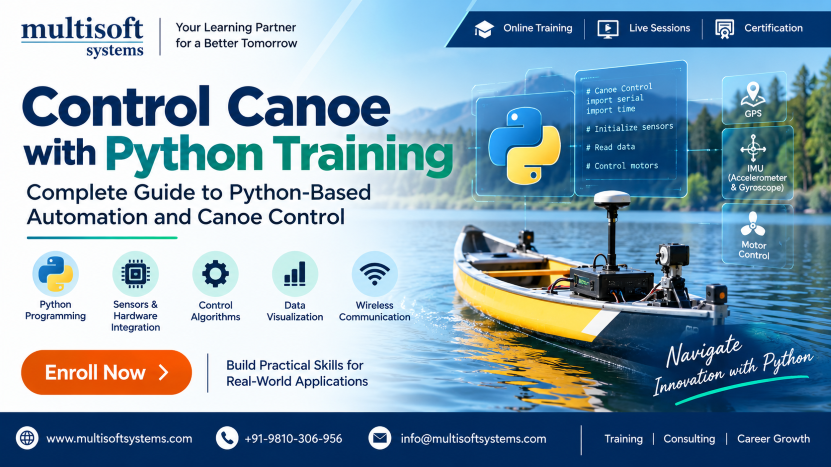
Control Canoe with Python Training: Complete Guide to Python-Based Automation and Canoe Control
Python is widely used for programming, automation, data handling and intelligent control applications. When combined with sensors, hardware components and control mechanisms, Python can also be applied to build systems that monitor and control physical devices. Control Canoe with Python Training introduces learners to this practical combination of Python programming, hardware interfacing and automated control.
The training offered by Multisoft Systems covers Python fundamentals along with sensors, hardware integration, canoe dynamics, control algorithms, testing and advanced applications. The program follows a project-based learning approach so participants can connect programming concepts with practical control scenarios.
What Is Control Canoe with Python?
Control Canoe with Python Training involves using Python programming to interact with sensors, microcontrollers, motors and other hardware components that can support automated canoe control. The approach combines software development with physical control systems. The course introduces learners to Python syntax, variables, data types, control structures, functions and modules before moving toward hardware-oriented concepts. Participants can learn how Python receives information from sensors and uses that information to send commands to actuators or motors. The objective is not only to understand Python as a programming language but also to explore how programming logic can be connected with real-world control applications.
Why Learn Python for Canoe Control?
Python provides a relatively accessible programming environment for developing control logic and working with data. In a hardware-based application, Python can be used to process sensor information and make decisions based on changing conditions. For canoe control applications, this can include monitoring orientation, tracking location or responding to changes detected by sensors. The Multisoft Systems course specifically introduces sensors such as gyroscopes, accelerometers and GPS along with motors and actuators.
Learning this combination can help participants understand several important concepts:
- Python programming fundamentals
- Hardware and software interaction
- Sensor data collection
- Actuator control
- Automation logic
- Control algorithms
- Testing and iteration
- Real-time monitoring
- Wireless communication
- Data visualization
What Will You Learn in Control Canoe with Python Training?
The training is structured into multiple modules that gradually move from Python fundamentals to practical control applications.
1. Introduction to Control Canoe with Python
The introductory module establishes the goals and scope of the training. Learners are introduced to canoe control concepts and basic water dynamics while also understanding why Python can be useful for hardware control. Safety is another important part of this stage because physical control systems need to be tested carefully. Learners are introduced to safety precautions and guidelines before progressing to practical activities.
2. Python Programming Basics
A strong understanding of Python is important before developing control applications. The course covers basic Python syntax, variables, data types and control structures. Participants also learn about functions and modules. These concepts help learners create reusable code and organize larger applications more effectively. The course objectives specifically include Python basics, control structures, functions and modules along with data handling and object-oriented programming.
3. Sensors and Hardware
Sensors provide important information to a control system. In the course curriculum, learners explore devices such as gyroscopes, accelerometers and GPS. They also learn about motors and actuators that can be used for controlling paddles or rudders. The module introduces microcontroller integration using platforms such as Raspberry Pi or Arduino. This section helps learners understand how physical hardware can provide input to a Python program and how software can respond to that input.
4. Interfacing Python with Hardware
Hardware interfacing is an important part of developing automated control applications. Participants learn how Python can retrieve information from hardware and send commands to connected components. The curriculum includes working with GPIO pins on Raspberry Pi, reading sensor data and sending commands to actuators or motors. This practical knowledge can help learners understand the complete flow from sensor input to software processing and physical output.
Understanding Canoe Dynamics
Programming alone is not enough when developing a control system for a moving object. Learners also need to understand how the object reacts to forces and changes in its environment. The course includes canoe dynamics covering basic fluid dynamics, buoyancy, movement and steering mechanisms. These concepts provide context for developing a control algorithm that responds appropriately to changes in the canoe's position or direction. Understanding these fundamentals can make the programming logic more meaningful because learners can connect software decisions with physical movement.
Building a Python Control Algorithm
One of the practical stages of the course involves building a control algorithm. Learners can develop Python scripts that use sensor inputs to influence canoe control. The curriculum covers detecting changes in orientation and responding to those changes. It also introduces automatic course correction and safety mechanisms such as capsizing prevention and collision avoidance.
A simplified control process can be understood as:
Sensor Input → Python Processing → Decision Logic → Actuator Command → Movement → New Sensor Input
This type of feedback loop is fundamental to many automated control systems. It also helps learners understand how software and hardware can work together continuously.
Testing and Iteration
Testing is essential for any physical automation project. A control algorithm may behave differently when exposed to real-world conditions than it does during initial development. The course includes dry testing before water-based testing. Participants can then progress toward controlled water testing in a safe environment such as a swimming pool before considering open-water testing with appropriate safety precautions. This approach encourages learners to identify problems early, refine their algorithms and improve system behavior step by step.
Advanced Topics in Python-Based Control
After covering the fundamentals, the training introduces advanced topics that can expand the capabilities of a control system. The curriculum includes the use of artificial intelligence and machine learning for predictive canoe control. It also covers building a user interface for real-time control and data visualization. Wireless communication for remote control is another advanced area included in the course. These topics demonstrate how a basic control application can be expanded into a more interactive and intelligent system.
Importance of Hands-On Learning
Hands-on practice is particularly valuable when learning a subject that combines programming with hardware. Reading Python concepts is useful but applying those concepts to sensors, motors and control systems provides a deeper understanding. Project-based activities allow learners to work through practical challenges such as sensor readings, actuator commands, control decisions and testing. Multisoft Systems highlights project-based learning and practical application as part of its training approach.
Practical learning can help participants improve:
- Programming confidence
- Hardware interfacing skills
- Logical thinking
- Troubleshooting abilities
- Control-system understanding
- Project development skills
Who Should Take Control Canoe with Python Training?
This training can be useful for learners and professionals interested in Python programming, automation and hardware-based applications.
It may be suitable for:
- Python developers
- Automation professionals
- Embedded system learners
- Engineering students
- Electronics professionals
- Robotics enthusiasts
- IoT professionals
- Software developers
- Hardware automation learners
- Professionals interested in control systems
Learners who want to combine software programming with physical systems can particularly benefit from the practical structure of the program.
Prerequisites for the Training
The course page focuses on Python fundamentals and progressively introduces hardware and control concepts. Learners can begin with programming basics before moving into more practical areas such as sensors, microcontrollers and control algorithms. A basic interest in programming and automation can make the learning process easier. Familiarity with Python is helpful but the course itself covers foundational Python topics including syntax, variables, data types, control structures, functions and modules.
Career Relevance of Python and Automation Skills
Python skills are applicable across software development, automation, data science and other technical domains. The training combines these programming capabilities with hardware interfacing and control concepts.
Learners can use the knowledge gained from such a program as a foundation for exploring broader areas such as:
- Python automation
- Embedded programming
- Robotics
- IoT development
- Hardware control
- Sensor-based applications
- Automation testing
- Data visualization
- Intelligent control systems
Career outcomes depend on an individual's existing skills, experience and ability to apply the knowledge in practical projects.
Why Choose Multisoft Systems for Control Canoe with Python Training?
Multisoft Systems offers instructor-led online training supported by project-based learning and experienced trainers. The course includes a completion certificate along with lifetime e-learning access and after-training support. The program also provides recorded videos and digital learning material after training. These resources can help participants review concepts after live sessions and continue practicing independently. The course structure is designed to move from Python basics toward hardware integration, control algorithms, testing and advanced applications. This progression can help learners build their understanding step by step.
Control Canoe with Python Training Assessment
Assessment is included to evaluate learners' understanding of the course. The Multisoft Systems assessment format includes multiple-choice questions and short-answer components along with analytical thinking, problem-solving and communication skills. The assessment platform also includes features such as secure login, automated scoring and time limits. This gives learners an opportunity to review their understanding of the topics covered during training.
Control Canoe with Python Corporate Training
Organizations can also use customized training to develop employee capabilities according to specific learning requirements. Multisoft Systems provides corporate training options where schedule, duration and course material can be customized based on organizational needs. For teams working with Python, automation or hardware-oriented projects, customized learning can help focus sessions on relevant technical areas and practical applications.
Frequently Asked Questions
What is Control Canoe with Python Training?
It is a training program that combines Python programming with sensors, hardware interfacing and control concepts for developing automated canoe-control applications.
What Python topics are covered?
The course covers syntax, variables, data types, control structures, loops, functions, modules, data handling and object-oriented programming.
Which sensors are covered?
The curriculum introduces sensors including gyroscopes, accelerometers and GPS along with motors and actuators.
Does the course include practical projects?
Yes. The program includes project-based learning along with a dedicated project and presentation module.
Is online training available?
Yes. Multisoft Systems lists instructor-led online training along with recorded videos, digital learning material and after-training support.
What advanced topics are included?
Advanced topics include AI and machine learning for predictive control, real-time user interfaces, data visualization and wireless communication.
Conclusion
Control Canoe with Python Training provides an interesting way to explore Python programming alongside sensors, hardware interfacing and automated control. The course moves from Python fundamentals to sensor integration, canoe dynamics, control algorithms, testing and advanced topics such as AI, machine learning, visualization and wireless communication. Through practical exercises and project-based learning, participants can strengthen their programming and problem-solving skills while gaining exposure to real-world control concepts. For learners interested in Python automation, embedded systems, robotics or hardware control, this training can provide a useful foundation for developing practical technical capabilities. Enroll in Multisoft Systems now!