Course Schedule
| Oct, 2026 | Weekdays | Mon-Fri | Enquire Now |
| Weekend | Sat-Sun | Enquire Now | |
| Nov, 2026 | Weekdays | Mon-Fri | Enquire Now |
| Weekend | Sat-Sun | Enquire Now |
How IBM AS400 Powers Enterprise Business Operations?
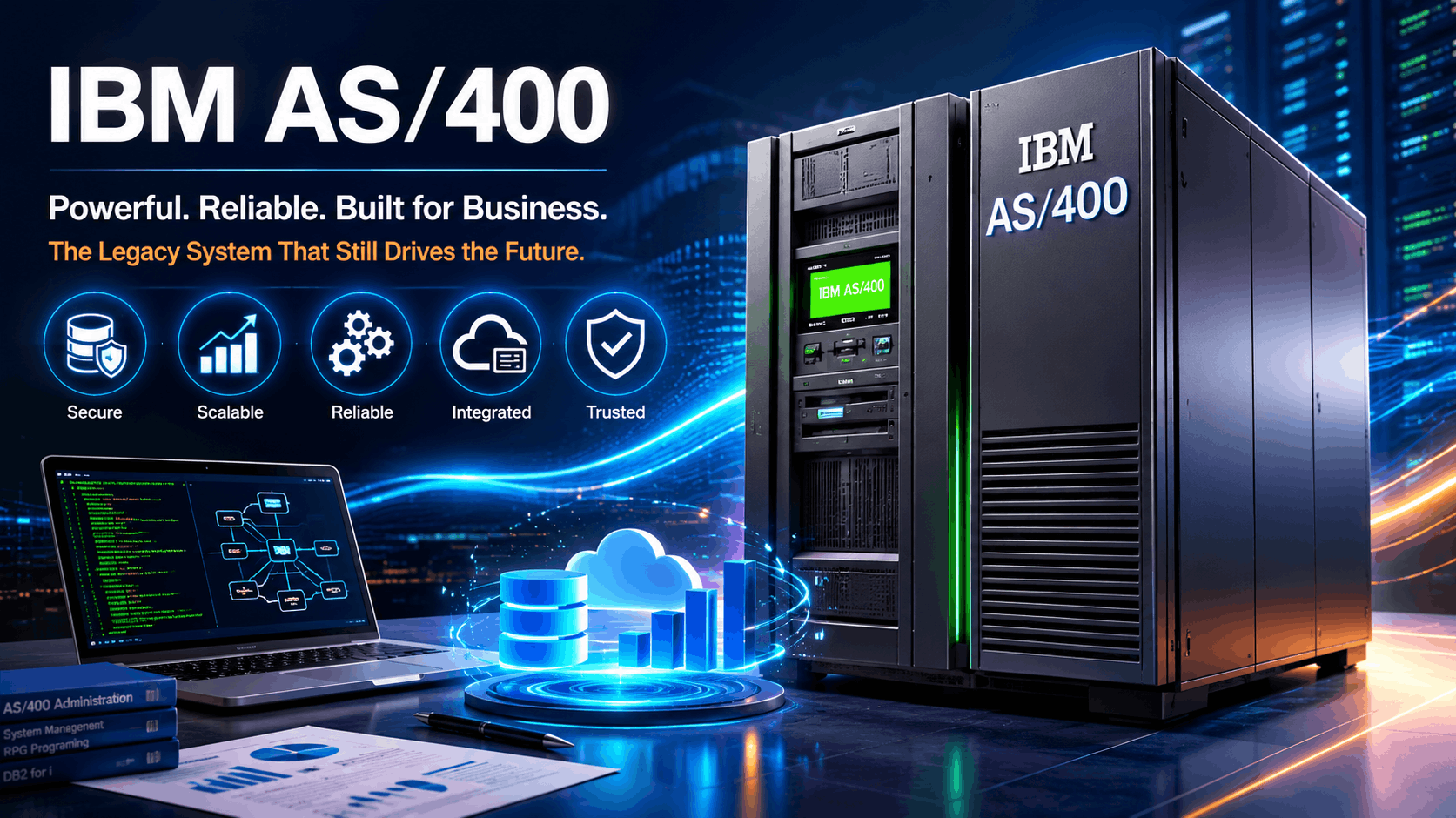
IBM AS400, also known as IBM Application System/400, is one of the most reliable and powerful midrange computer systems developed by IBM for enterprise computing. Introduced in 1988, the AS400 platform became highly popular among organizations because of its exceptional stability, integrated architecture, strong security features, and business-oriented processing capabilities. Over time, the platform evolved into IBM iSeries, System i, and now IBM Power Systems running IBM i operating systems. IBM AS400 was designed to simplify business computing by integrating hardware, software, storage, database management, and security into a single platform. Unlike traditional systems requiring multiple layers of administration, AS400 offered an all-in-one architecture that minimized complexity and increased operational efficiency. This made it particularly attractive for industries such as banking, manufacturing, retail, logistics, healthcare, and government sectors.
One of the biggest strengths of IBM AS400 is its long-term reliability. Many enterprises continue to use the platform decades after deployment because of its stable environment, minimal downtime, and ability to handle mission-critical applications efficiently. The system is widely recognized for its capability to support ERP applications, financial systems, inventory management, and enterprise databases without requiring frequent maintenance.
Modern IBM AS400 environments now support advanced technologies including cloud integration, virtualization, web services, APIs, artificial intelligence connectivity, and hybrid enterprise solutions. Organizations still rely on IBM AS400 online training for secure transaction processing, large-scale data handling, and enterprise application hosting. The platform remains a preferred choice for businesses seeking high availability, performance, scalability, and strong security in enterprise operations.
History and Evolution of IBM AS400
IBM introduced the AS400 platform as the successor to IBM System/38 and System/36. The goal was to create a simplified business computing platform that integrated applications, database management, operating systems, and hardware into one environment. This revolutionary approach reduced operational complexity and improved reliability for enterprise users.
During the 1990s, AS400 became highly successful among medium and large enterprises. Its integrated DB2 database, object-based architecture, and security-focused design distinguished it from competing server platforms. Organizations appreciated the system’s ability to run continuously for years without major failures or interruptions. As technology evolved, IBM upgraded the platform multiple times. The AS400 later became IBM iSeries, followed by IBM System i, and eventually IBM Power Systems running IBM i. Modern IBM Power Systems provide advanced processing capabilities, virtualization support, Linux integration, and cloud compatibility while preserving backward compatibility for legacy AS400 applications. The backward compatibility feature is one of IBM AS400’s greatest achievements. Applications developed decades ago can still run on modern IBM Power Systems with minimal modifications. This protects enterprise investments and allows organizations to modernize gradually without replacing their entire infrastructure.
Today, IBM AS400 certification continues to serve enterprises worldwide. The platform supports modern programming languages, APIs, open-source tools, and enterprise integration frameworks while maintaining the reliability and security that made it successful originally.
Architecture of IBM AS400
IBM AS400 is built on an integrated and object-oriented architecture designed for enterprise-level stability, security, and performance. Unlike conventional computing systems that separate operating systems, databases, and applications, AS400 combines these components into a unified environment.
The hardware layer of AS400 consists of IBM Power processors, storage systems, memory management units, and integrated communication controllers. These processors are optimized for high-volume transaction processing and enterprise workloads. The architecture supports multiple users simultaneously while maintaining excellent performance and reliability. The operating system layer is powered by IBM i, previously known as OS/400. This operating system is specifically designed for enterprise business computing and includes integrated security, workload management, database management, and job scheduling capabilities. IBM i manages system resources efficiently while ensuring stable application execution. One of the core architectural strengths of IBM AS400 is its integrated DB2 database system. Unlike external databases that require separate installation and maintenance, DB2 is deeply embedded into the operating system. This integration improves performance, security, and data consistency while reducing administrative overhead.
The object-based architecture is another major component of AS400. In this model, all system components including files, programs, libraries, devices, and users are treated as objects. This structure enhances system integrity and simplifies resource management. The architecture prevents unauthorized access and reduces system corruption risks. AS400 also includes a machine interface layer that isolates hardware from application programs. This abstraction allows IBM to upgrade hardware technologies without affecting existing applications. Businesses benefit from long-term compatibility and investment protection. Modern IBM AS400 systems additionally support virtualization technologies, cloud integration, REST APIs, web applications, and open-source frameworks. This enables organizations to integrate legacy AS400 systems with modern enterprise platforms and digital transformation initiatives.
Key Features
IBM AS400 offers several powerful features that contribute to its popularity in enterprise environments.
- One of the strongest characteristics of AS400 is system reliability. The platform is designed for continuous operations with minimal downtime. Many organizations operate AS400 systems for years without major failures.
- Security is deeply embedded into the AS400 architecture. The platform includes object-level security, user authorization controls, encryption mechanisms, and audit logging capabilities. This makes AS400 highly suitable for sensitive business environments.
- The built-in DB2 database simplifies database administration and improves overall system efficiency. Since the database is integrated into the operating system, there is no need for separate configuration or management tools.
- AS400 supports organizations ranging from small businesses to large enterprises. The platform can scale processing power, storage, and workloads efficiently without disrupting operations.
- The system efficiently handles thousands of concurrent users and transactions. This makes it ideal for ERP systems, banking applications, and enterprise resource management solutions.
- Applications created decades ago can continue running on modern IBM Power Systems. This protects enterprise investments and reduces migration costs.
- Modern AS400 systems support logical partitioning and virtualization technologies, enabling efficient resource utilization and workload isolation.
- IBM i operating systems include advanced job scheduling and workload balancing capabilities that optimize performance across multiple applications.
Programming Languages Used in IBM AS400
IBM AS400 supports multiple programming languages for enterprise application development.
1. RPG (Report Program Generator)
RPG is the most widely used programming language on AS400 systems. It is specifically designed for business application development and remains heavily used in enterprise environments.
2. COBOL
COBOL is commonly used for financial systems, banking applications, and transaction processing on AS400 platforms.
3. CL Programming
Control Language (CL) is used for job control, automation, system administration, and command execution within IBM i environments.
4. SQL
SQL is extensively used for database management and query processing in DB2 databases integrated with AS400 systems.
5. Java
Modern IBM AS400 systems support Java-based enterprise applications and middleware integrations.
6. PHP and Python
IBM i platforms now support open-source programming environments including PHP and Python for web applications and automation solutions.
Industry Applications
IBM AS400 is widely used across multiple industries because of its reliability, scalability, and secure transaction-processing capabilities. In the banking and financial sector, AS400 supports core banking systems, loan processing, account management, and financial reporting. Manufacturing companies use the platform for ERP systems, inventory control, supply chain management, and production planning. In the retail industry, IBM AS400 manages billing operations, warehouse management, order processing, and customer databases efficiently. Healthcare organizations utilize AS400 for patient records management, insurance processing, hospital administration, and medical billing systems. Logistics and transportation companies depend on the platform for shipment tracking, warehouse automation, and fleet management solutions. Government organizations also use IBM AS400 for taxation systems, payroll management, citizen records, and administrative operations due to its high security standards. Additionally, insurance companies use the system for policy administration, claims processing, and risk management. Its stability and long operational life make IBM AS400 training a preferred platform for mission-critical enterprise applications worldwide.
Advantages of IBM AS400
IBM AS400 provides several long-term advantages to enterprises.
- The platform offers exceptional uptime and stability, reducing operational disruptions. Integrated security minimizes cyber risks and unauthorized access. Built-in database management reduces administrative complexity. Scalability allows organizations to grow without changing platforms entirely.
- AS400 also offers strong investment protection through backward compatibility. Organizations can modernize infrastructure gradually while continuing to run existing applications. The system’s integrated architecture simplifies IT management and reduces maintenance requirements.
- Another important advantage is performance consistency. AS400 efficiently handles large transaction volumes without significant degradation. This makes it suitable for mission-critical business operations.
Challenges of IBM AS400
Despite its strengths, IBM AS400 also presents certain challenges. One challenge is the aging workforce of AS400 professionals. Many experienced RPG and AS400 administrators are nearing retirement, creating a skill gap in the industry. Modernizing legacy applications can also be complex. Older green-screen applications may require redesigning for web-based or mobile environments. Integration with modern cloud-native architectures sometimes requires additional middleware or APIs. Organizations may need modernization strategies to connect AS400 systems with contemporary digital platforms. Licensing and hardware costs can be higher compared to low-cost commodity servers. However, many enterprises justify these costs through long-term reliability and lower downtime.
Modernization of IBM AS400
Many organizations are modernizing AS400 environments rather than replacing them entirely. Modernization strategies include API integration, web application enablement, cloud connectivity, and database optimization. Green-screen applications are being transformed into browser-based interfaces using modernization tools. Enterprises are also integrating AS400 systems with AI platforms, analytics systems, and enterprise cloud solutions. IBM Power Systems now support hybrid cloud deployments, virtualization, Linux workloads, and open-source technologies. This allows businesses to combine legacy reliability with modern digital capabilities. Automation and DevOps practices are also being introduced into IBM i environments. Organizations are using CI/CD pipelines, automated testing, and infrastructure management tools to improve operational efficiency.
Future Scope of IBM AS400
The future of IBM AS400 remains promising despite the emergence of newer technologies. Many enterprises continue to depend on the platform for mission-critical operations because of its reliability and security.
- IBM continues investing in Power Systems and IBM i technologies, ensuring long-term platform support. Integration with cloud computing, AI, machine learning, and analytics platforms enhances the relevance of AS400 in modern enterprises.
- The increasing focus on cybersecurity also benefits IBM AS400 because of its strong security architecture. Industries handling sensitive data continue to prefer secure and stable enterprise systems like AS400.
- Modernization initiatives are extending the lifespan of AS400 applications. Organizations are combining traditional enterprise systems with digital transformation strategies rather than replacing them entirely.
As businesses seek reliable hybrid computing environments, IBM AS400 is expected to remain an important enterprise platform for years to come.
Conclusion
IBM AS400 is one of the most reliable and durable enterprise computing platforms ever developed. Its integrated architecture, powerful security mechanisms, stable operating environment, and strong transaction-processing capabilities have allowed it to remain relevant for decades.
From banking and manufacturing to healthcare and logistics, organizations worldwide continue using AS400 for mission-critical business operations. The platform’s backward compatibility and modernization support enable enterprises to protect their investments while adapting to modern technological demands. Although challenges such as modernization complexity and skill shortages exist, IBM AS400 continues evolving through integration with cloud computing, APIs, open-source technologies, and AI-driven systems. Modern IBM Power Systems running IBM i demonstrate that AS400 is not merely a legacy platform but a continuously evolving enterprise computing solution.
For organizations seeking stability, scalability, security, and long-term reliability, IBM AS400 remains a trusted and valuable technology platform in the modern digital era. Enroll in Multisoft Systems now!