Course Schedule
| Oct, 2026 | Weekdays | Mon-Fri | Enquire Now |
| Weekend | Sat-Sun | Enquire Now | |
| Nov, 2026 | Weekdays | Mon-Fri | Enquire Now |
| Weekend | Sat-Sun | Enquire Now |
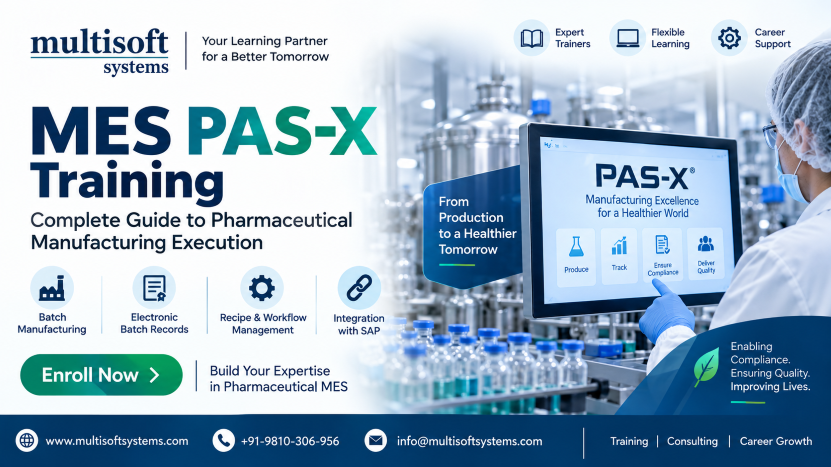
MES PAS-X Training: Complete Guide to Pharmaceutical Manufacturing Execution
Pharmaceutical and life sciences manufacturers operate in highly regulated environments where production accuracy, traceability, data integrity and compliance are essential. As manufacturing processes become increasingly digital, organizations are moving from paper-based procedures toward Manufacturing Execution Systems (MES) that connect production activities with enterprise systems and provide better control over manufacturing operations. MES PAS-X Training helps professionals understand how Werum PAS-X, now part of Körber's pharma software portfolio, can support digital pharmaceutical manufacturing. PAS-X MES connects people, systems and equipment while supporting production execution, electronic batch records, process control and traceability. Multisoft Systems' MES PAS-X Training is designed around pharmaceutical and life sciences manufacturing and covers PAS-X architecture, master data, batch execution, Electronic Batch Records (EBR), recipe and workflow management, shop-floor execution, SAP integration, compliance, reporting, administration and troubleshooting.
This guide explains what PAS-X MES is, how it works, its important capabilities, training areas, prerequisites, career opportunities and how professionals can develop practical PAS-X skills.
What Is MES PAS-X?
MES PAS-X is a Manufacturing Execution System designed to support and manage pharmaceutical manufacturing processes. It helps connect production activities with people, equipment and enterprise systems while improving process control, traceability and compliance. PAS-X supports key manufacturing functions such as electronic batch records, master data management, workflow configuration, batch execution, exception handling and production reporting. It can also integrate with ERP systems such as SAP to connect manufacturing operations with broader business processes. Through digital and paperless workflows, MES PAS-X helps organizations standardize production activities, maintain accurate records and support regulatory requirements such as GMP and FDA 21 CFR Part 11.
Why Is PAS-X MES Important in Pharmaceutical Manufacturing?
Pharmaceutical manufacturing requires strict control over processes, materials, equipment and production records. Manual documentation can make it more difficult to maintain consistent records, trace production activities and review manufacturing information. PAS-X supports digital production processes and electronic batch recording, helping organizations replace paper-based activities with controlled digital workflows. Körber highlights PAS-X's role in digitalizing pharmaceutical manufacturing, including production guidance, real-time monitoring and traceability.
Important areas supported by MES PAS-X include:
- Electronic Batch Records
- Production execution
- Manufacturing workflows
- Material management
- Equipment information
- Batch traceability
- Data collection
- Exception handling
- Reporting
- Audit trails
- Electronic signatures
- ERP integration
These capabilities can help pharmaceutical organizations establish more structured and traceable manufacturing processes.
How Does MES PAS-X Work?
MES PAS-X works by connecting pharmaceutical production processes, operators, equipment and enterprise systems within a controlled digital environment. It uses master data and configured workflows to guide operators through each manufacturing step while recording production information electronically. The system supports batch execution, electronic batch records, process instructions, exception and deviation handling, and real-time production monitoring. PAS-X can also integrate with ERP systems such as SAP to exchange relevant manufacturing and business data. By capturing production activities digitally and maintaining traceable records, MES PAS-X helps organizations improve process consistency, data accuracy and regulatory compliance throughout the manufacturing lifecycle.
Key Components of MES PAS-X
-
Master Data Management
Master data management in MES PAS-X involves organizing and maintaining essential manufacturing information used during production. This can include materials, products, equipment, process parameters and other production-related data. Accurate master data helps ensure that manufacturing activities follow standardized processes and that the right information is available when required.
-
Batch Manufacturing
MES PAS-X supports batch manufacturing by providing structured control over production activities. It helps define and manage batch processes, monitor manufacturing steps and capture relevant production information. This improves process consistency and provides better visibility into batch execution from start to completion.
-
Electronic Batch Records
Electronic Batch Records (EBRs) replace paper-based production records with controlled digital records. PAS-X captures important information generated during batch production, including completed activities, process data, operator actions and required approvals. EBRs improve traceability and help organizations maintain accurate and accessible manufacturing documentation.
-
Recipe and Workflow Management
Recipe and workflow management helps define how manufacturing processes should be performed. PAS-X can guide operators through configured process steps and instructions while ensuring activities are completed in the required sequence. This supports standardized execution and reduces the risk of process variations during production.
-
Shop-Floor Execution
Shop-floor execution connects planned manufacturing activities with actual production operations. PAS-X guides operators through production tasks, captures information as work is performed and provides visibility into batch progress. It also supports process instructions, operator actions and exception handling, helping manufacturing teams maintain consistent and traceable execution on the shop floor.
Electronic Batch Records in PAS-X
Electronic Batch Records are an important part of PAS-X-based digital manufacturing. A batch record contains information associated with the production of a batch. In a digital environment, relevant information can be captured electronically during manufacturing rather than being recorded entirely through paper-based procedures.
A typical EBR process may involve:
- Creating or receiving the manufacturing order.
- Starting the relevant production process.
- Executing defined recipe steps.
- Recording process information.
- Capturing material and equipment information.
- Recording operator confirmations.
- Managing exceptions.
- Reviewing the completed batch record.
- Completing required approvals and release activities.
Körber's PAS-X Academy also identifies Master Batch Record management, EBR execution, exception handling and batch record review as core PAS-X learning areas.
PAS-X Recipe and Workflow Management
Recipe management is important because pharmaceutical manufacturing involves defined procedures that must be followed consistently.
PAS-X training can help learners understand:
- Master recipes
- Control recipes
- Operations
- Phases
- Parameters
- Workflow logic
- Process instructions
- Recipe versioning
- Change control
Multisoft Systems includes recipe concepts, master versus control recipes, workflow logic and recipe versioning in its published PAS-X curriculum. Professionals working with recipe design need to understand not only how recipes are created but also how changes can affect manufacturing execution.
PAS-X Integration With SAP
PAS-X can integrate with SAP to connect pharmaceutical manufacturing operations with enterprise resource planning processes. This integration enables relevant production and business data to flow between the MES and ERP environments, supporting activities such as material management, production planning and batch-related processes. By connecting PAS-X with SAP, organizations can improve data consistency, reduce manual data entry and maintain better visibility across manufacturing operations. The integration also helps coordinate shop-floor execution with enterprise-level processes while supporting traceability and standardized workflows.
PAS-X Compliance and Data Integrity
PAS-X supports compliance and data integrity by providing controlled digital workflows and maintaining traceable records throughout pharmaceutical manufacturing processes. The system helps organizations manage electronic batch records, process instructions, operator activities, approvals and production data in a structured environment. Features such as electronic signatures, audit trails and controlled access can support requirements related to GMP and FDA 21 CFR Part 11. By recording manufacturing activities digitally and consistently, PAS-X helps reduce reliance on paper-based processes, improve data accuracy and strengthen traceability. This makes compliance and reliable data management important aspects of PAS-X implementation in regulated pharmaceutical manufacturing environments.
PAS-X Reporting and Monitoring
Manufacturing organizations need visibility into production activities and batch performance. PAS-X reporting and monitoring capabilities can help users review manufacturing information, batch history and production-related data. Multisoft Systems' course includes production and batch reports, batch history and genealogy, KPI monitoring and compliance reporting.
Reporting can help different teams answer questions such as:
- What happened during a production batch?
- Which materials were used?
- What exceptions occurred?
- What was the status of the batch?
- Which process information needs review?
- What production indicators should be monitored?
This information can support production, quality and operational decision-making.
PAS-X Administration
PAS-X administration is another important area for technical professionals.
Administration activities may include:
- User administration
- Role management
- System configuration
- Environment management
- Backup and restore concepts
- System monitoring
- Reporting configuration
- Client configuration
Multisoft Systems' curriculum includes user and role administration, system configuration, DEV/QA/PROD environment management and backup and restore concepts. Körber's official PAS-X Academy also offers dedicated system administration training covering system architecture, user administration, rights management, audit trails, reporting, system monitoring and client configuration.
PAS-X Troubleshooting and Support
Manufacturing systems must be monitored continuously because technical or process-related issues can affect production activities.
Troubleshooting skills can help professionals investigate:
- Failed transactions
- Batch execution problems
- Integration errors
- Configuration issues
- Communication failures
- Log messages
- User access problems
- Workflow issues
Multisoft Systems' MES PAS-X curriculum includes common execution issues, log analysis, error handling during batch execution and support and escalation processes. A structured troubleshooting process generally begins with identifying the problem, reviewing available information and logs, checking configuration and then testing a controlled resolution.
What Can You Learn in MES PAS-X Training?
A comprehensive MES PAS-X Training program can help learners develop knowledge across the complete manufacturing execution lifecycle.
At Multisoft Systems, the published curriculum covers:
- MES and PAS-X fundamentals
- PAS-X system architecture and navigation
- Master data
- Batch manufacturing
- Electronic Batch Records
- Recipe and workflow management
- Shop-floor execution
- SAP ERP integration
- GMP and GxP requirements
- FDA 21 CFR Part 11
- Audit trails and electronic signatures
- Reporting and monitoring
- PAS-X administration
- Troubleshooting and support
- Real-time projects and use cases
This broad coverage can help learners understand how different PAS-X functions connect within a pharmaceutical manufacturing environment.
Who Should Learn MES PAS-X?
- MES Engineers
- Manufacturing Engineers
- Production Executives and Managers
- Automation and Process Engineers
- Life Sciences Professionals
- SAP Consultants
- IT Professionals
- System Administrators
- MES Consultants
- MES Implementation Specialists
- Engineering Graduates
- Professionals working in Pharmaceutical Manufacturing
MES PAS-X Training Prerequisites
The prerequisites for learning PAS-X can vary depending on the course level and professional objective. Multisoft Systems recommends a basic understanding of manufacturing processes, preferably in pharmaceutical or life sciences industries. Familiarity with MES concepts is beneficial but not mandatory, while basic SAP or ERP knowledge is an added advantage.
Learners can also benefit from understanding:
- Manufacturing processes
- Production planning
- Basic ERP concepts
- MES fundamentals
- Data management
- Quality processes
- Basic IT concepts
A strong understanding of pharmaceutical manufacturing can be particularly useful because PAS-X is closely connected to regulated production environments.
Why Hands-On Practice Matters in PAS-X Training
Hands-on practice helps learners understand how MES PAS-X concepts are applied in real pharmaceutical manufacturing environments. Practical sessions allow participants to work with system navigation, master data, electronic batch records, recipes, workflows, batch execution and troubleshooting scenarios. This experience improves confidence in performing day-to-day PAS-X tasks and helps learners connect theoretical knowledge with actual production processes. It also develops practical problem-solving skills that are valuable for MES implementation, support and operational roles.
MES PAS-X Career Opportunities
MES PAS-X skills can open career opportunities across pharmaceutical manufacturing, MES implementation, production technology and digital transformation. Professionals with practical PAS-X knowledge can explore roles such as:
- MES PAS-X Consultant
- MES Engineer
- PAS-X Implementation Specialist
- MES Support Engineer
- Manufacturing Systems Engineer
- MES Administrator
- Automation and Process Engineer
- MES Business Analyst
- SAP-MES Integration Consultant
- Pharmaceutical Manufacturing Technology Specialist
- MES Validation Specialist
- Production Systems Specialist
- MES Project Engineer
- Digital Manufacturing Consultant
PAS-X and the Future of Pharmaceutical Manufacturing
Pharmaceutical manufacturing is increasingly moving toward connected and digital production environments. Organizations are looking for ways to improve manufacturing visibility, reduce manual documentation and strengthen data-driven operations. Körber positions PAS-X MES as part of digital pharmaceutical production and describes its role in connecting people, systems and equipment while supporting digital manufacturing processes. PAS-X is also being used as part of broader digitalization initiatives. For example, Körber reports that Bayer implemented PAS-X MES at its Beijing Supply Center to introduce electronic batch recording and digitalize manufacturing processes. This direction makes MES knowledge increasingly relevant for professionals involved in pharmaceutical manufacturing transformation.
How to Choose the Right MES PAS-X Training
When selecting MES PAS-X Training, focus on the actual learning coverage rather than the course title alone.
Important factors include:
- PAS-X Fundamentals: The course should explain MES and PAS-X concepts clearly.
- Practical Learning: Look for hands-on exercises and realistic manufacturing scenarios.
- EBR Coverage: Electronic Batch Records should be an important part of the curriculum.
- Recipe and Workflow: Check whether the course covers MBRs, recipes and workflow execution.
- ERP Integration: SAP integration knowledge can be valuable for professionals working with enterprise manufacturing systems.
- Compliance: GMP, GxP, electronic signatures and data integrity should be addressed for regulated environments.
- Troubleshooting: Practical error handling and log analysis can improve project readiness.
- Experienced Trainers: Trainers should understand the manufacturing and MES context.
- Current Content: Verify that the course reflects the relevant PAS-X version and project requirements.
A well-structured program should connect technical concepts with actual manufacturing workflows.
Why Choose Multisoft Systems for MES PAS-X Training?
- Instructor-led online training
- Project-based learning approach
- Certified and experienced trainers
- Practical, real-world training sessions
- Hands-on learning with PAS-X concepts
- Customized learning schedules
- Doubt-clearing sessions
- Course completion certificate
- Training focused on industry-relevant skills
- Suitable for beginners and working professionals
- Support for understanding PAS-X implementation concepts
- Career-oriented learning approach
Conclusion
MES PAS-X training helps professionals develop practical knowledge of pharmaceutical manufacturing execution and digital production processes. It covers important areas such as master data, batch manufacturing, electronic batch records, recipe and workflow management, shop-floor execution, SAP integration, compliance and data integrity. Hands-on learning can further strengthen understanding and prepare learners to handle real-world manufacturing scenarios. For MES engineers, manufacturing professionals, SAP consultants, automation specialists and aspiring MES professionals, PAS-X expertise can support career growth in digital manufacturing environments. Choosing the right MES PAS-X Training can therefore be a valuable step toward building technical skills and contributing effectively to modern pharmaceutical manufacturing operations. Enroll in Multisoft Systems now!