Course Schedule
| Oct, 2026 | Weekdays | Mon-Fri | Enquire Now |
| Weekend | Sat-Sun | Enquire Now | |
| Nov, 2026 | Weekdays | Mon-Fri | Enquire Now |
| Weekend | Sat-Sun | Enquire Now |
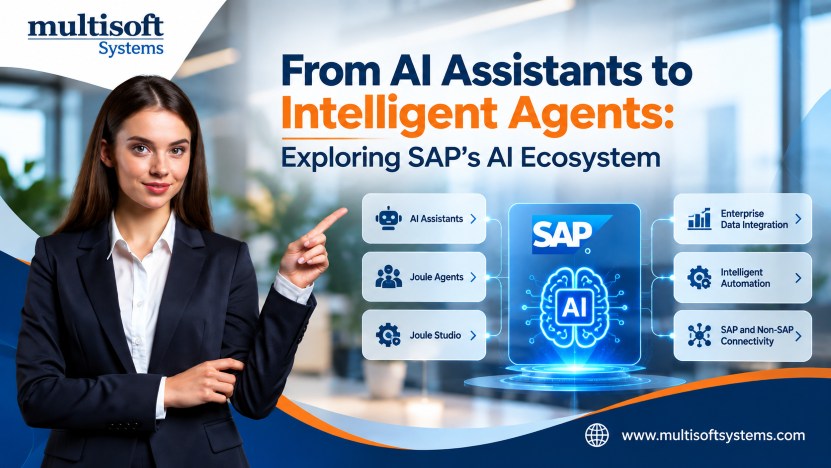
From AI Assistants to Intelligent Agents: Exploring SAP’s AI Ecosystem
Artificial intelligence is moving beyond chatbots and simple task automation. Enterprises are increasingly exploring AI systems that can understand business context, make decisions, coordinate multiple steps, and take action across connected applications. This shift is commonly described as agentic AI. SAP is bringing this approach into enterprise operations through its broader SAP Business AI strategy, including Joule, Joule Agents, Joule Assistants, and Joule Studio. SAP describes Joule Agents as context-aware AI agents designed to automate workflows and work with business data, processes, applications, and tools.
For SAP professionals, developers, consultants, architects, and technology teams, understanding this emerging technology can be an important step toward working with AI-enabled business applications. SAP Agentic AI Training can help learners understand how to design, integrate, govern, and apply intelligent agents in real enterprise scenarios.
What Is SAP Agentic AI?
SAP Agentic AI Training refers to the use of intelligent AI agents within SAP and enterprise business environments to understand business context, support decision-making, coordinate multiple steps, and take actions across connected workflows. Unlike basic AI tools that mainly provide information or generate responses, agentic AI is designed to work toward a specific business objective by analyzing available information, selecting appropriate actions, and coordinating tasks. SAP's broader Business AI ecosystem includes technologies such as Joule, Joule Agents, and Joule Studio, which connect AI capabilities with business applications, data, and processes. For SAP professionals, understanding agentic AI can help them explore new approaches to automation, intelligent workflows, and digital transformation.
Why Agentic AI Is Becoming Important for SAP Professionals
Enterprise organizations manage complex processes across finance, procurement, supply chain, human resources, sales, and other business functions. Traditional automation can handle many predefined activities, but modern businesses increasingly need systems that can respond to changing situations and coordinate multiple tasks. Agentic AI can help bring greater intelligence and flexibility to these workflows. For SAP professionals, this creates an opportunity to combine their existing knowledge of SAP business processes with AI, automation, integration, and orchestration skills.
Key reasons to learn SAP Agentic AI include:
- Growing use of AI in enterprise business processes
- Ability to connect AI with SAP business data and applications
- Support for more intelligent and dynamic workflows
- Opportunities to automate multi-step business processes
- Growing importance of AI-assisted decision-making
- Integration of SAP and non-SAP applications
- Increasing demand for AI and automation skills
- Opportunities to work with emerging SAP AI technologies
- Strong relevance to digital transformation initiatives
- Ability to combine SAP expertise with modern AI capabilities
How SAP Agentic AI Differs from Traditional Automation
Traditional automation generally follows predefined rules and instructions. When a particular condition is met, the system performs an action that has already been configured. This approach works well for repetitive and predictable processes, but it may be less flexible when a situation requires analysis, decision-making, or multiple possible actions. Agentic AI introduces a more dynamic approach. An AI agent can understand a defined objective, analyze available business information, determine which tools or actions may be appropriate, and coordinate multiple steps to achieve the desired outcome. It can also work with other agents or applications as part of a broader workflow. For example, traditional automation might send a notification when an invoice reaches a particular status. An agentic workflow could potentially analyze the invoice, examine relevant business information, identify an exception, and coordinate the appropriate next step based on the available tools and business rules. The key difference is that traditional automation primarily follows predefined instructions, while agentic AI is designed to support goal-oriented, context-aware execution.
Key Components Covered in SAP Agentic AI Learning
A comprehensive SAP Agentic AI learning program should cover both fundamental AI concepts and their application within enterprise environments. Learners need to understand how agents work, how they interact with business applications, and how workflows can be designed and governed.
AI Agents and Agentic Workflows
AI agents are intelligent software systems designed to work toward specific objectives. They can interpret information, reason about possible actions, use available tools, and coordinate multiple steps within a workflow. Agentic workflows extend this concept by connecting several actions or agents to complete a broader business process. Depending on the use case, an agent may gather information, analyze it, select an appropriate tool, perform an action, and evaluate the result. For SAP professionals, learning these concepts helps explain how AI can move beyond simple chat-based interactions toward practical business process execution.
SAP Joule and Joule Agents
Joule is SAP's AI assistant and an important part of its Business AI ecosystem. It is designed to help users interact with SAP business applications and information using natural language and business context. Joule Agents take the concept further by supporting more complex, multi-step business workflows. Agents can work with relevant business data, tools, skills, and other agents to help accomplish defined business objectives. Learning about Joule and Joule Agents helps SAP professionals understand how AI can become integrated into everyday enterprise processes rather than functioning as a separate technology.
Joule Studio
Joule Studio is designed to help organizations build, customize, integrate, and manage AI agents and intelligent workflows. It provides an environment for creating AI-powered solutions that can work across SAP and connected non-SAP systems. For developers and technical consultants, Joule Studio is particularly relevant because it moves beyond simply using AI and focuses on building and managing enterprise AI solutions. Learning can include concepts such as agent development, workflow orchestration, integration with business applications, tool connectivity, governance, and lifecycle management. This makes Joule Studio an important area for professionals who want to move toward developing customized AI agents and intelligent business workflows within SAP environments.
Business Context and Enterprise Data
Business context is essential for making AI useful in an SAP environment. Enterprise systems contain information about customers, suppliers, financial transactions, products, employees, orders, inventory, and business processes. Agentic AI needs access to relevant and reliable information to understand a situation and provide meaningful recommendations or actions. By connecting AI capabilities with business data and process context, organizations can move beyond generic AI responses toward more relevant, business-oriented workflows. For SAP professionals, understanding data, business processes, permissions, and application context is therefore an important part of learning how agentic AI can be applied within enterprise environments.
Connecting SAP and Non-SAP Systems
Modern organizations rarely operate using SAP alone. They often depend on CRM platforms, cloud applications, data platforms, collaboration tools, and specialized third-party systems. Connecting these environments allows AI agents and workflows to access information and coordinate activities across different applications. Integration can involve APIs, business tools, workflows, and other connectivity mechanisms that allow systems to exchange data and trigger actions. Learning how SAP and non-SAP systems can work together helps professionals understand how agentic AI can support end-to-end business processes rather than being limited to a single application. This integration capability is particularly valuable for enterprise architects, SAP consultants, developers, and automation professionals working on digital transformation initiatives.
Multi-Agent Systems and Workflow Orchestration
Some business processes are too complex for a single AI agent. Multiple specialized agents can work together, with each agent handling a particular responsibility. For example, one agent might analyze financial information, another could evaluate procurement data, and another could coordinate a workflow. An orchestration layer can help manage communication and sequencing between these agents. SAP's current Joule Studio environment supports multi-agent workflow orchestration and integration with enterprise systems. SAP has also highlighted technologies such as Agent-to-Agent (A2A) communication and Model Context Protocol (MCP) within its agentic AI development direction. Understanding these concepts can help technical professionals design more scalable AI solutions.
Security, Governance, and Responsible AI
Enterprise AI cannot be implemented successfully without security and governance. An agent that can access business applications and execute actions needs appropriate identity controls, permissions, monitoring, and lifecycle management. SAP emphasizes governance, identity, runtime controls, observability, and agent performance management within its agentic AI platform.
A professional learning SAP Agentic AI should therefore understand areas such as:
- Identity and access management
- Role-based permissions
- Data privacy
- AI governance
- Agent monitoring
- Execution tracking
- Human oversight
- Responsible AI practices
- Testing and evaluation
- Lifecycle management
Practical Applications of SAP Agentic AI
Agentic AI can potentially support many enterprise scenarios.
Finance
Agents can assist with financial analysis, exception handling, reconciliation-related workflows, and decision support.
Supply Chain
AI agents can help analyze supply and demand information, identify potential issues, and coordinate planning-related workflows.
Procurement
Agents can support supplier-related processes, purchasing activities, and exception management by bringing together information from different systems.
Human Resources
AI-powered workflows can support employee-related requests, information retrieval, and administrative processes.
Customer Experience
Agents can help coordinate customer-related workflows, retrieve relevant business information, and support service processes.
Application Development
Developers can use AI-assisted capabilities to accelerate application and workflow development. SAP's new Joule Studio also introduces intent-based development, allowing users to describe desired outcomes in natural language and generate structured development artifacts.
What You Can Learn Through SAP Agentic AI Training
- Fundamentals of SAP Agentic AI and intelligent enterprise automation
- Difference between Generative AI, AI assistants, and AI agents
- Concepts of AI agents and agentic workflows
- SAP Business AI and its role in enterprise processes
- SAP Joule and Joule Agents
- Introduction to Joule Studio and agent development
- Designing goal-oriented AI workflows
- Business context and enterprise data integration
- Connecting SAP and non-SAP applications
- APIs, tools, and workflow integration
- Multi-agent systems and workflow orchestration
- AI-powered business process automation
- Model Context Protocol (MCP) and Agent-to-Agent (A2A) concepts
- AI agent security and access management
- AI governance and responsible AI practices
- Agent monitoring, testing, and evaluation
- Enterprise AI use cases across finance, procurement, HR, and supply chain
- Practical approaches to implementing AI agents in SAP environments
- Best practices for developing scalable and business-focused AI solutions
Who Should Consider SAP Agentic AI Training?
- SAP Consultants
- SAP Functional Consultants
- SAP Technical Consultants
- SAP Developers and ABAP Developers
- SAP BTP Professionals
- SAP Solution Architects
- Enterprise Architects
- AI and Machine Learning Professionals
- Cloud Technology Professionals
- Business Analysts
- Automation Specialists
- Digital Transformation Professionals
- IT Managers and Technology Leaders
- Professionals working with SAP Business AI and intelligent automation
- Professionals looking to combine SAP expertise with emerging AI technologies
SAP Agentic AI Training and Career Development
SAP Agentic AI Training can support professional development by helping learners build knowledge at the intersection of SAP, artificial intelligence, intelligent automation, and enterprise workflows. As organizations explore AI-driven business processes, professionals who understand how AI agents can work with business applications, data, tools, and workflows may be better prepared for emerging technology roles. The learning can be particularly valuable for SAP consultants, developers, architects, automation specialists, and digital transformation professionals who want to expand beyond traditional SAP skills. Potential career directions may include SAP AI Consultant, SAP BTP Consultant, AI Automation Specialist, Intelligent Automation Consultant, SAP Integration Consultant, Enterprise AI Developer, and Digital Transformation Consultant. A training or course completion certificate can demonstrate participation in a structured learning program, while any official SAP certification should be pursued separately through the applicable SAP certification pathway.
Why Online Training Can Be Useful for Working Professionals
Professionals often need to learn emerging technologies while continuing their existing careers. SAP Agentic AI Training Online can provide a flexible way to study AI concepts, SAP technologies, and enterprise use cases from a remote learning environment. Online instructor-led learning can allow participants to interact with trainers, discuss technical questions, review examples, and work through practical scenarios. A structured learning plan can also make it easier to progress from fundamental AI concepts toward more advanced enterprise applications. For working professionals, the most valuable training is likely to be learning that connects theory with real business problems rather than focusing only on terminology.
Why Choose Multisoft Systems?
Multisoft Systems can be positioned as a training partner for professionals who want to develop skills in emerging enterprise technologies. A well-structured SAP Agentic AI learning program can help participants understand the relationship between artificial intelligence, SAP business processes, automation, integration, and enterprise technology.
The learning experience can be particularly useful when it combines:
- Instructor-led learning
- Practical demonstrations
- Industry-oriented examples
- Business use cases
- Interactive doubt-clearing sessions
- Learning resources
- Assessments and practice activities
- Flexible online learning
- Career-oriented guidance
As agentic AI continues to evolve, professionals should also ensure that their learning remains aligned with current SAP product capabilities and releases.
The Future of SAP and Agentic AI
The direction of enterprise AI is shifting from simple question-and-answer systems toward systems that can help execute complete business processes. SAP's current strategy reflects this movement, with Joule, AI agents, SAP Business AI Platform, and Joule Studio designed to connect AI with business applications, data, processes, and governance. This does not mean that human expertise becomes unnecessary. Instead, the role of professionals may evolve toward designing processes, defining business goals, supervising AI behavior, managing exceptions, and ensuring that AI operates within appropriate organizational controls. The combination of SAP expertise and agentic AI knowledge can therefore become increasingly relevant as organizations explore more autonomous ways of working.
Conclusion
Agentic AI represents an important development in enterprise technology because it moves AI from generating responses toward planning, reasoning, coordinating tools, and supporting business execution. SAP is developing this direction through its broader Business AI ecosystem, including Joule, Joule Agents, Joule Assistants, and Joule Studio. For SAP consultants, developers, architects, automation professionals, and technology leaders, learning how these capabilities work can provide a foundation for participating in the next generation of intelligent enterprise solutions.
SAP Agentic AI Training can help professionals understand the fundamentals of AI agents, business context, workflow orchestration, integration, governance, and practical enterprise use cases. As organizations continue exploring AI-driven business transformation, combining SAP knowledge with agentic AI skills can be a valuable professional development path.