Course Schedule
| Oct, 2026 | Weekdays | Mon-Fri | Enquire Now |
| Weekend | Sat-Sun | Enquire Now | |
| Nov, 2026 | Weekdays | Mon-Fri | Enquire Now |
| Weekend | Sat-Sun | Enquire Now |
SAP C4C Implementation Guide: Process, Challenges, Best Practices, and Future Trends
Customer expectations continue to evolve, making it essential for businesses to deliver personalized experiences, faster services, and meaningful interactions at every stage of the customer journey. Traditional customer relationship management systems often struggle to keep pace with these changing demands, creating the need for intelligent, cloud-based CRM solutions that improve efficiency while strengthening customer relationships. SAP Hybris Cloud for Customer (SAP C4C) addresses these challenges by offering a comprehensive platform that integrates sales, service, and customer engagement into a single, unified environment. Implementing SAP C4C is not simply a technical deployment; it is a strategic initiative that transforms the way organizations manage customer data, automate business processes, and collaborate across departments. A successful implementation requires careful planning, detailed business analysis, proper system configuration, seamless integration with enterprise applications, accurate data migration, rigorous testing, and effective user training. Each implementation phase contributes to ensuring that the solution aligns with business objectives and delivers measurable value.
This blog provides a comprehensive overview of the SAP Hybris Cloud for Customer project implementation lifecycle, explaining every stage from project planning to post-go-live support. It also highlights implementation best practices, common challenges, and proven strategies that help organizations reduce project risks, improve user adoption, and maximize the return on their SAP C4C investment.
What is SAP Hybris Cloud for Customer?
SAP Hybris Cloud for Customer (SAP C4C) is a cloud-based Customer Relationship Management (CRM) solution developed by SAP to help organizations manage customer interactions, sales processes, and customer service operations through a centralized platform. As part of the SAP Customer Experience (SAP CX) portfolio, it enables businesses to streamline customer engagement, automate routine tasks, and maintain a unified view of customer information across departments.
The platform includes powerful capabilities such as lead and opportunity management, account and contact management, sales forecasting, service ticket management, workflow automation, analytics, and mobile access. SAP C4C also integrates seamlessly with SAP ERP, SAP S/4HANA, SAP Business Technology Platform (BTP), and various third-party applications, allowing organizations to synchronize customer and business data in real time. By providing intelligent insights, enhanced collaboration, and automated business processes, SAP Hybris Cloud for Customer helps organizations improve customer satisfaction, increase sales productivity, optimize service delivery, and support long-term business growth.
SAP C4C Modules
SAP Hybris Cloud for Customer consists of several integrated modules that work together to improve customer engagement and business performance. Each module is designed to address specific customer relationship management functions while ensuring seamless collaboration across departments.
1. Sales Cloud
The Sales Cloud module helps sales teams manage the complete sales lifecycle, from lead generation to opportunity management and final sales conversion. It enables sales representatives to track customer interactions, manage accounts, forecast revenue, monitor sales pipelines, and automate routine sales activities. By providing real-time customer insights, the module helps improve sales efficiency and increase conversion rates.
2. Service Cloud
The Service Cloud module focuses on delivering exceptional customer support through efficient case and ticket management. It enables organizations to manage customer inquiries, service requests, complaints, warranties, and service contracts from a centralized platform. Features such as knowledge management, service level agreements (SLAs), escalation workflows, and omnichannel support help businesses resolve customer issues quickly while improving customer satisfaction.
3. Customer Engagement
SAP C4C enables organizations to create personalized customer experiences by maintaining a 360-degree view of customer information. Businesses can track customer interactions across multiple touchpoints, understand customer preferences, and deliver consistent communication through email, phone, chat, and other digital channels.
4. Marketing Integration
SAP C4C integrates with marketing solutions to help organizations align marketing campaigns with sales activities. Marketing teams can share qualified leads with sales representatives, track campaign performance, and improve customer targeting using centralized customer data.
5. Mobile CRM
The mobile capabilities of SAP C4C allow sales and service professionals to access customer information, manage appointments, update opportunities, and resolve service requests from smartphones and tablets. This mobility ensures uninterrupted productivity regardless of location.
SAP C4C vs Traditional CRM Implementation
|
Feature |
SAP C4C Implementation |
Traditional CRM Implementation |
|
Deployment Model |
Cloud-based (Software-as-a-Service) |
Primarily on-premise infrastructure |
|
Implementation Time |
Faster implementation with pre-configured best practices |
Longer implementation due to extensive infrastructure setup |
|
Infrastructure Requirements |
No dedicated hardware required |
Requires servers, storage, and IT infrastructure |
|
Initial Investment |
Lower upfront investment with subscription-based pricing |
High capital expenditure for hardware and software licenses |
|
Maintenance |
Managed by SAP with automatic updates and patches |
Managed by the organization's IT team with manual upgrades |
|
Scalability |
Easily scalable based on business growth |
Scaling often requires additional hardware and significant investment |
|
System Updates |
Automatic and regular feature enhancements |
Manual upgrades that may require system downtime |
|
Accessibility |
Accessible from anywhere via web and mobile devices |
Usually limited to corporate networks unless configured for remote access |
|
Integration |
Seamless integration with SAP ERP, SAP S/4HANA, SAP BTP, and third-party applications |
Integration often requires custom development and additional middleware |
|
Customization |
Supports configuration, extensions, and low-code customization |
Heavy customization often increases implementation complexity |
|
Data Security |
Enterprise-grade cloud security with continuous monitoring |
Security depends on internal IT policies and infrastructure management |
|
Business Continuity |
High availability with cloud disaster recovery capabilities |
Disaster recovery depends on the organization's infrastructure |
|
Performance Monitoring |
Real-time dashboards and cloud monitoring tools |
Requires separate monitoring tools and manual administration |
|
Mobile Access |
Native mobile support for sales and service teams |
Mobile capabilities may require additional applications or development |
|
Cost of Ownership |
Lower long-term operational costs |
Higher maintenance and infrastructure costs over time |
|
User Experience |
Modern, intuitive, and user-friendly interface |
User experience varies depending on CRM platform and customization |
|
Innovation |
Regular access to the latest SAP innovations and AI capabilities |
New features typically require major upgrades or custom development |
|
Best Suited For |
Organizations seeking rapid digital transformation and cloud adoption |
Organizations with legacy systems or strict on-premise requirements |
How to Overcome SAP C4C Implementation Challenges
Implementing SAP Hybris Cloud for Customer (SAP C4C) can be a complex process involving multiple business functions, integrations, and stakeholders. Organizations often encounter challenges such as unclear business requirements, poor data quality, integration complexities, user resistance, scope changes, and insufficient testing. However, these challenges can be effectively managed through proper planning, strong project governance, and adherence to SAP implementation best practices. A successful SAP C4C implementation requires active stakeholder involvement, experienced consultants, comprehensive user training, and continuous monitoring throughout the project lifecycle. By adopting a structured implementation approach and focusing on continuous improvement, organizations can minimize risks, accelerate deployment, and maximize the return on their SAP C4C investment.
Key strategies to overcome SAP C4C implementation challenges include:
- Define Clear Business Objectives: Establish measurable goals and expected business outcomes before beginning the implementation project.
- Conduct Detailed Requirement Analysis: Gather comprehensive business requirements from all stakeholders to ensure the solution aligns with organizational needs.
- Develop a Realistic Project Plan: Create a structured implementation roadmap with clearly defined timelines, milestones, resources, and responsibilities.
- Maintain Strong Executive Sponsorship: Secure active involvement from senior leadership to support decision-making, governance, and project success.
- Control Project Scope: Prevent scope creep by managing change requests through a formal approval process and maintaining focus on business priorities.
- Ensure High-Quality Data Migration: Clean, validate, and standardize legacy data before migration to improve data accuracy and system reliability.
- Plan Seamless System Integration: Design and test integrations with SAP ERP, SAP S/4HANA, SAP Business Technology Platform (BTP), and third-party applications to ensure smooth data exchange.
- Perform Comprehensive Testing: Conduct unit testing, system testing, integration testing, performance testing, and User Acceptance Testing (UAT) to identify and resolve issues before go-live.
- Invest in User Training: Deliver role-based training programs, practical workshops, and user documentation to improve system adoption and productivity.
- Implement Effective Change Management: Communicate project objectives, benefits, and progress regularly to reduce resistance and encourage user engagement.
- Engage Experienced SAP Consultants: Utilize skilled functional and technical consultants to guide implementation, resolve challenges, and follow SAP best practices.
- Monitor Risks Continuously: Identify potential project risks early and implement mitigation strategies to avoid delays, cost overruns, and operational disruptions.
- Provide Post-Go-Live Support: Establish a dedicated hypercare team to address user issues, stabilize the system, and ensure a smooth transition to daily operations.
- Measure Performance Regularly: Track key performance indicators (KPIs), gather user feedback, and continuously optimize the SAP C4C solution to support evolving business requirements.
Future Trends in SAP Customer Experience (CX)
As customer expectations continue to evolve, organizations are increasingly adopting intelligent technologies to deliver personalized, seamless, and data-driven experiences. SAP Customer Experience (CX) is continuously expanding its capabilities by integrating advanced technologies that enhance customer engagement, improve operational efficiency, and support digital transformation. The following trends are expected to shape the future of SAP CX solutions, including SAP Hybris Cloud for Customer (SAP C4C).
-
Artificial Intelligence (AI)
Artificial Intelligence is becoming a key component of SAP Customer Experience by enabling businesses to automate decision-making and deliver personalized customer interactions. AI-powered features can analyze customer behavior, recommend products or services, prioritize sales opportunities, automate customer support, and generate intelligent insights from large volumes of business data. As AI continues to evolve, organizations will be able to provide faster, more accurate, and highly personalized customer experiences while improving operational efficiency.
-
Machine Learning
Machine Learning (ML) enables SAP CX solutions to continuously learn from historical customer data and improve business outcomes without requiring manual programming. ML algorithms can identify purchasing patterns, predict customer preferences, detect anomalies, recommend next-best actions, and optimize sales and service processes. By learning from customer interactions over time, businesses can improve forecasting accuracy, enhance customer satisfaction, and make smarter business decisions.
-
Predictive Analytics
Predictive Analytics helps organizations anticipate future customer behavior by analyzing historical data and identifying trends. Within SAP Customer Experience, predictive analytics can forecast sales performance, estimate customer lifetime value, predict customer churn, identify cross-selling opportunities, and optimize inventory planning. These insights enable businesses to make proactive decisions rather than reacting to issues after they occur, ultimately improving customer retention and revenue growth.
-
Intelligent Automation
Intelligent Automation combines workflow automation, artificial intelligence, and robotic process automation (RPA) to simplify repetitive business processes. SAP CX solutions increasingly automate tasks such as lead assignment, approval workflows, customer follow-ups, service ticket routing, data synchronization, and document processing. This reduces manual effort, minimizes human errors, accelerates business operations, and allows employees to focus on strategic activities that create greater business value.
-
Conversational AI
Conversational AI is transforming customer interactions by enabling intelligent communication through chatbots, virtual assistants, and voice-enabled applications. Integrated with SAP Customer Experience solutions, conversational AI can answer customer queries, schedule appointments, track orders, create support tickets, and provide personalized recommendations around the clock. This improves customer satisfaction by offering instant responses while reducing the workload on customer service teams.
-
Omnichannel Customer Engagement
Modern customers interact with businesses through multiple channels, including websites, mobile applications, social media, email, live chat, phone calls, and messaging platforms. SAP Customer Experience is increasingly focused on delivering consistent and personalized experiences across all these touchpoints. Omnichannel customer engagement ensures that customer information, communication history, and service requests remain synchronized regardless of the channel used, enabling organizations to provide seamless and unified customer experiences.
-
Low-Code Extensions
As businesses require faster application development and greater flexibility, low-code development is becoming an essential trend within SAP Customer Experience. Low-code tools enable organizations to build custom applications, automate workflows, design user interfaces, and extend SAP CX functionalities with minimal programming effort. This approach accelerates innovation, reduces development costs, empowers business users to participate in application development, and enables organizations to quickly adapt to changing business requirements.
-
SAP Business Technology Platform (BTP)
SAP Business Technology Platform (SAP BTP) plays a crucial role in the future of SAP Customer Experience by providing a unified platform for application development, integration, automation, data management, and analytics. Organizations can use SAP BTP to extend SAP CX applications, integrate with SAP ERP and third-party systems, develop custom business solutions, leverage artificial intelligence and machine learning services, and create advanced business workflows. With its scalable cloud architecture and extensive integration capabilities, SAP BTP enables businesses to innovate rapidly while maintaining secure, connected, and intelligent enterprise applications. As digital transformation initiatives continue to grow, SAP BTP will remain a foundational technology supporting the evolution of SAP Customer Experience solutions.
Conclusion
SAP Hybris Cloud for Customer (SAP C4C) is a powerful cloud-based CRM solution that helps organizations strengthen customer relationships, streamline sales and service operations, and accelerate digital transformation. However, the success of an SAP C4C implementation depends on careful planning, well-defined business requirements, seamless system integration, accurate data migration, comprehensive testing, and effective user training. By following industry best practices and maintaining strong project governance, businesses can minimize implementation risks, improve user adoption, and maximize the return on their CRM investment.
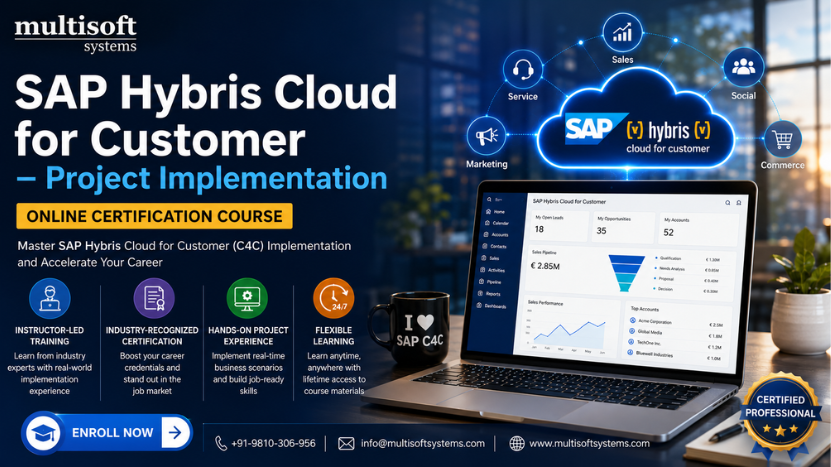
As SAP continues to enhance its Customer Experience (CX) portfolio with technologies such as Artificial Intelligence (AI), Machine Learning (ML), Predictive Analytics, and SAP Business Technology Platform (BTP), organizations can expect even greater innovation and business value. For professionals and businesses looking to build expertise in SAP C4C, Multisoft Systems offers industry-focused SAP Hybris Cloud for Customer (SAP C4C) Training led by experienced trainers. The training combines practical learning, real-world project exposure, and hands-on exercises, enabling learners to gain the skills needed to successfully implement, manage, and optimize SAP C4C solutions in today's competitive business environment.