Course Schedule
| Oct, 2026 | Weekdays | Mon-Fri | Enquire Now |
| Weekend | Sat-Sun | Enquire Now | |
| Nov, 2026 | Weekdays | Mon-Fri | Enquire Now |
| Weekend | Sat-Sun | Enquire Now |
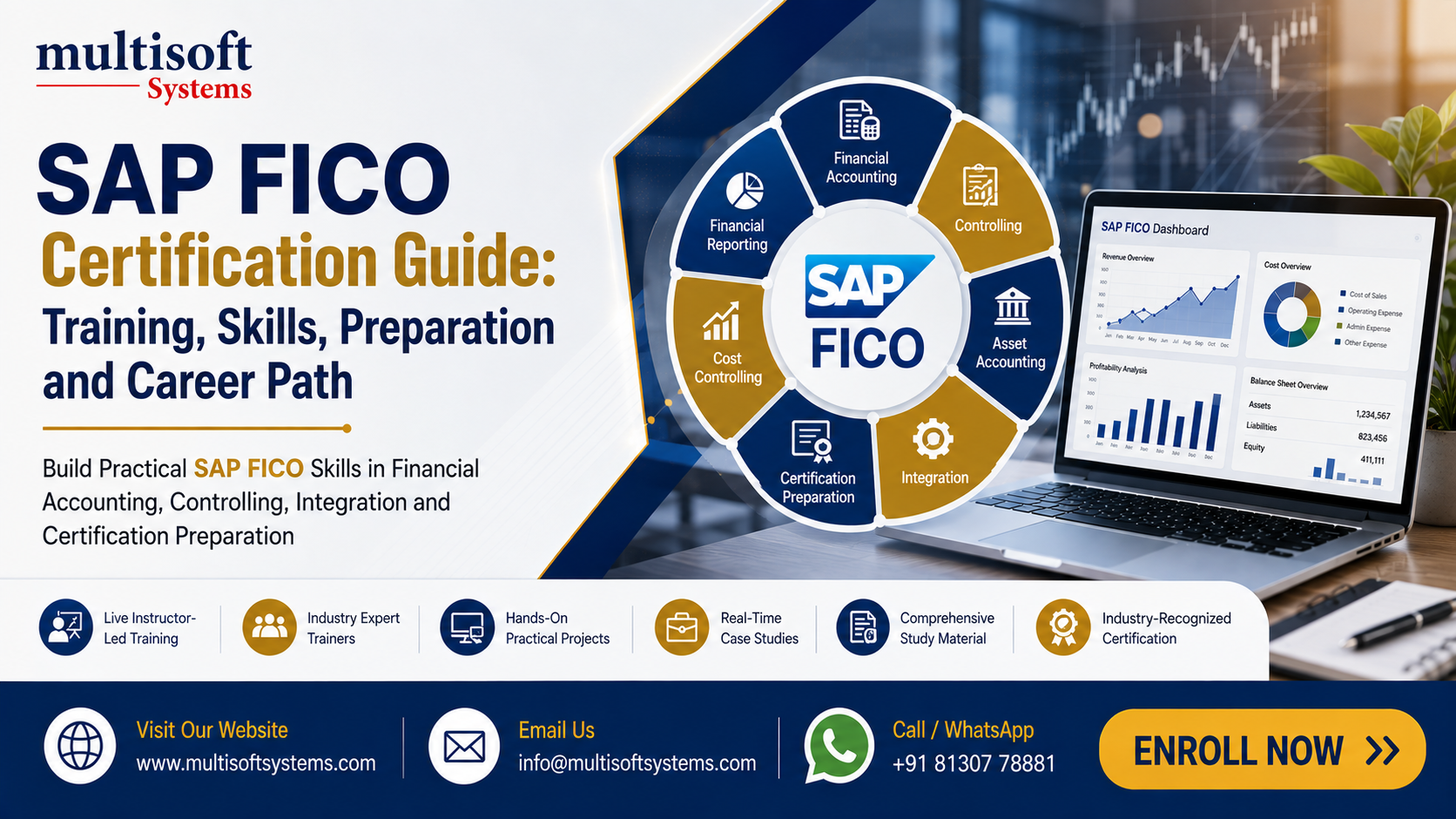
SAP FICO Certification Guide: Training, Skills, Preparation and Career Path
SAP Finance and Controlling (FICO) is one of the key functional areas for managing financial accounting, cost control, reporting, and business processes in an SAP environment. As organizations continue to modernize their finance operations, professionals with SAP finance knowledge can contribute to implementation, support, reporting, accounting automation, and ERP transformation projects. A structured SAP FICO Training program can help learners understand both Financial Accounting (FI) and Controlling (CO). The Multisoft Systems course covers areas such as General Ledger, Accounts Payable, Accounts Receivable, Asset Accounting, Bank Accounting, taxation, closing operations, Cost Center Accounting, Internal Orders, Profit Center Accounting, Product Costing, and Profitability Analysis. It also covers integration with other SAP areas such as MM and SD.
This SAP FICO Certification Guide explains the skills to learn, important topics to prepare, practical learning requirements, and how SAP FICO training can support professional development.
What Is SAP FICO?
SAP FICO stands for Financial Accounting and Controlling. It combines two important SAP functional areas:
- FI - Financial Accounting
- CO - Controlling
Financial Accounting focuses on recording and managing financial transactions. It includes areas such as General Ledger, Accounts Payable, Accounts Receivable, Asset Accounting, Bank Accounting, taxation, and financial reporting. Controlling focuses on internal financial management. It helps organizations monitor costs, revenues, budgets, profitability, and business performance. Together, FI and CO help connect financial accounting with internal management information. This allows organizations to maintain financial records while also analyzing costs and business performance.
SAP FICO Certification: What Should You Understand?
SAP certification preparation should not focus only on memorizing definitions. Learners should understand how financial processes work and how different SAP functions connect.
For example, a finance professional should understand:
- How a financial document is created
- How General Ledger postings work
- How vendor invoices are processed
- How customer invoices are recorded
- How payments are handled
- How open items are cleared
- How assets are acquired and depreciated
- How costs are assigned to cost centers
- How profit centers support performance analysis
- How FI integrates with other SAP modules
SAP's current learning resources for Financial Accounting focus on implementation and customization skills across organizational units, master data, General Ledger, Accounts Payable, Accounts Receivable, Asset Accounting, closing, and reporting.
SAP FICO Training and Certification Preparation
A good training program can provide the foundation needed to prepare for SAP-related certification and real-world projects. Multisoft Systems provides instructor-led online SAP FICO training with project-based learning, experienced trainers, practical exercises, customized schedules, and doubt-clearing sessions. The course is designed for finance professionals, accountants, ERP finance professionals, and finance, CA, and ICWA students. The training covers both accounting concepts and SAP processes, making it useful for learners who want to connect their finance knowledge with ERP applications.
SAP FICO Certification Preparation Roadmap
A structured SAP FICO Certification Preparation Roadmap can help learners build their knowledge step by step instead of trying to study all topics at once. Start with SAP and ERP fundamentals, followed by SAP navigation and enterprise structure. Next, develop a strong foundation in Financial Accounting, including General Ledger, Accounts Payable, Accounts Receivable, Asset Accounting, Bank Accounting, taxation, financial closing, and reporting. After FI, move to Controlling (CO) topics such as Cost Center Accounting, Internal Orders, Profit Center Accounting, Product Costing, and Profitability Analysis. Finally, focus on FI-CO integration, cross-module integration, practical business scenarios, revision, and assessments. This progressive approach can help learners connect accounting concepts with SAP processes and build practical knowledge for certification preparation.
SAP FICO Integration With Other SAP Modules
SAP FICO integration with other SAP modules is important because financial transactions are closely connected with business activities such as purchasing, sales, inventory, production, and human resources. When these processes are integrated, relevant financial information can flow into SAP Financial Accounting and Controlling automatically. The SAP FICO training curriculum covers integration with areas such as Materials Management (MM), Sales and Distribution (SD), and Human Resources (HR).
-
FI-MM Integration
FI-MM integration connects financial accounting with purchasing and materials management activities. Business transactions related to procurement and materials can create corresponding financial postings. This helps finance teams maintain accurate financial records while business activities are processed.
-
FI-SD Integration
FI-SD integration connects financial accounting with sales and distribution processes. When sales-related transactions take place, relevant accounting information can be transferred to Financial Accounting. This helps businesses connect customer sales activities with financial reporting.
-
FI-HR Integration
FI-HR integration connects financial processes with relevant human resource activities. This allows organizations to maintain financial information associated with applicable HR processes and supports better coordination between finance and human resource functions.
-
Why FICO Integration Matters
Understanding integration helps SAP FICO professionals see the complete business process rather than treating finance as a separate function. It also helps learners understand how transactions from different SAP areas can affect financial accounting and controlling. This integration knowledge is particularly useful for professionals preparing for SAP FICO implementation, support, and consulting roles.
SAP FICO Certification Skills Checklist
Before attempting certification-related assessments, learners should be comfortable with the following areas:
SAP Fundamentals
- ERP concepts
- SAP overview
- SAP navigation
- System landscape
- SAP project roles
Financial Accounting
- Enterprise structure
- GL accounting
- AP
- AR
- Asset Accounting
- Bank Accounting
- Taxation
- Financial closing
- Reporting
Controlling
- Cost elements
- Cost centers
- Internal orders
- Profit centers
- Product costing
- Profitability analysis
- Budgeting
Integration
- FI-MM
- FI-SD
- FI-HR
- FI and CO integration
This checklist can help learners identify areas that require more practice.
SAP FICO Training With Practical Learning
Practical exposure can help learners understand how SAP FICO concepts are applied in business environments. Multisoft Systems describes its training as project-based and hands-on, using real-time scenarios, industry case studies, and practical assignments. It also highlights certification training guidance and customized delivery. This approach can help learners move from theoretical understanding to practical application. For example, instead of only learning what Accounts Payable means, learners can work through a complete vendor transaction process. Similarly, instead of memorizing Cost Center Accounting definitions, they can understand how a business department's expenses are tracked and analyzed.
Who Should Choose SAP FICO Training?
SAP FICO training can be useful for professionals who want to combine finance knowledge with ERP skills.
Finance Professionals
They can learn how accounting activities are managed through SAP.
Accountants
Accountants can expand their knowledge from traditional accounting processes to SAP-based financial management.
ERP Professionals
ERP professionals can develop specialized finance and controlling knowledge.
Finance Students
Students can gain exposure to enterprise finance processes.
SAP Aspirants
People planning a career in SAP functional consulting can use structured training to build a foundation in FICO.
SAP FICO Certification and Career Opportunities
SAP FICO knowledge can support career paths in areas such as:
- SAP FICO Consultant
- SAP Finance Consultant
- SAP Controlling Consultant
- SAP Functional Consultant
- SAP Support Consultant
- ERP Finance Consultant
- SAP Implementation Consultant
- Business Process Consultant
Career growth depends on experience, practical knowledge, project exposure, communication skills, and the specific SAP certification or role being pursued.
Professionals should also distinguish between a training completion certificate and an official SAP certification.
Multisoft Systems states that its program provides a course completion certificate and certification preparation guidance.
Official SAP certifications are separate credentials awarded by SAP after successfully completing the applicable certification requirements. SAP's current learning journeys identify specific certification paths for areas such as Financial Accounting in SAP S/4HANA.
SAP FICO Certification vs Training Certificate
This distinction is important for learners.
SAP FICO Training Certificate
A training provider may issue a certificate confirming that a participant completed a training program.
Multisoft Systems states that its training certificate includes details such as the course ID, course name, issue date, awardee name, and digital signature.
SAP Global Certification
An official SAP certification is awarded by SAP after passing the relevant SAP certification examination.
SAP describes its Global Certification badges as recognition of expertise demonstrated through a proctored SAP Global Certification exam.
Therefore, learners should clearly understand which certification they are pursuing before enrolling or preparing for an examination.
How to Prepare for SAP FICO Certification Successfully
A successful preparation plan should combine theory, practical learning, revision, and assessment.
1. Understand Accounting Fundamentals
Make sure you understand:
- Debit and credit
- General Ledger
- Payables
- Receivables
- Assets
- Expenses
- Revenue
- Financial statements
2. Learn SAP Terminology
Understand SAP-specific terms and organizational structures.
3. Study FI First
Build a strong foundation in Financial Accounting.
4. Move to CO
Study cost management, profitability, budgeting, and internal reporting.
5. Learn Integration
Understand how FI and CO interact with other SAP processes.
6. Practice
Use practical exercises and business scenarios.
7. Review Weak Areas
Regularly identify and revise topics that are difficult.
8. Use Current SAP Learning Resources
SAP's current learning journeys provide structured paths for Financial Accounting and related SAP S/4HANA finance skills.
Common SAP FICO Certification Preparation Mistakes
Learners can face difficulties when preparation is based only on memorization.
Common mistakes include:
- Studying definitions without understanding processes
- Ignoring accounting fundamentals
- Focusing only on FI and ignoring CO
- Not learning integration
- Avoiding practical exercises
- Memorizing configuration without understanding business requirements
- Using outdated certification information
- Confusing a training certificate with an official SAP certification
- Not checking the current SAP certification path
- Not revising weak areas
A balanced approach can produce better learning outcomes.
Why Choose Multisoft Systems for SAP FICO Training?
Multisoft Systems offers instructor-led online SAP Finance and Controlling Training with project-based learning and practical exposure.
The course highlights include:
- Instructor-led online training
- Project-based learning
- Certified and experienced trainers
- Course completion certificate
- Customized learning schedules
- Doubt-clearing sessions
- Practical exercises
- Real-world business scenarios
- Certification preparation guidance
The training curriculum covers a broad range of FI and CO topics, from enterprise structure and General Ledger through Accounts Payable, Accounts Receivable, Asset Accounting, Controlling, Product Costing, and Profitability Analysis.
For professionals who prefer guided learning, this format can provide a structured way to develop SAP FICO knowledge.
The Future of SAP FICO Skills
Finance is increasingly connected with automation, analytics, cloud ERP, and real-time business information.
SAP's current finance learning resources emphasize automated finance processes, accounting, cost management, analytics, and planning within SAP S/4HANA Cloud.
For professionals, this means SAP FICO knowledge can increasingly extend beyond traditional accounting.
Future-oriented SAP finance professionals can benefit from developing knowledge of:
- SAP S/4HANA Finance
- Cloud finance processes
- Financial analytics
- Business process automation
- Integrated reporting
- Cost management
- Financial planning
- Cross-module integration
Building these additional skills can help professionals remain relevant as enterprise finance systems evolve.
Conclusion
SAP FICO Training provides a structured way for finance and ERP professionals to understand Financial Accounting and Controlling within an SAP environment. A strong learning path should cover SAP fundamentals, enterprise structure, General Ledger, Accounts Payable, Accounts Receivable, Asset Accounting, Bank Accounting, taxation, closing, Cost Center Accounting, Internal Orders, Profit Center Accounting, Product Costing, Profitability Analysis, and integration. These are central areas covered in the Multisoft Systems SAP FICO curriculum. For certification preparation, learners should combine accounting knowledge, SAP concepts, practical exercises, business scenarios, revision, and assessment. It is also important to distinguish a training completion certificate from an official SAP certification and to verify the current SAP certification path before preparing for an exam. SAP currently provides dedicated learning journeys for Financial Accounting in SAP S/4HANA and SAP S/4HANA Cloud.
With practical SAP FICO knowledge and continued learning in areas such as S/4HANA Finance, cloud ERP, automation, analytics, and integration, professionals can build a stronger foundation for SAP finance and ERP career opportunities.