Course Schedule
| Oct, 2026 | Weekdays | Mon-Fri | Enquire Now |
| Weekend | Sat-Sun | Enquire Now | |
| Nov, 2026 | Weekdays | Mon-Fri | Enquire Now |
| Weekend | Sat-Sun | Enquire Now |
The Role of COMSOL Multiphysics in Advanced Engineering and Scientific Research
In today's competitive engineering and research environment, organizations require powerful tools to design, analyze, and optimize products before physical prototypes are built. Simulation-driven engineering has become a critical part of product development, helping industries reduce costs, shorten development cycles, and improve product reliability. Among the leading simulation platforms available today, COMSOL Multiphysics stands out as one of the most versatile and powerful software solutions for modeling and solving complex physical phenomena.
COMSOL Multiphysics is a finite element analysis (FEA)-based simulation software that enables engineers, scientists, and researchers to model and analyze multiple interacting physical processes within a single environment. Whether dealing with heat transfer, fluid flow, electromagnetics, structural mechanics, chemical reactions, acoustics, or multiphysics interactions, COMSOL provides a unified platform to create highly accurate simulation models. The software is widely used across industries including aerospace, automotive, electronics, energy, biomedical engineering, manufacturing, chemical processing, and academic research. Its ability to couple multiple physical domains makes it particularly valuable for solving real-world engineering problems where different physical effects influence one another simultaneously.
This article by Multisoft Systems provides a detailed overview of COMSOL Multiphysics online training, its architecture, capabilities, working methodology, modules, applications, benefits, challenges, and future trends.
What is COMSOL Multiphysics?
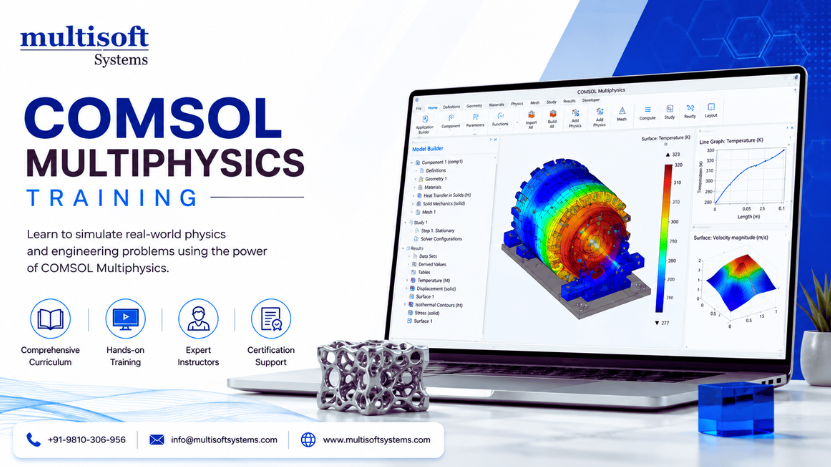
COMSOL Multiphysics is a simulation software platform designed for modeling and solving problems involving multiple physical phenomena. It utilizes advanced numerical techniques, primarily the Finite Element Method (FEM), to simulate real-world systems and predict their behavior under various operating conditions. The software enables users to create virtual prototypes that replicate physical processes and interactions. Instead of relying solely on expensive laboratory testing and physical prototypes, engineers can use COMSOL simulations to evaluate designs, identify potential issues, and optimize performance. One of COMSOL's distinguishing features is its multiphysics capability. Traditional simulation tools often focus on a single discipline, such as structural analysis or fluid dynamics. COMSOL allows these disciplines to interact within the same model, creating more realistic simulations.
For example, an electric motor may involve:
- Electromagnetic fields
- Heat generation
- Structural deformation
- Fluid cooling
COMSOL can model all these processes simultaneously, providing a comprehensive understanding of system performance.
Evolution of COMSOL Multiphysics
COMSOL originated from research in numerical methods and finite element analysis. Over the years, it evolved into a complete simulation environment capable of handling increasingly complex engineering challenges. The software continuously expanded its capabilities by introducing specialized modules for different engineering domains. These additions transformed COMSOL from a finite element solver into a multidisciplinary simulation platform used by organizations worldwide. Today, COMSOL supports advanced simulation workflows, optimization studies, digital prototyping, application deployment, and cloud-based simulation sharing, making it one of the most comprehensive engineering simulation tools available.
Architecture of COMSOL Multiphysics
The architecture of COMSOL Multiphysics is designed to provide flexibility, scalability, and seamless integration of multiple physical domains.
- At the core of the platform lies the COMSOL Simulation Engine, which manages geometry creation, meshing, equation solving, and result visualization. The architecture follows a modular approach where users can add specialized modules based on their engineering requirements.
- The workflow begins with geometry definition. Users can create models directly within COMSOL or import designs from CAD software. The geometry serves as the foundation for all subsequent simulation activities.
- Once the geometry is created, material properties are assigned to various components. These properties may include density, thermal conductivity, electrical conductivity, elasticity, viscosity, and numerous other parameters.
- The next layer involves physics interfaces. These interfaces define the governing equations associated with specific physical phenomena such as fluid flow, heat transfer, structural mechanics, or electromagnetics.
- The meshing engine discretizes the geometry into finite elements. This process converts complex mathematical equations into a form that numerical solvers can handle efficiently.
- The solver framework then performs calculations based on user-defined boundary conditions, material properties, and physical interactions. Advanced algorithms ensure convergence and solution accuracy even for highly nonlinear systems.
Finally, post-processing tools generate graphical outputs such as contour plots, vector fields, temperature distributions, stress maps, animations, and reports that help engineers interpret simulation results effectively.
How COMSOL Multiphysics Works?
COMSOL follows a structured simulation workflow that enables engineers to transform engineering concepts into predictive models. The process begins with defining the physical problem. Engineers identify the phenomena that need to be modeled and determine the objectives of the simulation. Geometry creation is the next step. The model geometry may represent a simple component or a highly complex industrial system. COMSOL provides built-in geometry tools as well as CAD integration capabilities. After geometry preparation, materials are assigned to different regions. Accurate material data is essential because simulation quality depends heavily on realistic physical properties. Physics interfaces are then added to define governing equations. Users can select predefined interfaces or customize equations according to specific requirements. Boundary conditions are applied to represent real-world operating environments. These may include loads, temperatures, voltages, fluid inlet velocities, pressures, or chemical concentrations. The model is then meshed into smaller finite elements. Mesh quality significantly influences solution accuracy and computational efficiency. The solver processes the equations and computes numerical solutions. Depending on model complexity, simulations may range from a few seconds to several hours.
Finally, results are visualized and analyzed using COMSOL's post-processing environment. Engineers can evaluate system behavior, identify design weaknesses, and optimize performance based on simulation insights.
Key Features
COMSOL offers a wide range of advanced capabilities that make it suitable for both industrial and research applications.
1. Unified Simulation Environment
All physics modules operate within a common platform, eliminating the need to transfer data between different software tools.
2. Multiphysics Coupling
Users can combine multiple physical phenomena within a single model, improving simulation realism and accuracy.
3. Advanced Meshing Technology
The software provides automated and customizable meshing options for complex geometries.
4. Parametric Studies
Engineers can analyze how design changes affect system performance through automated parameter variations.
5. Optimization Capabilities
Design optimization tools help identify the best configuration based on predefined objectives and constraints.
6. Application Builder
Users can create custom simulation applications for non-experts, simplifying simulation deployment across organizations.
7. High-Performance Computing Support
COMSOL supports parallel processing and cluster computing for large-scale simulations.
8. CAD Integration
The platform integrates with major CAD systems, enabling efficient model preparation and updates.
Major Modules
COMSOL offers specialized modules that address different engineering disciplines.
1. Structural Mechanics Module
This module focuses on stress analysis, deformation, vibration, fatigue, and structural performance evaluation. Engineers use it to analyze mechanical components subjected to various loading conditions.
2. Heat Transfer Module
The Heat Transfer Module simulates conduction, convection, radiation, and thermal management systems. It is widely used in electronics cooling, manufacturing, and energy applications.
3. CFD Module
The Computational Fluid Dynamics (CFD) Module analyzes fluid flow, pressure distribution, turbulence, and heat transfer in liquids and gases.
4. AC/DC Module
This module supports simulation of electric fields, electrostatics, current flow, and electromagnetic devices.
5. RF Module
The RF Module is used for antennas, microwave devices, waveguides, and wireless communication systems.
6. Chemical Reaction Engineering Module
This module helps engineers simulate chemical reactions, reactor performance, and process optimization.
7. Acoustics Module
The Acoustics Module supports noise analysis, vibration studies, speaker design, and acoustic system development.
8. Plasma Module
The Plasma Module enables simulation of plasma-based processes used in semiconductor manufacturing, surface treatment, and research applications.
9. Semiconductor Module
This module supports advanced semiconductor device simulation including transistors, diodes, and integrated circuits.
Advantages
COMSOL provides several advantages that contribute to its widespread adoption across industries.
- The ability to couple multiple physical phenomena allows engineers to create realistic models that closely represent actual operating conditions.
- Its intuitive graphical interface simplifies model development while still providing access to advanced simulation capabilities.
- The software reduces development costs by minimizing the need for physical prototypes and repeated experimental testing.
- COMSOL supports innovation by enabling engineers to explore design alternatives quickly and efficiently.
- The platform offers exceptional flexibility, allowing users to define custom equations and specialized physics models beyond standard engineering applications.
- Its scalability makes it suitable for both small research projects and large industrial simulations.
Industrial Applications
COMSOL is extensively used across diverse industrial sectors. In aerospace engineering, it supports thermal analysis, structural assessment, propulsion system design, and electromagnetic compatibility studies. Automotive manufacturers use COMSOL for battery thermal management, aerodynamics, electric vehicle design, and vibration analysis. Electronics companies rely on the software for cooling system design, semiconductor development, antenna simulation, and electromagnetic interference studies. In the energy sector, COMSOL assists with fuel cells, batteries, solar panels, wind energy systems, and power generation equipment. Biomedical engineers use the platform to model medical devices, drug delivery systems, tissue interactions, and diagnostic equipment. Chemical industries employ COMSOL for reactor design, process optimization, mass transfer analysis, and environmental simulations. Research institutions use the software extensively for scientific investigations involving complex multiphysics phenomena.
COMSOL Multiphysics in Academic Research
Academic institutions worldwide utilize COMSOL as a teaching and research tool. Its flexibility enables researchers to model experimental systems before conducting physical investigations. Universities often incorporate COMSOL into engineering curricula to help students understand fundamental physical principles through simulation-based learning. Research projects involving nanotechnology, renewable energy, biomedical engineering, material science, and advanced manufacturing frequently depend on COMSOL for predictive analysis and design optimization.
The software also facilitates publication-quality visualization and validation of scientific findings.
Challenges in Using COMSOL Multiphysics
Despite its powerful capabilities, COMSOL presents certain challenges.
- Developing highly accurate models requires a strong understanding of both engineering principles and numerical simulation techniques.
- Complex multiphysics simulations can demand significant computational resources, particularly when dealing with large geometries or highly detailed meshes.
- Selecting appropriate boundary conditions, solver settings, and material properties often requires considerable expertise.
- Model validation remains essential because simulation accuracy depends heavily on input quality and assumptions.
- Organizations may also face licensing costs when deploying multiple specialized modules across large engineering teams.
However, proper training and experience can significantly reduce these challenges and improve simulation effectiveness.
Future Trends of COMSOL Multiphysics
The future of COMSOL Multiphysics certification is closely aligned with emerging technologies and digital engineering initiatives. Artificial Intelligence and machine learning are expected to enhance simulation workflows by improving optimization, surrogate modeling, and predictive analysis. Digital twin technology will increasingly rely on COMSOL simulations to create virtual representations of physical assets for real-time monitoring and performance prediction. Cloud computing will enable larger simulations and greater collaboration among globally distributed engineering teams. Integration with Industrial Internet of Things (IIoT) platforms will support real-time data-driven simulation and operational optimization. Advanced automation capabilities will simplify model creation and reduce the expertise required for routine simulation tasks. As industries continue embracing virtual engineering and simulation-driven product development, COMSOL will remain a critical platform for innovation and technological advancement.
Conclusion
COMSOL Multiphysics has established itself as one of the most powerful and versatile simulation platforms available today. Its ability to combine multiple physical phenomena within a unified environment enables engineers and researchers to solve complex real-world problems with remarkable accuracy. From structural mechanics and fluid dynamics to electromagnetics, heat transfer, acoustics, plasma physics, and chemical engineering, COMSOL provides a comprehensive set of tools for simulation-driven design and analysis. Organizations across aerospace, automotive, electronics, energy, biomedical, and manufacturing industries depend on its capabilities to accelerate innovation, reduce costs, and improve product quality.
As digital transformation continues to reshape engineering practices, COMSOL Multiphysics training will play an increasingly important role in virtual prototyping, digital twins, artificial intelligence integration, and advanced product development. Its flexibility, scalability, and multiphysics capabilities ensure that it will remain a leading solution for engineering simulation and scientific research for years to come. Enroll in Multisoft Systems now!