Course Schedule
| Oct, 2026 | Weekdays | Mon-Fri | Enquire Now |
| Weekend | Sat-Sun | Enquire Now | |
| Nov, 2026 | Weekdays | Mon-Fri | Enquire Now |
| Weekend | Sat-Sun | Enquire Now |
Transform Financial Services with Smarter Salesforce Skills
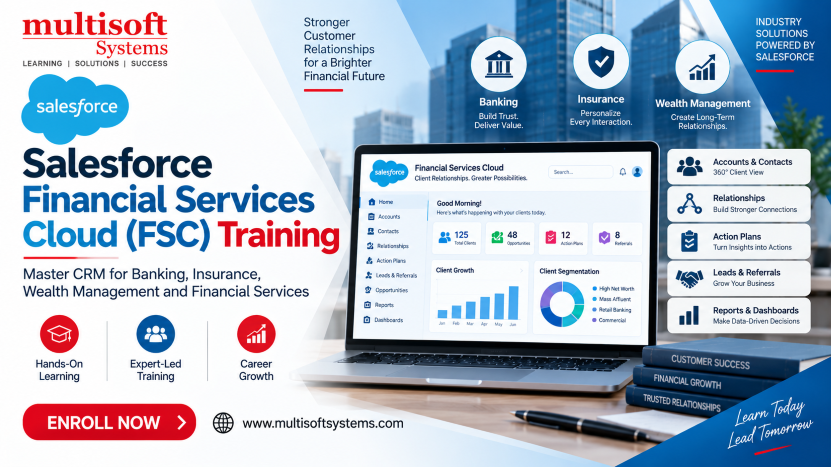
The financial services industry is changing quickly. Banks, insurance companies, wealth management firms and lending organizations need better ways to manage customer relationships, connect information and deliver personalized services. Salesforce Financial Services Cloud (FSC) is designed to support these industry-specific requirements by bringing customer and financial information together in a unified CRM environment. Salesforce Financial Services Cloud (FSC) Training helps professionals understand how to configure, customize and use Salesforce capabilities for financial services.
The course covers areas such as accounts and contacts, relationships, life events, business milestones, action plans, document tracking, leads, referrals, opportunities, compliant data sharing, mobile capabilities and industry-specific features.
What Is Salesforce Financial Services Cloud?
Salesforce Financial Services Cloud (FSC) Training is a Salesforce solution designed around the needs of financial services organizations. It supports different areas including banking, insurance, wealth management, mortgage and investment services. The platform brings customer information and financial relationships into a connected environment. Salesforce currently positions Financial Services Cloud as Agentforce Financial Services, with capabilities that use AI and automation to support financial professionals and customer engagement. For professionals, this means learning how Salesforce can be adapted to financial workflows instead of using a general CRM approach alone.
Why Is FSC Important for Financial Services?
Financial organizations manage large amounts of customer, account, relationship and transaction-related information. Employees also need to coordinate activities across different departments while maintaining appropriate data controls. A financial-services-focused CRM can help teams organize customer information and support more consistent processes.
FSC can help organizations with:
- Customer relationship management
- Account and contact management
- Relationship mapping
- Leads and referrals
- Opportunities
- Action planning
- Document tracking
- Reporting and dashboards
- Mobile access
- Industry-specific processes
- Compliant data sharing
Salesforce also highlights unified customer data, personalized engagement, automation and industry-specific AI as important capabilities of its current Financial Services Cloud offering.
What You Learn in Salesforce Financial Services Cloud Training
The training provides a structured introduction to the major features used in Salesforce Financial Services Cloud. According to the Multisoft Systems curriculum, learners move from industry fundamentals and FSC basics into customer records, relationships, action plans, referrals, industry-specific features and reporting.
1. Introduction to Salesforce Industry Verticals
The course starts with an understanding of Salesforce industry solutions and the specific requirements of financial services organizations. Learners can understand how different financial sectors have different business processes and customer requirements.
The training covers financial service areas such as:
- Banking
- Wealth management
- Insurance
- Mortgage
- Investments
- Credit services
This foundation makes it easier to understand why FSC provides specialized capabilities for financial organizations.
2. Introduction to Salesforce Financial Services Cloud
This section introduces FSC and its purpose within financial services organizations. Learners explore the platform's core concepts and understand how its features can be configured around business requirements. The focus is not only on using the platform but also on understanding how Salesforce administrators, consultants, developers and architects can work with FSC features.
3. Getting Started with FSC
Once the basic concepts are covered, learners move into the FSC environment and its essential functionality. This stage helps participants become familiar with the platform and understand how different components work together. A strong understanding of the basic environment creates a foundation for more advanced configuration and financial services use cases.
4. Accounts and Contacts in FSC
Accounts and contacts are central to customer relationship management. FSC provides a way to organize customer information and connect it with relevant financial relationships.
Training in this area helps learners understand how customer records can be managed within the financial services environment.
Key areas include:
- Account management
- Contact management
- Customer information
- Financial relationships
- Customer data organization
- Connected client information
A well-structured customer record can help financial professionals access relevant information more efficiently.
5. Relationships in FSC
Financial services often involve complex relationships between individuals, households, businesses and financial organizations. Relationship management is therefore an important part of FSC. Learners explore how relationships can be represented within Salesforce so users can understand the connections surrounding a customer. This can help professionals develop a broader view of customer relationships rather than looking at individual records in isolation.
Life Events and Business Milestones
Customers' financial needs can change as their personal and professional situations change. Events such as marriage, retirement, buying a home or starting a business may influence financial planning and service requirements. FSC training introduces Life Events and Business Milestones so learners can understand how relevant events can be captured and associated with customer relationships. This information can help financial professionals identify opportunities to have more meaningful conversations with customers.
Understanding Roll-Ups
Roll-ups help users summarize relevant information across related records. In a financial services environment, summarized information can make it easier to understand a customer's wider relationship with an organization. Learning roll-ups helps participants understand how related information can be brought together to support a broader customer view.
Action Plans for Financial Workflows
Action plans are another important area of FSC training. They help organize activities and tasks around specific business processes. For example, a financial professional may need to complete several activities when onboarding a new client or handling a particular financial service request. Training covers how action plans can help structure these activities and create more consistent workflows.
Document Tracking and Approvals
Financial services organizations regularly work with documents that may require review, approval and tracking. Proper document management can help teams maintain organized processes. The FSC curriculum includes document tracking and approvals, helping learners understand how these activities can be handled within the Salesforce environment. This area is particularly useful for professionals who work with customer onboarding, lending, insurance or other processes involving multiple documents and approvals.
Leads, Referrals and Opportunities
Sales and relationship development are important parts of financial services. FSC provides capabilities for managing leads, referrals and opportunities throughout the customer lifecycle. Training helps learners understand how these areas can be used to organize potential business and customer interactions.
Key concepts include:
- Lead management
- Referral management
- Opportunity tracking
- Business development
- Customer follow-up
- Relationship-based selling
Salesforce's current Financial Services Cloud capabilities also emphasize connecting the sales cycle from prospecting through onboarding and using unified customer information to support personalized engagement.
Compliant Data Sharing
Financial organizations handle sensitive customer information and therefore need appropriate processes for sharing data. The training includes compliant data sharing as part of the FSC curriculum. This helps learners understand the importance of managing financial information responsibly within Salesforce-based workflows. Data governance and security requirements can vary by organization and jurisdiction, so professionals should always follow their company's policies and applicable regulations.
FSC on Mobile Devices
Financial professionals are not always working from a desk. Advisors, bankers, loan officers and insurance professionals may need access to customer information while meeting clients or working remotely. The course includes FSC on mobile, helping learners understand how financial service users can work with Salesforce capabilities beyond the traditional desktop environment. Mobile access can support productivity by allowing professionals to stay connected with customer information and activities when working away from their main workstation.
FSC Features for Different Financial Sectors
One of the strongest aspects of Financial Services Cloud is its focus on different financial services segments. The Multisoft Systems curriculum specifically includes commercial banking, insurance, mortgage, retail banking and wealth management features.
-
Commercial Banking
Commercial banking involves business customers with different financial needs from individual consumers. FSC can support relationship management and processes designed around commercial banking requirements.
-
Insurance
Insurance organizations need to manage policyholders, relationships and service interactions. FSC provides industry-specific capabilities designed to support insurance processes.
-
Mortgage
Mortgage operations involve customers, applications, documents, approvals and multiple stakeholders. FSC includes mortgage-related features that can support these workflows.
-
Retail Banking
Retail banking focuses heavily on individual and household relationships. A connected customer view can help banking professionals better understand customer needs and interactions.
-
Wealth Management
Wealth management professionals need a strong understanding of clients, households, goals and financial relationships. Salesforce highlights unified portfolio and relationship information as part of its current financial services capabilities.
Reports and Dashboards in FSC
Data becomes more useful when professionals can convert it into understandable information. FSC training includes reports and dashboards to help users work with business information and monitor important activities.
Reports and dashboards can support:
- Customer analysis
- Sales performance
- Opportunity tracking
- Referral monitoring
- Activity management
- Business reporting
- Management decisions
The ability to interpret CRM data is becoming increasingly important as financial organizations rely on data-driven customer engagement.
The Role of AI in Modern Financial Services Cloud
The Salesforce financial services platform is evolving beyond traditional CRM functionality. Salesforce now highlights AI-powered capabilities designed specifically for financial services. Current capabilities include AI-supported client engagement, financial planning insights, automation and AI agents for financial workflows. Salesforce also describes Agentforce Financial Services as a way to use industry-specific AI and unified data across banking, wealth and insurance environments. This makes AI awareness increasingly valuable for professionals learning FSC. However, users should understand both the business purpose and the controls required when working with sensitive financial data.
Who Should Learn Salesforce FSC?
Multisoft Systems specifically lists Salesforce Administrators, Consultants, Developers, Architects and relevant financial services end-users among the target audience. The end-user group includes wealth managers, personal bankers, loan officers and insurance agents.
The training can be useful for:
- Salesforce Administrators
- Salesforce Consultants
- Salesforce Developers
- Salesforce Architects
- Wealth Managers
- Personal Bankers
- Loan Officers
- Insurance Agents
- Financial services professionals working with Salesforce
Prerequisites for Salesforce FSC Training
The Multisoft Systems course page states that Salesforce Lightning Experience is required. It also recommends work experience as a Salesforce Certified Administrator or App Builder for Salesforce administrators, architects, consultants and developers.
Beginners should ideally have a basic understanding of:
- Salesforce CRM
- Salesforce Lightning
- Accounts and contacts
- CRM workflows
- Basic Salesforce administration
A foundation in financial services can also make industry-specific concepts easier to understand.
Why Hands-On Practice Matters
Understanding FSC concepts is useful but practical experience makes the learning more meaningful. Working through realistic scenarios can help learners understand how financial services processes are represented in Salesforce.
Hands-on practice can include:
- Creating and managing customer records
- Working with relationships
- Building action plans
- Managing leads and referrals
- Exploring opportunities
- Working with reports
- Understanding dashboards
- Exploring industry-specific features
- Reviewing mobile functionality
Project-based learning can also help learners connect technical Salesforce capabilities with real business requirements.
Career Opportunities After FSC Training
Salesforce skills combined with financial services knowledge can create opportunities across consulting, administration, development and implementation.
Potential roles include:
- Salesforce FSC Consultant
- Salesforce Administrator
- Salesforce Developer
- Salesforce Business Analyst
- Salesforce Solution Architect
- Salesforce Implementation Consultant
- Financial Services CRM Consultant
- Salesforce Technical Consultant
Professionals who understand both Salesforce and financial services workflows can be valuable when organizations need to customize CRM systems for specific industry requirements.
Why Choose Multisoft Systems for Salesforce FSC Training?
Multisoft Systems provides instructor-led online training with project-based learning, experienced trainers, a course completion certificate, customized learning schedules and doubt-clearing sessions. The course is designed around the features and workflows that financial services professionals need to understand.
Key benefits include:
- Instructor-led online learning
- Project-based training
- Experienced trainers
- Customized learning schedules
- Doubt-clearing sessions
- Course completion certificate
- Financial services-focused curriculum
- MCQ and short-answer assessment
Multisoft Systems also offers corporate training designed around organizational learning goals and budgets.
Assessment and Learning Evaluation
The Salesforce FSC training includes an assessment that evaluates understanding through MCQs and short-answer questions. It also considers analytical thinking, problem-solving and communication skills. The assessment platform includes secure login, automated scoring and time controls. Assessment can help learners identify knowledge gaps and strengthen their understanding of important FSC concepts.
Final Thoughts
Salesforce Financial Services Cloud is designed to address the specific needs of banking, insurance, mortgage and wealth management organizations. Its capabilities cover customer relationships, accounts, referrals, opportunities, action plans, documents, reporting and industry-specific workflows. As Salesforce continues to add AI and automation capabilities to its financial services platform, professionals who understand both CRM fundamentals and financial industry processes can develop relevant skills for modern digital transformation.
Salesforce Financial Services Cloud (FSC) Training from Multisoft Systems provides a structured way to learn these concepts through instructor-led sessions and project-based learning. For Salesforce professionals and financial services users who want to strengthen their industry-specific CRM knowledge, this training can be a practical step toward broader Salesforce career opportunities.