Course Schedule
| Oct, 2026 | Weekdays | Mon-Fri | Enquire Now |
| Weekend | Sat-Sun | Enquire Now | |
| Nov, 2026 | Weekdays | Mon-Fri | Enquire Now |
| Weekend | Sat-Sun | Enquire Now |
Understanding API 650 Tank Design Standards for Aboveground Storage Tanks
API 650 Tank Design is a globally recognized standard for the design, fabrication, erection, and inspection of welded steel storage tanks used primarily in the oil, gas, petrochemical, and chemical industries. Developed and maintained by the American Petroleum Institute, this standard ensures that atmospheric storage tanks are built to safely store liquids at near-ambient pressure conditions while meeting strict requirements for structural integrity, safety, and reliability. Over decades, API 650 has evolved into the most widely adopted reference for aboveground welded steel tanks. Engineers, fabricators, inspectors, and project owners rely on this standard to minimize design errors, control fabrication quality, and ensure long-term performance of tanks operating under a wide range of environmental and service conditions.
This blog by Multisoft Systems provides a comprehensive overview of API 650 Tank Design online training, covering its scope, design philosophy, materials, key components, load considerations, fabrication rules, inspection requirements, and practical benefits.
What Is API 650?
API 650 is a standard that specifies requirements for the design and construction of welded steel tanks for the storage of liquids at atmospheric pressure or very low internal pressures. These tanks are commonly used for crude oil, refined petroleum products, chemicals, water, and other non-volatile liquids. The standard applies primarily to tanks with:
- A maximum internal pressure not exceeding 2.5 psig
- A design metal temperature typically above –40°C
- Cylindrical, vertical, aboveground construction
API 650 is not limited to oil and gas applications. It is widely used in power plants, water treatment facilities, fertilizer plants, and other industrial sectors where safe liquid storage is essential.
Scope and Applicability of API 650
API 650 covers the complete lifecycle of a storage tank from engineering design to final inspection. Its scope includes:
- Design calculations for shell, bottom, roof, and structural components
- Selection of materials and plate thicknesses
- Fabrication and welding requirements
- Erection tolerances and dimensional controls
- Inspection, testing, and documentation
The standard is applicable to both new tank construction and tank modifications when referenced by project specifications. However, it does not cover underground tanks, pressure vessels, or tanks designed for high internal pressure. For such applications, other standards like API 620 or ASME codes are typically used.
Design Philosophy of API 650 Tanks
The design philosophy of API 650 tanks is centered on ensuring safety, reliability, and long-term structural integrity through conservative and proven engineering practices. Developed by the American Petroleum Institute, the API 650 standard emphasizes simplicity, consistency, and practicality in the design of aboveground welded steel storage tanks operating at atmospheric or near-atmospheric pressure. Instead of relying heavily on complex numerical modeling, API 650 uses empirical formulas and established engineering methods derived from decades of field experience and industry performance data. The philosophy prioritizes adequate shell thickness to resist hydrostatic liquid pressure, stable bottom and foundation interaction to minimize settlement-related failures, and robust roof and structural designs to withstand environmental loads such as wind, seismic forces, and snow. A key aspect of API 650 is its conservative safety margins, which account for material variability, fabrication tolerances, corrosion, and unforeseen operating conditions.
Welded construction is a fundamental requirement, ensuring leak-tightness and structural continuity throughout the tank. Additionally, the standard integrates inspection, testing, and quality control as part of the overall design intent, recognizing that proper construction and verification are as critical as calculations. This holistic, experience-based philosophy has made API 650 certification the most trusted and widely adopted standard for atmospheric storage tank design worldwide.
Materials of Construction
Materials of construction in API 650 tank design are selected to ensure adequate strength, durability, weldability, and resistance to service-related degradation under atmospheric storage conditions. As specified by the American Petroleum Institute, the standard primarily permits carbon steel and low-alloy steel materials that meet defined chemical composition and mechanical property requirements. Commonly used plate materials include ASTM A36, ASTM A283, ASTM A285, and ASTM A516, chosen based on yield strength, thickness availability, operating temperature, and expected corrosion rates. The design also considers material toughness, particularly for low-temperature service, where impact testing may be required to prevent brittle fracture. Roof plates, bottom plates, and structural components such as rafters, columns, and wind girders generally use compatible steel grades to ensure uniform performance during fabrication and service. In addition, API 650 requires consideration of corrosion allowance and compatibility with protective coatings or cathodic protection systems. Proper material selection in accordance with API 650 is fundamental to achieving long service life, safe operation, and consistent weld quality in welded steel storage tanks.
Tank Components Defined in API 650
An API 650 storage tank consists of several key components, each with specific design requirements.
1. Tank Shell
The shell is the vertical cylindrical wall that contains the stored liquid. Its thickness varies from course to course, with thicker plates at the bottom to withstand higher hydrostatic pressure. API 650 provides formulas such as the one-foot method and variable design point method to calculate shell thickness accurately.
2. Tank Bottom
The bottom prevents leakage into the soil and provides structural support. API 650 specifies minimum thicknesses, corrosion allowances, and welding details for bottom plates. Annular plates are often used in larger tanks to handle higher stresses at the shell-to-bottom junction.
3. Tank Roof
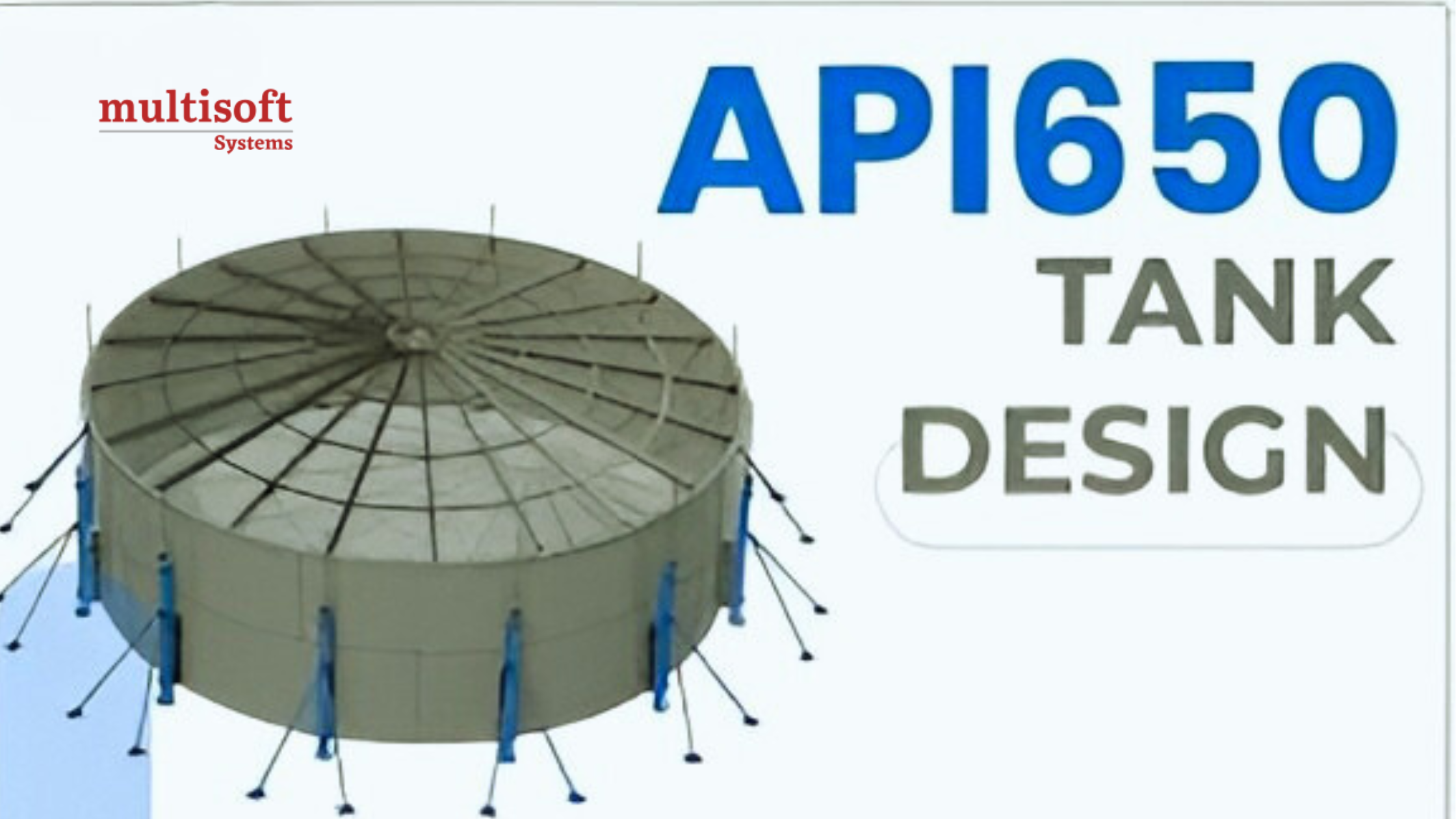
API 650 allows several roof types, including:
- Cone roof
- Dome roof
- Floating roof (external or internal)
The roof design depends on stored product, vapor control requirements, and environmental loads.
4. Nozzles and Appurtenances
Nozzles, manways, vents, and fittings are designed to allow safe operation, inspection, and maintenance. API 650 defines reinforcement requirements to ensure openings do not weaken the shell.
Load Considerations in API 650 Tank Design
Load considerations in API 650 tank design training are critical to ensuring the structural stability and safe operation of aboveground welded steel storage tanks throughout their service life. The design accounts for multiple load types acting individually and in combination, as defined by the American Petroleum Institute standard. The primary load is hydrostatic pressure generated by the stored liquid, which directly influences shell thickness and bottom design. Dead loads include the self-weight of the shell, bottom, roof, insulation, and all permanently attached appurtenances. Live loads mainly apply to roof structures and consider maintenance personnel and temporary equipment. Environmental loads play a significant role, particularly wind loads that can cause shell buckling or overturning, and seismic loads that induce hydrodynamic pressures, uplift, and sliding forces in earthquake-prone regions. In colder climates, snow loads must also be considered in roof design to prevent structural overstressing. API 650 defines appropriate load combinations and allowable stresses to ensure tanks remain stable under normal operation, testing, and extreme environmental conditions, providing a conservative and reliable framework for safe tank design.
Welding and Fabrication Requirements
Welding quality is fundamental to the integrity of API 650 tanks. The standard specifies:
- Approved welding processes
- Welder qualification requirements
- Welding procedure specifications (WPS)
All shell and bottom joints are welded, ensuring leak-tight construction. API 650 defines joint types, weld sizes, and inspection methods to maintain consistent quality across projects. Fabrication tolerances are also addressed, controlling roundness, plumbness, and dimensional accuracy to ensure proper tank performance.
Foundation and Settlement Considerations
Foundation and settlement considerations are vital to the safe and reliable performance of API 650 storage tanks, as the foundation directly supports the tank shell and bottom while distributing loads to the underlying soil. According to guidelines set by the American Petroleum Institute, an inadequately designed foundation can lead to uneven settlement, excessive shell stresses, bottom plate distortion, and long-term leakage issues. API 650 emphasizes that while detailed foundation design may be performed separately, tank designers must account for anticipated soil behavior, loading conditions, and settlement limits during the engineering phase. Uniform load transfer, proper drainage, and sufficient bearing capacity are essential to maintaining tank stability throughout its operational life. Controlled settlement within allowable limits is acceptable; however, differential settlement must be minimized to avoid structural damage at the shell-to-bottom junction and along weld seams.
Key Foundation and Settlement Considerations:
- Selection of suitable foundation type such as ringwall, slab (mat), or piled foundation based on soil conditions
- Adequate bearing capacity to support hydrostatic, dead, and environmental loads
- Proper compaction of subgrade and foundation materials to reduce post-construction settlement
- Control of differential settlement to prevent shell distortion and bottom cracking
- Effective drainage systems to avoid water accumulation and soil softening
- Monitoring and maintenance to detect and manage settlement during service life
These considerations ensure long-term structural integrity and leak-free performance of API 650 tanks.
Corrosion Allowance and Protection
Corrosion is a major concern for storage tanks. API 650 requires designers to include corrosion allowance in shell and bottom thickness calculations based on expected service conditions. Additional protection methods include:
- Protective coatings
- Cathodic protection systems
- Corrosion-resistant materials
Proper corrosion management extends tank life and reduces maintenance costs.
Advantages of API 650 Tank Design
API 650 offers several key benefits that make it the preferred standard worldwide.
- Proven and widely accepted design methodology
- High safety margins and reliability
- Flexibility for different tank sizes and applications
- Clear guidance for fabrication, inspection, and testing
- Compatibility with international engineering practices
These advantages make API 650 tanks suitable for both small storage facilities and large tank farms.
API 650 vs Other Tank Standards
|
Parameter |
API 650 |
API 620 |
EN 14015 |
ASME Section VIII |
|
Governing Body |
American Petroleum Institute |
American Petroleum Institute |
European Committee for Standardization (CEN) |
American Society of Mechanical Engineers |
|
Tank Type |
Welded steel atmospheric storage tanks |
Welded steel low-pressure storage tanks |
Welded steel atmospheric tanks |
Pressure vessels |
|
Design Pressure |
Atmospheric to ≤ 2.5 psig |
Up to 15 psig |
Atmospheric to low pressure |
High internal pressure |
|
Typical Applications |
Crude oil, petroleum products, chemicals, water |
Refrigerated and low-pressure tanks |
Fuel, chemicals, water (Europe) |
Process vessels, reactors, separators |
|
Tank Orientation |
Vertical, aboveground |
Vertical, aboveground |
Vertical, aboveground |
Vertical or horizontal |
|
Roof Types |
Cone, dome, internal/external floating |
Cone, dome, self-supporting |
Cone, dome, floating |
Not applicable |
|
Design Methodology |
Empirical formulas, conservative stress limits |
Advanced stress analysis |
Similar to API 650 with EU practices |
Detailed stress and pressure design |
|
Seismic & Wind Design |
Included with defined load combinations |
Included (more rigorous) |
Included (Eurocode-aligned) |
Included but pressure-focused |
|
Global Usage |
Worldwide (most widely adopted) |
Specialized applications |
Primarily Europe |
Worldwide (pressure equipment) |
|
Cost & Complexity |
Moderate, cost-effective |
Higher due to pressure design |
Moderate |
High |
|
When to Use |
Large atmospheric storage tanks |
Low-pressure or refrigerated tanks |
Projects governed by EU codes |
High-pressure containment |
Applications of API 650 Tanks
API 650 tanks are used across multiple industries, including:
- Crude oil and petroleum product storage
- Petrochemical and chemical plants
- Power generation facilities
- Water and wastewater treatment plants
- Agricultural and fertilizer storage
Their versatility and proven performance make them a cornerstone of industrial storage infrastructure.
Conclusion
API 650 Tank Design represents the benchmark for safe and reliable storage of liquids in welded steel tanks. By providing clear design rules, material specifications, fabrication requirements, and inspection procedures, the standard ensures that tanks can withstand operational, environmental, and accidental loads throughout their service life.
For engineers, inspectors, and plant owners, understanding API 650 is essential to delivering storage systems that are not only compliant but also durable and cost-effective. As industries continue to demand higher safety and environmental standards, API 650 will remain a critical reference for aboveground storage tank design worldwide. Enroll in Multisoft Systems now!