PTC Creo elements/Pro (Pro/E) Training
Build advanced 3D CAD and product design skills with PTC Creo Elements/Pro (Pro/E) Training. Learn part modeling, assemblies, surface design, drafting and design optimization through practical exercises, helping engineers and designers create accurate, efficient and production-ready mechanical designs.
 1K+ Reviews
Instructor-Led Training Parameters
Course Highlights
- Instructor-led Online Training
- Project Based Learning
- Certified & Experienced Trainers
- Course Completion Certificate
- Customized Learning Schedule
- Doubt-Clearing Sessions
PTC Creo elements/Pro (Pro/E) Training Course Overview
PTC Creo Elements/Pro (formerly known as Pro/E) is an integrated CAD/CAM/CAE parametric modeling software from PTC, Parametric Technology Corporation. This software serves as an integral and a scalable designing platform. It is widely used software among the mechanical engineers for designing complete 3D models of the product. The knowledge of using the available range of tools enables the user to produce collaborative development.
Creo Elements/Pro (Pro/E) training equips the aspirants with the skills related to the rule-based capabilities and integrated-designing functions of this mechanical design software. The participants explore solid modeling, assembly modeling, sheetmetal designing, drafting, and finite element analysis. Through this training the candidates gain capabilities in designing, analysis, and manufacturing.
At the completion of this training you will exhibit the following skills:
- Understanding Solid Part Modeling & Assembly
- Using Sketcher tools and layers
- Creating Swept Blends, holes, chamfers
- Measuring and Inspecting Models
- Creating and modifying sheetmetal design and models
- Practicing surface modeling and tools
- Creating and editing solids using Quilts
- Creating New Drawings and Drawing Views
- Adding Model Details to Drawings
Target audience
- Mechanical Engineer
- Designer
- Analyst
Prerequisites
The candidates from mechanical background or having Pro/E experience are ideal for this training.
Instructor-led Training Live Online Classes
Suitable batches for you
| Oct, 2026 | Weekdays | Mon-Fri | Enquire Now |
| Weekend | Sat-Sun | Enquire Now | |
| Nov, 2026 | Weekdays | Mon-Fri | Enquire Now |
| Weekend | Sat-Sun | Enquire Now |
Share details to upskills your team
Enquire for Self-Paced Learning
Share your details and our training advisor will connect with you regarding self-paced learning options.
PTC Creo elements/Pro (Pro/E) Training Course Content
Part Modeling & Assembly
1. Introduction to the Pro/ENGINEER Wildfire Basic Modeling Process- Pro/ENGINEER Wildfire Basic Modeling Process
- Understanding Solid Modeling Concepts
- Understanding Feature-Based Concepts
- Understanding Parametric Concepts
- Understanding Associative Concepts
- Understanding Model-Centric Concepts
- Recognizing File Extensions
- Understanding the Main Interface
- Understanding the Folder Browser
- Understanding the Window Menu
- Setting the Working Directory and Opening and Saving Files
- Managing Files in Pro/ENGINEER
- Understanding Basic Display Options
- Creating and Managing View Orientations
- Managing and Editing Appearances
- Setting Up New Part Models
- Understanding Pro/ENGINEER Basic Controls
- Using Drag Handles
- Understanding the Model Tree
- Selecting Items using Direct Selection
- Selecting Items using Query Selection
- Understanding Selection Filters
- Utilizing Undo and Redo Operations
- Editing Features and Regenerating
- Activating and Editing Models
- Using Dynamic Edit
- Deleting and Suppressing Items
- Reviewing Sketcher Theory
- Understanding Design Intent
- Utilizing ConstraintsSketching Lines
- Sketching Centerlines
- Sketching Rectangles and Parallelograms
- Sketching Circles
- Sketching Arcs
- Understanding Construction Geometry Theory
- Using Geometry Tools within Sketcher
- Dimensioning Entities within Sketcher
- Modifying Dimensions within Sketcher
- Sketcher Conflicts
- Creating Sketches ('Sketch' Feature)
- Specifying the Sketch Setup
- Using Entity from Edge within Sketcher
- Thickening Edges
- Creating Datum Features Theory
- Creating Datum Planes
- Creating Solid Extrude Features
- Common Dashboard Options: Extrude Depth
- Common Dashboard Options: Feature Direction
- Common Dashboard Options: Thicken Sketch
- Creating Solid Revolve Features
- Common Dashboard Options: Revolve Angle
- Creating Profile Rib Features
- Creating Sweeps with Open Trajectories
- Creating a Parallel Blend Protrusion or Cut
- Common Dashboard Options: Hole Depth
- Creating Linear Holes
- Creating Radial and Diameter Holes
- Creating Shell Features
- Creating Draft Features
- Creating Basic Split Drafts
- Analyzing Draft Hinges and Pull Direction
- Creating Rounds Theory
- Creating Rounds by Selecting Edges
- Creating Rounds by Selecting Two Surfaces
- Creating Full Rounds
- Creating Chamfers by Selecting Edges
- Analyzing Basic Chamfer Dimensioning Schemes
- Copying and Pasting Features
- Moving and Rotating Copied Features
- Mirroring Selected Features
- Direction Patterning in the First Direction
- Axis Patterning in the First Direction
- Creating Reference Patterns of Features
- Viewing and Editing Model Properties
- Investigating Model Units
- Analyzing Mass Properties
- Measuring Models
- Creating Planar Part Cross-Sections
- Measuring Global Interference
- Understanding Assembly Theory
- Creating New Assembly Models
- Understanding Constraint Theory
- Assembling Components using the Default
- Constraining Components using Insert
- Constraining Components using Mate Coincident
- Constraining Components using Align Coincident
- Constraining Components using Align and Mate Offset
- Constraining Components using Align and Mate Angle
- Creating and Managing Explode States
- Understanding Layers
- Creating and Managing Layers
- Utilizing Layers in Part Models
- Reordering Features
- Inserting Features
- Redefining Features and Sketches
- Understanding and Identifying Failures
- Analyzing Geometry Failures
- Analyzing Open Section Failures
- Understanding Resolve Mode Tools
- Recovering Models
- Using Pro/ENGINEER Help
Sheetmetal Design
1. Introduction to the Pro/ENGINEER Wildfire Sheetmetal Design Process- Pro/ENGINEER Wildfire Sheetmetal Design Process
- Sheetmetal Model Fundamentals
- Understanding Developed Length
- Creating a New Sheetmetal Part in Assembly Mode
- Creating a New Sheetmetal Model in Part Mode
- Converting a Solid Model to a Sheetmetal Model
- Understanding Sheetmetal Wall Features
- Creating Flat Walls
- Extruded Sheetmetal Wall Features
- Revolved Sheetmetal Wall Features
- Sheetmetal Wall Sketching Tools
- Understanding Secondary Walls
- Creating Secondary Flat Walls
- Using Flange Walls
- Using Extruded Walls
- Wall Dashboard Options
- Understanding Relief
- Bends
- Bend Options
- Unbend Features
- Bend Back Features
- Flat Pattern
- Sheetmetal Cuts
- Die Form Features
- Punch Form Features
- Rip
- Order of Bend Features
- Fixed Geometry
- Flat States
Surface Modeling
1. Surface Modeling Overview- Introduction to Surfacing
- Surface Modeling Uses
- Surface Modeling Paradigms
- Freeform Overview
- Blending Surface Modeling Paradigms
- Surfacing Terms
- Advanced Chain Selection
- Advanced Surface Selection
- Creating Surface Extrude Features
- Creating Surface Revolve Features
- Creating Fill Surfaces
- Creating Sweep Surfaces with Open Trajectories
- Creating Parallel Blend Surfaces
- Creating General Blend Surfaces
- Understanding Helical Sweeps Theory
- Utilizing Helical Sweeps for Surfaces
- Thickening Surface Quilts
- Solidifying Quilts to Add Material
- Solidifying Quilts to Remove Material
- Solidifying Quilts to Replace Material
- Offsetting Surfaces using the Replace Option
Detailing (Drawing)
1. Introduction to Drawings- Understanding Drawing Concepts
- Drawing Development Process
- Understanding the Drawing Ribbon User Interface
- Exploring Drawing Ribbon Commands
- Creating Drawings Using Formats and Sheets
- Adding General Views
- Adding Projection Views
- Editing Drawing Views
- Editing Visible View Area
- Adding Detailed Views
- Adding 2-D Cross-Section Views
- Modifying Cross Hatching Display .
- Adding Assembly Exploded Views
- Understanding Annotations in Drawings
- Showing, Erasing, and Deleting Annotations
- Adjusting Dimensions and Detail Items
- Changing Dimension Display
- Adding and Editing Notes
- Understanding Dimensional Tolerances
- Understanding Geometric Tolerances
- Setting Up Geometric Tolerance References
- Applying Geometric Tolerances
- Using Surface Finish Symbols
- Using the Symbol Palette and Custom Symbols
- Understanding Layers in Drawings
- Using Layers in Drawings
- Creating and Configuring Tables
- Creating Report Tables
- Using BOM Balloons

Request for Enquiry
Explore Course Resources
Strengthen your learning with useful resources designed to help you prepare, practice, and evaluate your understanding.
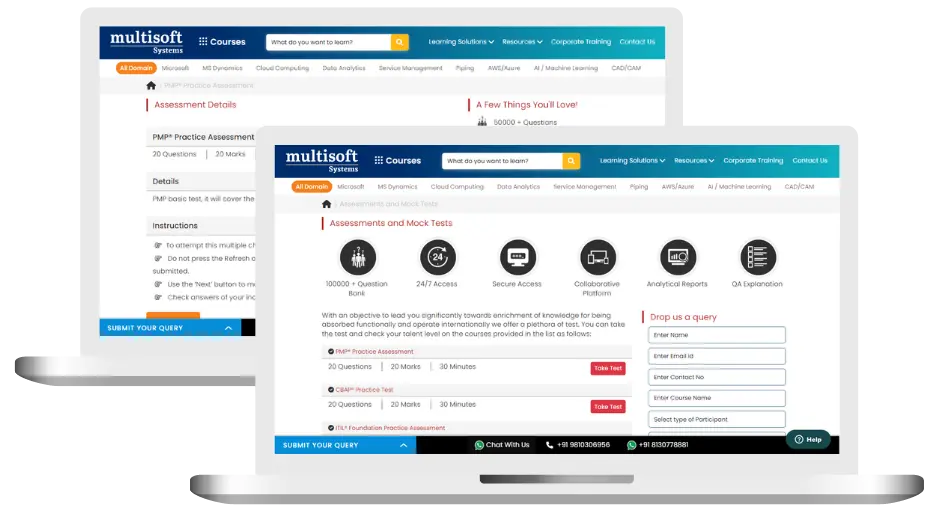
PTC Creo elements/Pro (Pro/E) Training (MCQ) Assessment
This assessment tests understanding of course content through MCQ and short answers, analytical thinking, problem-solving abilities, and effective communication of ideas. Some Multisoft Assessment Features :
- User-friendly interface for easy navigation
- Secure login and authentication measures to protect data
- Automated scoring and grading to save time
- Time limits and countdown timers to manage duration.
PTC Creo elements/Pro (Pro/E) Corporate Training
Employee training and development programs are essential to the success of businesses worldwide. With our best-in-class corporate trainings you can enhance employee productivity and increase efficiency of your organization. Created by global subject matter experts, we offer highest quality content that are tailored to match your company’s learning goals and budget.
Global Clients



Customized Training
Be it schedule, duration or course material, you can entirely customize the trainings depending on the learning requirements
Expert
Mentors
Be it schedule, duration or course material, you can entirely customize the trainings depending on the learning requirements
360º Learning Solution
Be it schedule, duration or course material, you can entirely customize the trainings depending on the learning requirements
Learning Assessment
Be it schedule, duration or course material, you can entirely customize the trainings depending on the learning requirements
Why PTC Creo elements/Pro (Pro/E) Training for Your Professional Growth
Strengthen your professional capabilities with practical learning, industry-relevant knowledge, and skills applicable to real-world business and technology environments.
Industry-Relevant Skills
Gain knowledge aligned with current industry practices, technologies, processes, and professional requirements.
Practical Learning
Understand concepts through practical scenarios, instructor-led discussions, exercises, and use cases.
Enhanced Professional Capability
Strengthen your ability to work confidently with relevant tools, workflows, platforms, and business processes.
Broader Career Opportunities
Add valuable capabilities to your profile and explore opportunities across relevant roles, projects, and industries.
Adapt to Changing Technologies
Stay familiar with evolving technologies, methodologies, and practices shaping modern enterprise environments.
Professional Recognition
Demonstrate your training achievement with a course completion certificate from Multisoft Systems.

 Zoom-in
Certification Training Achievements: Recognizing Professional Expertise
Multisoft Systems is the “one-top learning platform” for everyone. Get trained with certified industry experts and receive a globally-recognized training certificate. Some Multisoft Training Certificate Features :
- Globally recognized certificate
- Course ID & Course Name
- Certificate with Date of Issuance
- Name and Digital Signature of the Awardee
Trending Courses
Why Learners Choose Multisoft Systems
Compare key training features and see how Multisoft Systems focuses on structured learning, practical understanding, and learner support.
Training Features That Matter
Evaluate the learning experience across important areas before selecting a training program.
Instructor-Led Learning
Structured sessions guided by experienced trainers.
Practical Learning
Hands-on exposure that supports concept understanding.
Flexible Learning Options
Learning formats designed around different schedules.
Learner Support
Assistance throughout the training journey.
Learning Resources
Resources that support revision and continued learning.
Training Certificate
Recognition after successful course completion.
Choose Training That Goes Beyond Theory
Multisoft Systems combines guided learning, practical exposure, flexible delivery, learner support, and structured resources to create a more complete training experience.

SAP SuccessFactors Implementing SmartRecruiters Training: A Complete Guide
Modern recruitment requires businesses to find suitable candidates quickly and... Read Article
LabWare LIMS: Features, Benefits, Applications & Training
Modern laboratories operate in an environment where accuracy, efficiency, traceability,... Read Article
What Is SAP Convergent Invoicing? Features, Processes, and Business Applications
Managing invoices accurately becomes challenging when businesses handle subscriptions, usage-based... Read Article
SAP SuccessFactors Recruiting: Features, Processes, and Career Opportunities
Recruiting the right talent is essential for business growth, but... Read ArticlePTC Creo elements/Pro (Pro/E) Training Trainer Profile
19+ Years Experienced
Our PTC Creo elements/Pro (Pro/E) Training Corporate & Certification Program trainers bring 13+ years of proven industry expertise, delivering practical insights aligned with real project environments.
Trained 3950+ Professionals
Our expert trainers have successfully trained 3350+ professionals through structured, real-time training programs designed for industry readiness and career growth.
Certified Experts & Real-Time Project Learning
Build strong practical skills through live project-based training sessions led by certified industry experts with real-world experience.
Hands-on Learning Approach
Gain practical exposure through real-time scenarios, industry case studies, and hands-on assignments that simulate actual project challenges.
Certification Training Guidance
Receive expert support to prepare effectively, practice strategically, and confidently achieve globally recognized certification success.
Customized Training Delivery
Flexible training approach tailored to individual learning goals, skill levels, and evolving industry requirements for maximum effectiveness.
What Attendees are Saying
Our clients love working with us! They appreciate our expertise, excellent communication, and exceptional results. Trustworthy partners for business success.
Share Feedback Download Curriculum