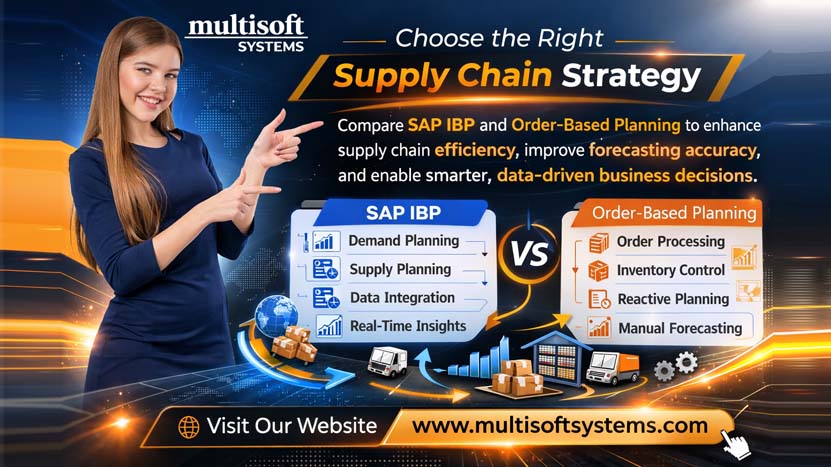
Modern supply chains operate in an environment where demand volatility, global disruptions, and customer expectations require highly responsive planning systems. Traditional planning tools often struggle to provide real-time visibility and coordination across the supply chain. To address these challenges, organizations increasingly rely on advanced digital planning solutions such as SAP Integrated Business Planning (SAP IBP) and Order-Based Planning (OBP) capabilities within SAP systems.
While both concepts are associated with supply chain planning, they serve different purposes and operate with distinct methodologies. SAP IBP represents a cloud-based advanced planning platform designed to integrate demand planning, supply planning, inventory optimization, and sales & operations planning. Order-Based Planning, on the other hand, focuses on detailed, order-level supply chain planning, particularly within SAP S/4HANA environments.
Understanding the differences between SAP IBP online training and Order-Based Planning online training is essential for organizations aiming to implement a modern supply chain strategy. This article explores their architecture, capabilities, benefits, and how they complement each other within an enterprise planning ecosystem.
What is SAP IBP?
SAP Integrated Business Planning (SAP IBP) is a next-generation cloud-based supply chain planning solution developed by SAP. It enables organizations to perform real-time planning, forecasting, and optimization using advanced analytics, artificial intelligence, and machine learning. SAP IBP integrates multiple planning processes into a unified platform. These include:
- Demand Planning
- Supply Planning
- Inventory Optimization
- Sales and Operations Planning (S&OP)
- Response and Supply Planning
The platform is built on SAP HANA in-memory technology, allowing organizations to process large volumes of data quickly and generate accurate planning scenarios.
SAP IBP enables businesses to simulate multiple supply chain scenarios, collaborate across departments, and make faster data-driven decisions. It also integrates seamlessly with SAP S/4HANA, SAP ECC, and other enterprise systems, ensuring smooth data flow between operational and strategic planning functions. Key advantages of SAP IBP certification include improved forecast accuracy, enhanced collaboration, better inventory optimization, and faster response to market changes.
What is Order-Based Planning (OBP)?
Order-Based Planning (OBP) is a detailed supply planning approach used within SAP environments, especially in SAP S/4HANA Supply Chain Planning. Unlike traditional planning models that rely on aggregated data such as product groups or time buckets, OBP operates at the individual order level. This means that each demand element—such as sales orders, stock transport orders, or planned orders—is planned and tracked individually throughout the supply chain. Order-Based Planning offers a highly granular view of supply chain activities, enabling planners to:
- Track individual orders through the supply chain
- Perform detailed capacity planning
- Identify constraints and bottlenecks
- Respond quickly to changes in supply or demand
OBP is particularly useful for industries where order accuracy, production sequencing, and capacity constraints play a critical role. Manufacturing sectors such as automotive, aerospace, electronics, and high-tech frequently rely on order-level planning to maintain operational efficiency.
By focusing on real orders instead of aggregated demand forecasts, OBP enables organizations to achieve a more precise and operationally realistic planning process.
Key Characteristics of SAP IBP
SAP IBP is designed to support strategic and tactical supply chain planning across multiple planning horizons. Its core characteristics include scalability, advanced analytics, and collaborative planning.
1. Cloud-Based Architecture
SAP IBP operates entirely in the cloud, enabling organizations to access planning tools without maintaining complex on-premise infrastructure. This allows businesses to scale planning capabilities quickly while reducing IT maintenance costs.
2. Real-Time Data Processing
Because SAP IBP runs on SAP HANA, it can process large datasets instantly. Planners can perform simulations, adjust forecasts, and analyze supply chain performance in real time.
3. Integrated Planning Modules
SAP IBP offers several modules that support different aspects of supply chain planning:
- IBP for Demand – forecasting and demand sensing
- IBP for Supply – supply planning and capacity optimization
- IBP for Inventory – inventory optimization
- IBP for S&OP – strategic planning and executive decision-making
- IBP for Response & Supply – near-real-time operational response
These modules work together to provide end-to-end visibility across the supply chain.
4. Scenario Planning
SAP IBP allows organizations to create multiple planning scenarios to evaluate potential outcomes. For example, companies can simulate demand spikes, supply shortages, or logistics disruptions to determine the best response strategy.
5. Collaboration and Visibility
One of the key benefits of SAP IBP is its ability to facilitate collaboration across departments. Sales teams, planners, procurement specialists, and executives can access the same planning data and contribute to decision-making processes.
Key Characteristics of Order-Based Planning
Order-Based Planning provides a granular and operationally focused planning model. Instead of working with aggregated data, OBP analyzes the supply chain at the level of individual orders.
1. Order-Level Planning
OBP plans each order separately, providing full visibility into how demand flows through the supply chain. This allows planners to trace each order from demand to production and delivery.
2. Detailed Scheduling
Because OBP operates at a detailed level, it can handle production sequencing, capacity constraints, and lead time dependencies more accurately than aggregated planning models.
3. Constraint-Based Planning
Order-Based Planning can consider multiple constraints simultaneously, including:
- Production capacity
- Transportation limits
- Supplier availability
- Inventory restrictions
This ensures that planning decisions reflect real-world operational limitations.
4. Realistic Supply Chain Modeling
OBP enables organizations to model complex supply chain networks with multiple production stages, suppliers, and distribution centers.
5. Integration with S/4HANA
Order-Based Planning is tightly integrated with SAP S/4HANA. This allows real-time synchronization between operational transactions and planning activities.
SAP IBP vs Order-Based Planning: Key Differences
Although SAP IBP and Order-Based Planning are related to supply chain planning, they differ significantly in scope, technology, and planning methodology.
|
Feature |
SAP IBP |
Order-Based Planning |
|
Planning Level |
Strategic and tactical planning |
Detailed operational planning |
|
Data Granularity |
Aggregated planning data |
Individual order-level data |
|
Deployment |
Cloud-based platform |
Typically integrated with SAP S/4HANA |
|
Planning Horizon |
Long-term and mid-term |
Short-term and execution-level |
|
Focus |
Forecasting, supply optimization, collaboration |
Detailed scheduling and order fulfillment |
|
Technology |
SAP HANA Cloud |
S/4HANA planning capabilities |
In essence, SAP IBP focuses on strategic planning, while Order-Based Planning focuses on operational execution.
How SAP IBP and OBP Work Together?
SAP Integrated Business Planning (SAP IBP) and Order-Based Planning (OBP) work together to create a comprehensive supply chain planning framework that connects strategic planning with detailed operational execution. SAP IBP primarily focuses on long-term and mid-term planning by using aggregated data, advanced analytics, and machine learning to forecast demand, optimize inventory, and balance supply across the entire supply chain network. It enables organizations to analyze historical trends, market conditions, and demand signals to generate accurate demand forecasts and high-level supply plans. These plans provide strategic guidance for production, procurement, and distribution decisions. Once these aggregated plans are created in SAP IBP, the planning results are transferred to the operational system, typically SAP S/4HANA, where Order-Based Planning takes over for detailed execution-level planning. OBP refines the planning process by working at the individual order level, considering real-time transactional data such as sales orders, production orders, and stock transport orders. It evaluates constraints such as production capacity, supplier availability, transportation limitations, and lead times to create feasible and executable schedules.
By planning each order individually, OBP certification ensures that supply chain operations remain realistic and aligned with operational constraints. The integration between SAP IBP and OBP allows organizations to maintain a synchronized planning environment where high-level strategic plans are continuously aligned with real-time operational realities. Changes in demand or supply conditions can be reflected quickly across both systems, enabling planners to adjust strategies and execution plans accordingly. This collaborative planning approach improves supply chain visibility, enhances responsiveness to disruptions, and ensures better coordination between strategic planning teams and operational planners. As a result, businesses can achieve greater planning accuracy, improved service levels, optimized resource utilization, and more efficient supply chain operations.
Business Benefits of Using SAP IBP
Implementing SAP IBP can significantly improve supply chain performance.
- Machine learning algorithms analyze historical data and external factors to produce highly accurate demand forecasts.
- Real-time analytics enable planners to respond quickly to market changes and supply disruptions.
- Advanced inventory optimization capabilities help organizations maintain the right stock levels while reducing carrying costs.
- SAP IBP creates a unified planning environment where multiple departments can collaborate effectively.
- Organizations gain end-to-end visibility into demand, supply, and inventory across the entire network.
Benefits of Order-Based Planning
Order-Based Planning provides operational benefits that are difficult to achieve with aggregated planning methods.
- Planning at the order level ensures more accurate scheduling and resource allocation.
- OBP enables detailed capacity planning, allowing companies to maximize production efficiency.
- Because each order is tracked individually, planners can quickly adjust schedules in response to demand or supply disruptions.
- OBP helps identify capacity constraints and production bottlenecks before they impact delivery schedules.
- By managing individual orders effectively, organizations can provide more reliable delivery commitments.
Industry Use Cases
SAP Integrated Business Planning (SAP IBP) and Order-Based Planning (OBP) are widely used across industries that require accurate demand forecasting, efficient supply chain coordination, and detailed production planning. In the manufacturing sector, companies use SAP IBP to forecast demand and balance supply across global production networks, while OBP ensures precise scheduling of individual production orders and capacity utilization. The automotive industry relies heavily on this combination due to its complex supply chains involving multiple suppliers, just-in-time production, and strict delivery timelines. SAP IBP helps automotive manufacturers predict demand for components and vehicles, while OBP manages detailed sequencing of production orders and supplier coordination.
In the consumer goods industry, SAP IBP supports demand sensing and inventory optimization, allowing companies to respond quickly to fluctuating customer demand and seasonal trends, while OBP ensures efficient order fulfillment and distribution planning. Electronics and high-tech industries benefit from these tools due to short product life cycles and volatile demand patterns, where accurate forecasting and fast response planning are essential. Additionally, pharmaceutical and life sciences companies use SAP IBP for regulatory-compliant supply planning and OBP for precise production scheduling and batch management. Together, these solutions enable organizations to achieve better visibility, improved planning accuracy, and efficient supply chain operations across industries.
Future of Supply Chain Planning with SAP
Supply chain planning continues to evolve as organizations adopt advanced technologies such as artificial intelligence, predictive analytics, and digital twins. SAP IBP is at the forefront of this transformation, offering capabilities like:
- AI-driven demand forecasting
- Real-time supply chain visibility
- Scenario-based planning
- Autonomous planning recommendations
Meanwhile, Order-Based Planning continues to enhance operational precision by enabling real-time order-level execution planning. As businesses pursue digital transformation initiatives, the combination of SAP IBP training and Order-Based Planning training will play a critical role in building resilient and agile supply chains.
Conclusion
Supply chain planning requires both strategic insight and operational accuracy. SAP Integrated Business Planning (SAP IBP) and Order-Based Planning (OBP) address these needs at different levels of the planning hierarchy. SAP IBP focuses on strategic and tactical planning, enabling organizations to forecast demand, optimize inventory, and collaborate across the enterprise. Order-Based Planning, in contrast, provides detailed operational planning, ensuring that individual orders are fulfilled efficiently within real-world constraints.
When used together, these technologies create a powerful supply chain planning ecosystem that combines high-level strategic planning with detailed execution capabilities. Organizations that integrate SAP IBP with Order-Based Planning can achieve improved forecast accuracy, better supply chain visibility, optimized production schedules, and enhanced customer service.
As supply chains become increasingly complex and dynamic, adopting advanced planning solutions like SAP IBP and OBP will be essential for businesses seeking to remain competitive in the digital economy. Enroll in Multisoft Systems now!